
Families across Texas face significant challenges when seeking care for children with developmental and behavioral health needs. Nationwide, fewer than 800 developmental-behavioral pediatricians serve millions of children with conditions such as autism, ADHD, anxiety, and intellectual disabilities.
At UTMB, those challenges have lessened thanks to recent growth in the Division of Development, Behavior, and Mental Health Services. Alexa Coon, DO, FAAP, a board-certified and fellowship-trained developmental-behavioral pediatrician, joined UTMB in 2021 and quickly saw demand skyrocket.
“When I first arrived, the wait list was about one to two months,” Dr. Coon recalls. “Once word got out that we were doing autism evaluations, it exploded to 18 months.”
Dr. Coon’s clinic serves children from birth through age 18, addressing a wide range of conditions: autism spectrum disorder, ADHD, anxiety, depression, intellectual and learning disabilities, and often multiple comorbidities. Evaluations are thorough, at 90 minutes for new autism assessments, 30 minutes for straightforward ADHD or anxiety concerns, and 45 minutes for follow-ups.
A major part of care goes beyond diagnosis. These diagnoses often mean lifelong management and navigating complex systems for support. Families receive guidance on medication management and navigating school-based supports, including special education evaluations and individualized plans.
“Many parents are unfamiliar with the process,” Dr. Coon says. “Helping them advocate for their child is a huge part of what we do.”
Through strategic changes and team growth, UTMB has dramatically improved access to these critical services. The division has added three general pediatricians and two nurse practitioners and is currently onboarding four psychiatric nurse practitioners.
This tiered model ensures that complex cases remain with Dr. Coon, while stable patients and straightforward concerns are managed by nurse practitioners. All providers have consult access to Dr. Coon, ensuring continuity and safety.
Importantly, UTMB now accepts external referrals, marking a major shift from previous years when only internal patients could be seen.
“Our model allows flexibility,” she says. “Families waited so long before. Now we can get more children in faster and provide timely medication management.”
The team works closely with physical, occupational, and speech therapists, and aims to expand psychological services for cognitive testing and anxiety treatment. Future goals include specialized clinics for conditions like Down syndrome and neurofibromatosis, modeled after Dr. Coon’s training experience.
While currently based at Bay Colony in League City, the division will soon add clinic hours on Galveston Island to increase convenience. Dr. Coon shares that families travel from north Houston, Lake Jackson, Louisiana, and even near San Antonio for care.
For most families, a diagnosis brings reassurance rather than distress. At a time when much is still being discovered about autism, and misinformation is common, families often feel validated after years of uncertainty.
“Parents aren’t upset about autism. They’re grateful to have answers and a plan,” Dr. Coon says.
UTMB’s investment in developmental and behavioral health is making a measurable difference. With a consultative, multidisciplinary model and expanded team, the division is building capacity to serve more children, with more comprehensive care.
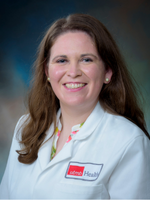 | Alexa Coon, DO, FAAP, sees patients at the UTMB Health Pediatric Development/Behavior Clinic at Bay Colony. Learn more about pediatric developmental and behavioral health at UTMB. |