
Syncope
Definition:
Syncope is a transient loss of consciousness and muscle tone caused by decreased cerebral blood flow. It is usually followed by spontaneous recovery. Presyncope, or near-syncope, consists of the symptoms that occur before syncope without complete loss of consciousness. These symptoms commonly include dizziness, nausea and perspiration.
Epidemiology:
Syncope is a frequent complaint in children, with the highest incidence during adolescence. Approximately 15%-20% of children experience at least one syncopal episode by 18 years of age. It occurs more frequently in females, especially adolescent girls. Vasovagal mechanism is the most common cause of syncope. In children younger than 6 years of age, seizures, breath-holding spells and cardiac arrhythmia should be considered. Cardiac causes are rarely the cause but should always be considered because they may be associated with sudden cardiac death.
Causes:
On standing, gravity causes pooling of blood in the lower extremities with a temporary decrease in venous return and stroke volume. The sympathetic nervous system responds with an increase in heart rate and peripheral vasoconstriction in order to maintain blood pressure and cerebral perfusion. Syncope occurs when this response is inadequate or when there is a decrease in cardiac output. The causes of syncope can be divided into autonomic, cardiac, neurogenic and other causes.
|
Causes of Pediatric Syncope |
|
|
Underlying Causes |
Examples |
|
Autonomic |
Vasovagal syncope, orthostatic hypotension, POTS, situational syncope |
|
Cardiac |
Arrhythmias, structural heart disease, myocardial dysfunction |
|
Neurogenic |
Seizures, migraines |
|
Other |
Breath-holding spells, hyperventilation, dehydration, anemia, hypoglycemia, electrolyte abnormalities, psychogenic events, alcohol or drug intoxication |
- Vasovagal syncope usually occurs with postural changes or emotional stress. An abnormal autonomic response causes vasodilation, bradycardia, or both. This results in decreased blood pressure and cardiac output with decreased blood flow to the brain and loss of consciousness.
- Orthostatic hypotension occurs when the normal vasoconstrictive response to standing is inadequate. The blood pressure falls with resultant decrease in cerebral blood flow. It is defined as a decrease in systolic blood pressure of at least 20 mm Hg or diastolic blood pressure of at least 10 mm Hg within 3 minutes of standing.
- Postural orthostatic tachycardia syndrome (POTS) occurs when standing causes an excessive increase in heart rate. This may result from impaired vasoconstriction, excessive pooling of blood in the lower extremities, or decreased circulating blood volume. It is defined by symptoms with standing and an increase in heart rate of at least 30 beats per minute within 10 minutes.
- Situational syncope occurs with certain actions, such as coughing, urination, defecation or breath-holding. These actions may decrease venous return or cardiac output with resultant decrease in cerebral blood flow.
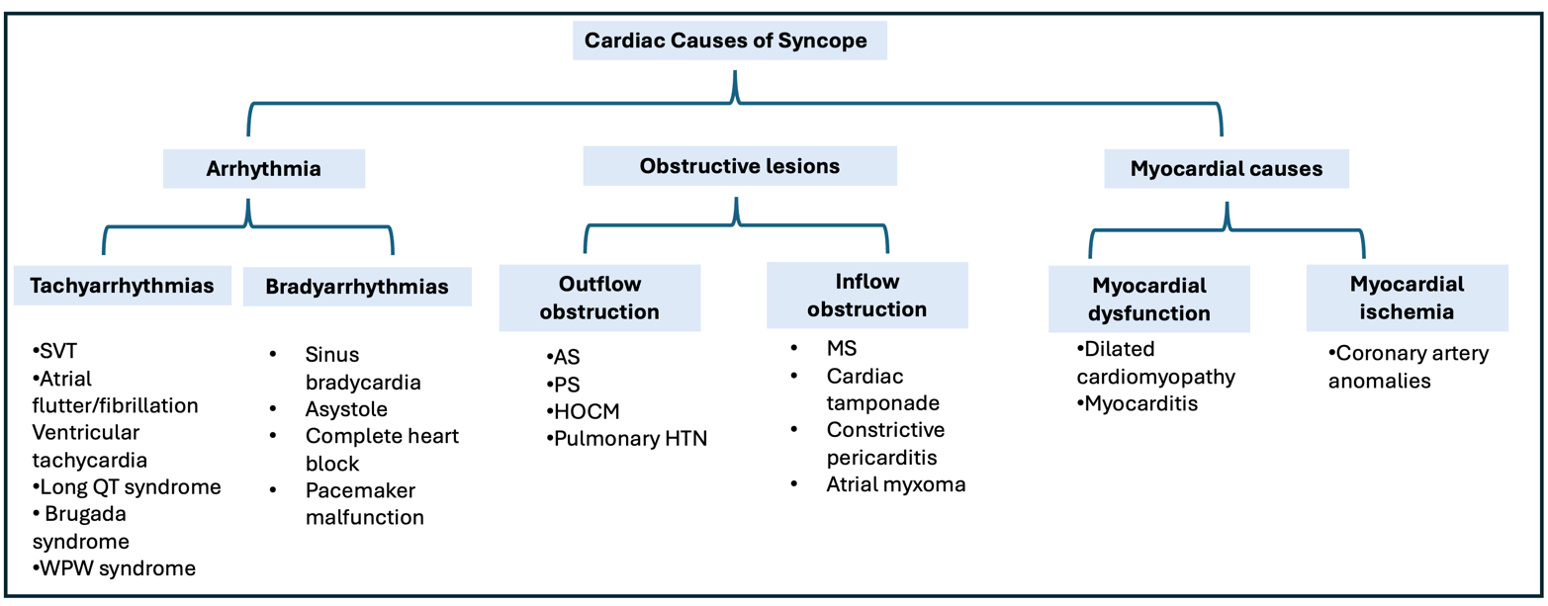
- Tachyarrhythmias cause a rapid heart rate with decreased ventricular filling time. The resultant decrease in stroke volume and cardiac output may lead to loss of consciousness. Bradyarrhythmias cause a slow heart rate with decreased cardiac output and cerebral blood flow.
- Outflow obstruction limits the ability of the heart to eject blood and increase cardiac output, especially during exercise. This may result in inadequate cerebral blood flow. Inflow obstruction limits ventricular filling with resultant decrease in preload, stroke volume and cardiac output.
- Myocardial dysfunction causes poor ventricular contraction with decreased stroke volume and cardiac output. Associated arrhythmias may further decrease cerebral perfusion. Myocardial ischemia may cause impaired ventricular contraction or a ventricular arrhythmia, with resultant decrease in cardiac output and cerebral blood flow.
- Neurogenic causes include seizures and migraines. Loss of consciousness in these conditions is secondary to neurologic dysfunction and may be confused with syncope. Prolonged confusion or a slow return to baseline is more suggestive of a seizure.
- Other causes include dehydration, anemia, hypoglycemia, electrolyte abnormalities, breath-holding, hyperventilation, psychogenic events, and alcohol or drug intoxication. These conditions may decrease blood volume or oxygen delivery, interfere with normal brain function, or mimic a syncopal episode.
Evaluation:
A good history, including a family history, is the most important part of the evaluation. The history should include the patient's position and activity at the time of the event, possible triggers, symptoms before the episode, duration of unconsciousness, recovery, and associated chest pain or palpitations. Syncope during exercise, while sitting or lying down, or without warning should raise the suspicion of a cardiac cause. This is especially important in patients with known cardiac disease or a family history of sudden cardiac death.
A cardiovascular and neurologic examination should be performed. Orthostatic heart rate and blood pressure measurements may be obtained when orthostatic intolerance is suspected. A 12-lead EKG should be done for any patient presenting with syncope. Further investigations depend on the history, physical examination, and EKG findings. Ambulatory EKG monitoring may be useful if an arrhythmia is suspected. Echocardiography may be done to evaluate for possible structural heart disease. An exercise stress test may be done if the syncope is associated with physical activity.
Management:
The management of syncope is directed to the underlying cause. Autonomic causes are managed with reassurance, increased fluid and salt intake and regular exercises. Dehydration, prolonged standing, and sudden changes in position should be avoided. Physical counterpressure maneuvers, such as crossing the legs, tensing the leg muscles, or squatting, may help prevent an episode. The patient should sit or lie down when warning symptoms occur. Cardiac, neurologic, and other causes are managed according to the specific etiology.
Citations:
Myung K. Park, Mehrdad Salamat. Chapter 21 - Syncope. In: Park's The Pediatric Cardiology Handbook. Sixth Edition. Elsevier Inc; 2022:393-401. doi:10.1016/B978-0-323-71866-0.00021-5
Bell-Cheddar, Y. R., & Abdulla, R. (2011). Syncope. Heart Diseases in Children, 397-409. https://doi.org/10.1007/978-1-4419-7994-0_34
Gilpin, K., & Goode, Z. (2024). Syncope. Pediatrics in Review, 45(10), 606-608. https://doi.org/10.1542/pir.2023-006053
Kidd, S. K., Doughty, C., & Goldhaber, S. Z. (2016). Syncope (fainting). Circulation, 133(16). https://doi.org/10.1161/circulationaha.115.01730