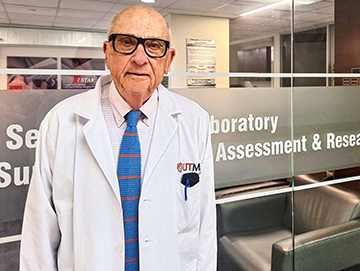
Dr. Courtney M. Townsend Jr., MD, FACS, is one of the most influential American academic surgeons of the past several decades. He is best known as the longtime Editor-in-Chief of Sabiston Textbook of Surgery: The Biological Basis of Modern Surgical Practice, one of the world's leading textbooks in general surgery, and as a distinguished professor at the University of Texas Medical Branch (UTMB) in Galveston.
Education
Career at UTMB
Dr. Townsend joined the UTMB faculty in 1978 after serving as a surgeon at the U.S. National Naval Medical Center in Bethesda, Maryland. During his career, he became:
Among his many honors are:
The American College of Surgeons (ACS) was founded on October 25, 1913, in Chicago, Illinois.
Why it was created
The ACS was established to improve the quality and safety of surgical care in the United States and Canada. At the beginning of the 20th century, there were no uniform standards for:
A group of leading surgeons believed that surgery should be practiced by well-trained physicians who met high professional and ethical standards.
The American College of Surgeons (ACS) Accredited Education Institutes (AEI) standardized surgical skills curriculum was developed in the mid-2000s in response to major changes in surgical education.
When was it developed?
There are two closely related milestones:
2005 – The ACS established the Accredited Education Institutes (AEI) Program to create a network of simulation centers dedicated to high-quality surgical education.
2005–2007 – The ACS and the Association of Program Directors in Surgery (APDS) formed the Surgical Skills Curriculum Task Force to create a standardized simulation-based curriculum for general surgery residents. The curriculum was introduced in phases:
Hurricane Ike and the University of Texas Medical Branch
Hurricane Ike was one of the most consequential events in the history of the University of Texas Medical Branch (UTMB). When the hurricane made landfall on September 13, 2008, near Galveston as a Category 2 storm with sustained winds of about 110 mph, it brought a devastating storm surge that fundamentally changed the institution.
The greatest damage came not from the wind but from the storm surge.
The blood bank, pharmacy, sterile processing, laboratories, and other critical infrastructure.
Leadership during the recovery
Several leaders played central roles in UTMB's recovery:
Dr. Courtney M. Townsend Jr., Chair of the Department of Surgery, helped preserve surgical education and residency training during the disruption. Under his leadership, surgical faculty maintained educational programs despite the temporary loss of clinical facilities, and the department later became a leader in simulation-based training and curriculum development.
Lasting legacy
Hurricane Ike permanently changed UTMB's approach to healthcare delivery and disaster preparedness. The experience became a national case study in:
For historians of surgery and medical education, Hurricane Ike marks a pivotal moment in UTMB's evolution.
The rebuilding effort accelerated innovations in simulation, competency-based surgical training, and resilient hospital design that continue to influence academic medical centers today.
Dr. Courtney M. Townsend Jr. was instrumental in the vision and development of the Laboratory for Surgical Training, Assessment, and Research (LSTAR). To lead the initiative, he recruited Dr. Kimberly M. Brown, MD, FACS, as the Surgical Director of Simulation. With strong institutional support in place, Dr. Townsend, Dr. Brown, and a multidisciplinary team of leaders collaborated to secure donor and philanthropic funding, transforming the vision for LSTAR into a state-of-the-art center for surgical education, simulation, and research.
A da Vinci® Surgical System dedicated to skills training was generously donated to LSTAR by the Sealy & Smith Foundation, significantly enhancing the center's capacity to provide hands-on robotic surgery education and simulation. In 2013, LSTAR earned initial national accreditation as an American College of Surgeons Comprehensive Accredited Education Institute (ACS-AEI).
LSTAR is strategically housed within the Department of Surgery, providing surgical residents and faculty with convenient access to simulation-based training, skills assessment, and educational resources that support continuous learning and technical proficiency.
Fun Fact: The name LSTAR—the Laboratory for Surgical Training, Assessment, and Research—was intentionally chosen to echo the spirit of the Lone Star State. Just as the lone star symbolizes Texas' tradition of leadership and excellence, LSTAR was designed to represent innovation, excellence, and the pioneering future of surgical education.