Vocabulary Microcredentials at UTMB Health

There is a growing interest in the ability to award digital microcredentials (badges and/or certificates) at UTMB. Digital microcredentials fulfill the unique needs of learners, programs, and employers by providing portable, verifiable digital records of achievement. Due to their portable and sharable nature, they help to build awareness of programs available at the university. Digital microcredentials also present a framework for thinking differently about teaching and the development of competencies in education and training for both matriculated and non-matriculated learners, including the current UTMB workforce.

Closeup shot hands using laptop computer

As the institution embarks on the adoption of microcredentials, it is important to define common vocabulary. UNESCO attests that:

Credentials verify, validate, confirm or corroborate a person’s learning achievements, knowledge, and preparedness for performing tasks. Credentials are diverse with regard to their scope, status, and purpose.”

UTMB has adapted the definition of microcredentials, first published by the SUNY System, as follows:

Microcredentials verify, validate and attest that specific skills and/or competencies have been achieved; are endorsed by the issuing institution; having been developed through established faculty and administrative governance processes; and are designed to be meaningful and high quality.”

Digital Microcredentials
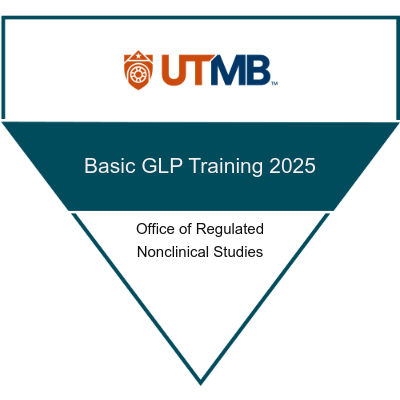
Badge with new UTMB logo and text for Basic GLP Training 2025 for ORNS

Open Digital Badges and Open Digital Certificates are an online standard for recognizing and verifying learning that complies with the Open Badges Specification. They are sometimes referred to by the general term, Learner Employment Record, LER, because they are a record of learning. These digital assets are image files of either a badge or a certificate that have agreed upon metadata fields. The assets are secure, portable, verifiable, and validated. Metadata stored behind the image includes the badge or certificate name, description, issuer, earner, earning criteria and additional options for links to other information such as key words, links to assessments, and links to map earned competencies to discipline standards.

Beyond agreeing to the definitions of credentials, microcredentials, open digital badges and open digital certificates, there are a host of other terms that are used in the Learner Employment Record (LER) Ecosystem. The following terms support the development of the LER Ecosystem at large. The following terms have been defined by and are found in refer the T3 Innovation Network Learning & Employment Record Guide (US Chamber of Commerce Foundation sponsored project.)

Glossary

  • Assertion

    A statement in a credential about a person's achievement.
  • Competency Framework

    A logically related set of competencies, knowledge, skills, abilities, or other attributes (KSAOs). When they are stored in computer-friendly formats, they can be easily used across systems.
  • Badge

    A visual digital symbol of some kind of learning or accomplishment, often about achievement of a skill, competency, qualification, certificate, membership, or service.
  • Comprehensive Learner Record (CLR)

    An open data standard for packaging together multiple achievement credentials that cover a range of learning experiences, potentially from multiple sources, or a document in this format.
  • Credential

    A set of claims made by an issuer. Examples of credentials include ID cards, licenses, diplomas, work eligibility claims, badges, and certifications. Credentials may be transmitted and processed as documentary evidence that a person has certain skills, status, or privileges.
  • Credential Transparency Description Language (CTDL)

    An open standard for describing information about credentials. It is used by a registry that stores public data about credentials which LERs can link to.
  • Digital Credential Wallet

    An application that supports the storage and exchange of digital credentials that conform to a credential standard. Here we are focused on LER/VC compliant credentials. They have services for storing, viewing, and sharing credentials that include protecting them from being tampered with by cryptographic proofs. Many wallets also support self-authoring of credentials that can be signed by the wallet holder. Many wallets can store credentials in formats like CLR, VC, and Open Badges.
  • Evidence

    Any artifacts such as multimedia, work samples, assessment results, or other documentation provided with a credential that supports its credibility and value.
  • Interoperability

    The ability of different devices, software, or systems to successfully talk to each other. Interoperability is a characteristic of a product or system to work with other products or systems.
  • Issuer

    An organization or person who creates and digitally signs a credential.
  • Learning and Employment Record (LER)

    A Learning and Employment Record (LER) documents any achievement related to learning or work and may be used to qualify the learner or worker for hiring or advancement. Employment records, academic transcripts, professional licenses, micro-credentials, badges, and degrees are all examples of LERs.
  • Learning and Employment Record (LER) Issued as a Verifiable Credential (LER/VC)

    Issuing a LER using the open data standard Verifiable Credentials enables them to be checked for fraud, easily transported, and better used to inform hiring and advancement decisions.
  • Microcredential

    While there is little agreement on the definition of a microcredential, one suggestion is: "A microcredential is generally a subset of learning achievements or outcomes that is less than a full degree or certificate" (AACRAO, 2022).

    Ideally, they are stackable and demonstrate earning criteria. A microcredential can be awarded in various formats, like as a digital badge or paper certificate.

  • Open Badges

    Badges issued using the Open Badges Specification are called Open Badges and are more interoperable than non-standardized badges.
  • Open Data Standard

    A publication outlining expectations for the expression of certain data. The standard is made available to the general public, free to use, and is maintained via a collaborative consensus-driven process by stakeholders.
  • Skill

    Used here as a versatile term encompassing competencies, learning outcomes, knowledge, skills, or abilities relevant to learning and work.
  • Skill Framework

    A skill/competency framework is a structured set of skills organized for a particular purpose, such as to express the range of skills relevant to occupations in a certain sector or organization. Frameworks may express relationships between individual skills.
  • Skills-based Hiring and Advancement (SBHA)

    Skills-based Hiring and Advancement (SBHA) refers to a recruitment and career development approach focused on evaluating and promoting people based on their skills and competencies. It is a process by which employers and HR service providers identify, recruit, hire, and advance candidates informed by skills and competency data, helping to more effectively match candidates' skills and competencies with the skill and competency requirements of work or learning opportunities (USCCF, 2022).
  • Verifier

    An entity that performs verification of credentials.
  • Verification

    The set of procedures intended to confirm the authenticity, status, applicability, and/or conformance of a credential to expectations or requirements. This typically involves at least verifying the digital signature on a credential.
  • Verifiable Credential

    An open data standard from the World Wide Web Consortium (W3C) that defines how to express a credential and attach a cryptographic verifiable proof.