




Emergency Blood Product Usage
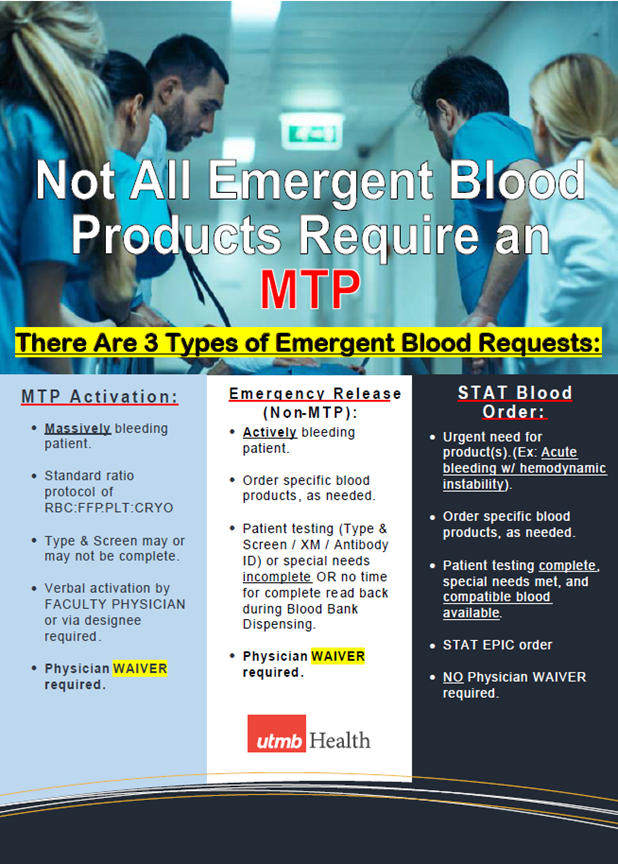
IMPORTANT: The ordering physician must sign an emergency release waiver if the urgency of the situation requires the release of un-crossmatched (group O) RBC units from the Blood Bank or bypassing patient testing or special needs.
There are 3-types of Emergent Blood Requests:
- Massive Transfusion Protocol (MTP)
- Emergency Release (Non-MTP)
- STAT Product Order
FYI: Not All Emergent Blood Products Require an MTP
Click image on the left to see overview of the 3-types of Emergent Blood Requests
Emergency Red Blood Cell Usage
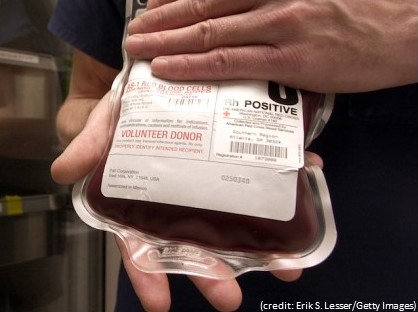
ABO compatibility of Red Blood Cells (RBC)
is fundamental to safe transfusion. Although ABO group typing only requires 5-10 minutes to perform, in certain critical situations a patient may lose a significant amount of blood during this time.
When clinical circumstances
do not allow time for determination of the patient's ABO group, the safest course of action is to provide group O RBCs otherwise considered un-crossmatched RBCs. As soon as the patient's ABO/Rh is established, the patient will be converted to type
specific crossmatched RBCs.
The Rh system
The Rh system is immunologically different than the ABO system. Unlike the ABO system, there are no naturally occurring (pre-formed) antibodies to the "D" antigen in the Rh system.
Under normal circumstances, Rh negative (Rh-) individuals who
have not been exposed to the Rh antigen will not make anti-D. Such individuals could be safely transfused with either Rh positive or Rh negative RBCs, particularly in an emergency situation.
Forming Anti- D
An Rh- individual may make anti-D only if exposed to the D-antigen via transfusion with Rh+ blood or platelets, or if pregnant with an Rh+ fetus. The probability of forming anti-D after transfusion of Rh+ RBCs is about one-third.
Note, however,
that this immunologic response requires approximately 3 to 4 months to develop and the patient is NOT at immediate risk of hemolysis. Individuals who have formed anti-D must receive only Rh- RBCs.
O Negative Selectivity
Many hospitals in the United States have a limited supply of group O- RBCs. Whenever possible; group 0- RBCs should be used for females of childbearing potential (generally women < 55 years of age) to avoid the possibility of alloimmunization.
In order to effectively maintain an adequate supply of O- RBCs for these and other patients who should or must receive only this type, it is common practice to transfuse Rh+ RBCs to Rh- males as well as females of non-childbearing potential
who require urgent or continued RBC transfusions.
Emergency Plasma Usage
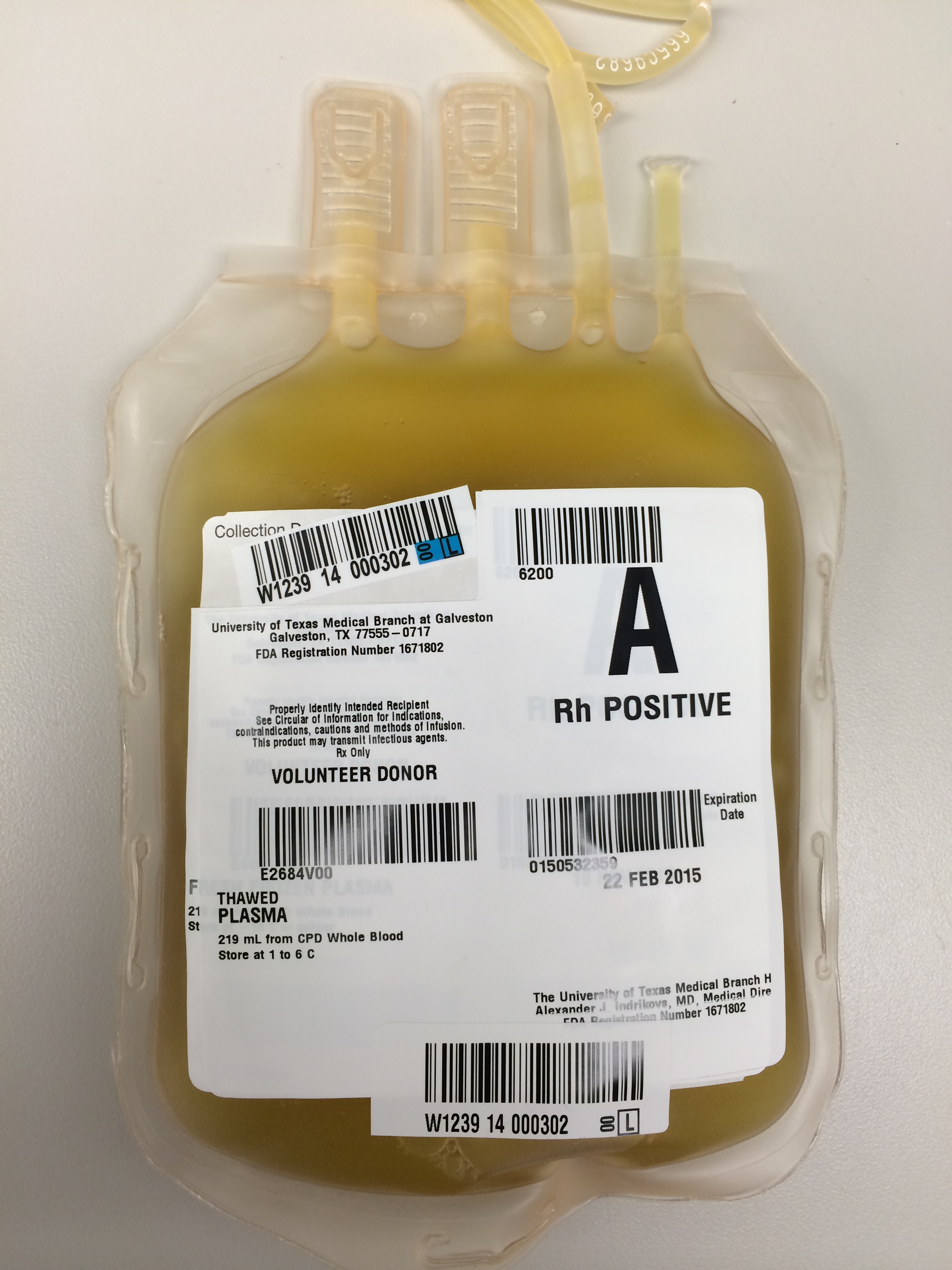
Emergency plasma transfusion
is critical, life-saving intervention for patients with massive hemorrhage, trauma, or severe coagulation issues. Rapid, early administration (ideally in a 1:1:1 ratio with platelets and red blood cells) helps control bleeding, reduces mortality, and addresses trauma-induced coagulopathy.
When clinical circumstances
do not allow time for determination of the patient's ABO group, the safest course of action is to provide Type A or AB plasma. As soon as the patient's ABO/Rh is established, the patient will be converted to type
compatible.