-attended-the-aaas-case-workshop-in-washington-d-c84d257af-f832-44d8-8736-5b79edfe610c.jpg?sfvrsn=a450f554_1 "Maura Ortiz, Ayana Pai, Sivatmika Palanisami, and Mohanad Albayyaa (not pictured) attended the AAAS CASE workshop in Washington, D.C.")
Four graduate students from The University of Texas Medical Branch (UTMB) traveled to Washington, D.C., this week to participate in the American Association for the Advancement of Science (AAAS) Catalyzing Advocacy in Science and Engineering (CASE) Workshop, a national program designed to empower emerging scientists to engage in science policy and advocacy throughout their careers.
The three-day workshop brought together more than 160 graduate and undergraduate students from 55 universities and professional societies for immersive training in science policy and civic engagement. Participants explored how scientific research informs federal decision-making, gained practical tools for communicating with policymakers, and learned how scientists can advocate for sustained research funding.
Through interactive seminars led by science policy experts, students learned about:
- The structure and functions of Congress
- The federal budget process
- Effective science communication strategies
- Opportunities for civic engagement and advocacy
- Career pathways in science policy
Participants also had the option to apply their new skills by meeting directly with policymakers on Capitol Hill.
Preparing the next generation of science advocates
The AAAS CASE Workshop is designed to demystify the policymaking process and help scientists understand how research and evidence shape public policy. By participating, UTMB trainees gain firsthand exposure to the intersection of science, government and society — an experience that can inform their leadership, outreach, and advocacy efforts throughout their careers. The students reasons for attending the workshop are as unique as their backgrounds.
Mohanad Albayyaa
Dr. Mohanad Albayyaa is a physician-scientist pursuing a doctoral degree in clinical science at the Graduate School of Biomedical Sciences (GSBS). He is also pursuing a Master of Public Health degree at the School of Public and Population Health (SPPH). His research focuses on health services research, patient outcomes, and health policy, with an emphasis on how treatment patterns, health care access, and policy decisions affect outcomes at the population level, including risks of cardiovascular disease and other chronic conditions.
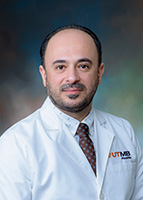
Using national datasets such as SEER-Medicare, the Texas Cancer Registry, TriNetX, and other real-world data registries, Albayyaa examines how evidence can inform more effective and equitable care delivery, particularly in understanding the association between cancer treatments and cardiovascular risks. Through his training, he has increasingly recognized the importance of science advocacy and policy engagement in ensuring that research findings translate into meaningful, evidence-based health policies that improve the quality, accessibility, and sustainability of patient care.
“I am particularly motivated to support policies that strengthen resources for cancer survivors, reduce cardiovascular and other long-term health risks, and sustain support of translational and population health research,” Albayyaa said.
Maura Ortiz
Dr. Maura Ortiz is a physician-scientist pursuing a doctoral degree in biomedical sciences at GSBS. Her research focuses on innate immune signaling pathways, particularly mitochondrial antiviral signaling protein (MAVS)-mediated antiviral responses, and how these pathways are disrupted in HIV infection and further modulated by substances of abuse.
Her work sits at the intersection of infectious disease, addiction biology, and health disparities — areas strongly shaped by federal policy decisions. Ortiz’s long-term goal is to lead translational research programs that bridge immunology, infectious diseases, and public health.
Ortiz recognizes that effective science communication and advocacy are essential to ensuring scientific evidence informs policy, funding priorities, and public health strategy. A ConTex-supported doctoral trainee, Ortiz represents an initiative between Texas and Mexico and brings an international perspective to science policy and advocacy discussions.
“I hope to deepen my understanding of how Congress evaluates scientific information, how federal agencies translate appropriations into research programs, and how scientists can responsibly advocate for evidence-based policies,” Ortiz said.
Ayana Pai
Ayana Pai is a doctoral student in the Human Pathophysiology and Translational Medicine program at GSBS. Her research focuses on infectious disease pathogenesis and host-pathogen interactions, with an emphasis on molecular signaling pathways and mechanisms of disease.
A first-generation American raised in a border town in southern New Mexico, Pai developed an early interest in advocacy after witnessing how poverty affects access to health care and education. At age 9, she founded a literacy program through a low-income medical clinic that provided children with a book at every doctor’s visit.
Since then, Pai has consistently paired science with service, including work as a pediatric vaccine coordinator with the New Mexico Department of Health during the COVID-19 pandemic and leadership roles advocating for student resources.
At UTMB, she is a Presidential Scholar and serves on the Student Government Budget Committee, where she reviews funding proposals and promotes equitable allocation of student resources.
“Every role I have pursued during my academic career connects science, institutions, and community needs,” Pai said. “My goal is to continue in biomedical research while also contributing to the policies that sustain it and serve my community.”
Sivatmika Palanisami
Sivatmika Palanisami is working toward a Master of Public Health degree with a concentration in bioethics at SPPH. Her training bridges public health and bioethics, focusing on the moral, social, and legal implications of public health policy, mandates, and practice.
Palanisami is interested in how bioethics provides a human-centered framework for science policy and public health decision-making, particularly in advancing equitable and accessible care.
By participating in the AAAS CASE Workshop, she aims to deepen her understanding of the stakeholders, processes, and ethical considerations that shape science policy, and to develop a more nuanced approach to evaluating health and science policies that balance public benefit with equity and moral responsibility.
“Having a background in neuroscience from my undergraduate education has piqued my interest in the growing field of neurotechnology, specifically brain-computer interfaces and AI in health care, and its implications for shaping future scientific research and issues with accessibility to equitable health,” Palanisami said.