
Medical Discovery NewsBridging the World of Medical Discovery and You

Recent Episodes

A Whiff of Flavor

MP3 WAV

  • I actually know someone who does not relish eating ' which I can't fathom. So, I definitely can't see him defining the difference between taste and flavor. Actually that's a tough one, even for us scientists!

    Let's start with taste. That's easy because taste is definitive and limited to five types: sweet, sour, bitter, salty, and umami, or savory, which are detected by receptors on the tongue. Flavor, by contrast, is more complex and more powerful. Rather than being sensed by taste buds, flavor is experienced in the brain, and the sense of smell is the key component.

    A recent book, Neurogastronomy, by Gordon Shephard, explores how the brain's perception of flavor impacts eating habits, such as food preferences, and cravings. Flavor presents food in its full dimension which is why the smell of popcorn makes a person's mouth water while evoking good memories.

    Scientists are beginning to understand the mechanism of flavor, which is mainly created by the sense of smell. While a person chews and swallows, they're also breathing, and when they exhale, pull in chemicals released by food into the nasal cavity, where they are sensed and transmitted to the brain. This is called retronasal smell. Once in the brain, a smell image is created. From there, flavor further engages the brain's higher, cognitive regions that control emotion and memory, creating more excitement or reward from food.

    Shepard believes flavor's role in the brain has an impact on modern social, behavioral and medical issues - particularly on our inability to choose healthy foods. If flavor does play such a large role, it goes against evolutionary biologists's belief that our sense of smell has waned.

More Information

Serious Reads: Neurogastronomy, by Gordon M. Shepard
A layman's review of Gordon Shepard's book, Neurogastronomy: How the Brain Creates Flavor and Why It Matters.

Challenging Beliefs about Flavor
An extensive review of Dr. Shepard's book by scientist and self-described "food geek" Kevin Liu.

Why We Overeat ' An Excerpt from "Neurogastronomy"
In this excerpt, Dr. Shepherd begins by looking at fast food and then looks at some of the neurological reasons for why we overeat at Thanksgiving and other times of the year.
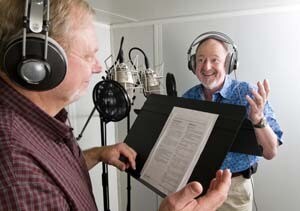

Two individuals wearing headphones stand in a recording booth, speaking into microphones with a music stand holding printed pages between them.

 Medicine...

Medicine is constantly advancing – that is a great thing about life in the 21st century. But it doesn’t just happen. Dedicated biomedical scientists are making discoveries that translate into those new medical advances.

Biomedical science is broad, encompassing everything from social science to microbiology, biochemistry, epidemiology, to structural biology and bioinformatics to name just a few areas. And, it can involve basic fundamental biology, the use of AI and chemistry to clinical studies that evaluate new medicines in patients.

No matter the research focus, the goal is always the same, to advance human health. It may take a few months, a few years or for fundamental science, a few decades. Few people make the connection that biomedical science is medicine and that biomedical scientists are working today on the medicine of tomorrow. Our weekly 500-word newspaper columns and 2-minute radio shows and podcasts provide insights into a broad range of biomedical science topics.

Medical Discovery News is dedicated to explaining discoveries in biomedical research and their promise for the future of medicine.

Podcasts

Alternatively, you can copy and paste the following web address (URL) into iTunes as a new subscription:
https://www.medicaldiscoverynews.com/shows/audio/mdnews.rss

You can also search and subscribe to "Medical Discovery News" in the podcast section of iTunes.

The www.medicaldiscoverynews.com web site and Medical Discovery News radio program (Program) are made possible by The University of Texas Medical Branch at Galveston (UTMB)as a community service and are intended to advance UTMB's mission of providing scholarly teaching, innovative scientific investigation, and state-of-the-art patient care in a learning environment to better the health of society and its commitment to the discovery of new innovative biomedical and health services knowledge leading to increasingly effective and accessible health care for the citizens of Texas.

All information provided on the web site and in the Program is for informational purposes only and is not intended for use as diagnosis or treatment of a health problem or as a substitute for consulting a licensed medical professional. Any information obtained by participating as a web site visitor or program listener is not intended to and should not be considered to constitute medical advice.

Thoughts and opinions expressed on the Program or on the website are those of the authors or guests and do not necessarily reflect the opinions of UTMB. The provision of links to other websites is not to be construed as written or implied sponsorship or endorsement of such websites by UTMB.

Please contact Dr. David Niesel or Dr. Norbert Herzog via email with any concerns, suggestions or comments.

All rights are reserved to information provided on the website or other information sources. No part of these programs can be reproduced stored in a retrieval system or transcribed in any form or by any means for personal or financial gained without the express written permission of Drs. Niesel and Dr. Herzog.