
Medical Discovery NewsBridging the World of Medical Discovery and You

Recent Episodes

Barefoot Running

MP3 WAV

  • A hot topic among runners these days is the idea of running barefoot, which may seem extreme to you.

    Barefoot running remains marginal, but more people are trying it because proponents believe they risk fewer injuries compared to shod or shoe-wearing runners.

    This claim is bolstered by a new study out of Harvard which is the first to measure and compare the force of the feet as they strike the ground in bare and shod runners.

    The study recruited two hundred American and Kenyan runners. They were placed in groups who never wore shoes, recently started wearing shoes and always wore shoes. The study – like others before it – clearly showed humans run differently in bare feet.

    The study also confirmed barefoot runners land on the ball of the foot, taking advantage of the flexible human arch and ankle, and use more calf and foot muscles. In comparison, researchers saw shod runners land on their heels.

    Next they measured the impact of the different foot strikes. They found shod runners hit the ground with a force of one and a half to two times their body weight with each foot strike. Barefoot runners only experience point five to point seven times their body weight.

    That's a reduction of about three fold in force for the barefoot runner!

    You may be tempted now to blame your high dollar shoes for your latest injury, but that'd be jumping the gun. The study does not conclude barefoot running results in fewer injuries than shod running. Further studies would need to establish that.

    The fact is, your body has become used to running in shoes. Some running experts say going without will likely trade one set of potential injuries for another.

    If you'd like to try running barefoot, make the transition gradually and find helpful tips in the links to the right.

More Information

Barefoot running info & tips
This website has been developed to provide an evidence-based resource for those interested in the biomechanics of different foot strikes in endurance running and the applications to human endurance running prior to the modern running shoe. Includes training tips.
For more information...

The shocking truth about running shoes.
ScienceNow summary presentation about the primary article in the scientific journal - Nature. Nice summary for the non-expert reader. Interesting comments from readers and runners at the end of the posting.
For more information...

Styles of New Running Shoes Mimic Running Barefoot
Interesting Mayo clinic article on the recent trend in the design of running shoes that mimic barefoot running.
For more information...

Foot strike patterns and collision forces in habitually barefoot versus shod runners
Primary scientific report from a leading scientific journal. This report explains the results of the study from a biomechanical perspective. Interesting reading for those with some biomechanical engineering background. Still interesting even if you cannot understand the specific details.
For more information...
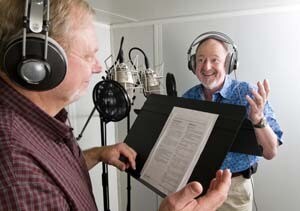

Two individuals wearing headphones stand in a recording booth, speaking into microphones with a music stand holding printed pages between them.

 Medicine...

Medicine is constantly advancing – that is a great thing about life in the 21st century. But it doesn’t just happen. Dedicated biomedical scientists are making discoveries that translate into those new medical advances.

Biomedical science is broad, encompassing everything from social science to microbiology, biochemistry, epidemiology, to structural biology and bioinformatics to name just a few areas. And, it can involve basic fundamental biology, the use of AI and chemistry to clinical studies that evaluate new medicines in patients.

No matter the research focus, the goal is always the same, to advance human health. It may take a few months, a few years or for fundamental science, a few decades. Few people make the connection that biomedical science is medicine and that biomedical scientists are working today on the medicine of tomorrow. Our weekly 500-word newspaper columns and 2-minute radio shows and podcasts provide insights into a broad range of biomedical science topics.

Medical Discovery News is dedicated to explaining discoveries in biomedical research and their promise for the future of medicine.

Podcasts

Alternatively, you can copy and paste the following web address (URL) into iTunes as a new subscription:
https://www.medicaldiscoverynews.com/shows/audio/mdnews.rss

You can also search and subscribe to "Medical Discovery News" in the podcast section of iTunes.

The www.medicaldiscoverynews.com web site and Medical Discovery News radio program (Program) are made possible by The University of Texas Medical Branch at Galveston (UTMB)as a community service and are intended to advance UTMB's mission of providing scholarly teaching, innovative scientific investigation, and state-of-the-art patient care in a learning environment to better the health of society and its commitment to the discovery of new innovative biomedical and health services knowledge leading to increasingly effective and accessible health care for the citizens of Texas.

All information provided on the web site and in the Program is for informational purposes only and is not intended for use as diagnosis or treatment of a health problem or as a substitute for consulting a licensed medical professional. Any information obtained by participating as a web site visitor or program listener is not intended to and should not be considered to constitute medical advice.

Thoughts and opinions expressed on the Program or on the website are those of the authors or guests and do not necessarily reflect the opinions of UTMB. The provision of links to other websites is not to be construed as written or implied sponsorship or endorsement of such websites by UTMB.

Please contact Dr. David Niesel or Dr. Norbert Herzog via email with any concerns, suggestions or comments.

All rights are reserved to information provided on the website or other information sources. No part of these programs can be reproduced stored in a retrieval system or transcribed in any form or by any means for personal or financial gained without the express written permission of Drs. Niesel and Dr. Herzog.