
Medical Discovery NewsBridging the World of Medical Discovery and You

Recent Episodes

Canned Energy… NOT!

MP3 WAV

  • When I have a morning lecture, I sometimes walk in with a cup of coffee. And so did a lot of my students.

    But over the years, the beverage of choice has evolved from coffee to soft drinks and now to energy drinks.

    I've noticed that. They're popular with young people because these drinks claim to give you extra pep.

    They contain ingredients such as tuarine, guarana (gwa-ra-NAH), ginseng, B–vitamins and most of all, lots of caffeine.

    If people down energy drinks to improve their mental and physical performance, there's little evidence they work. Nearly all the ingredients are stimulants.

    Guarana seeds have up to three times as much caffeine as coffee. Ginseng, which claims to boost the immune system, is based on paltry scientific evidence.

    There's also sugar and of course, caffeine.

    Some brands contain up to 300 milligrams of caffeine in an 8 ounce serving. But some people drink more than one can at a time. If you're a healthy adult, research shows that's generally fine.

    But women of reproductive age are advised to limit caffeine to no more than 300 milligrams a day. And adolescents shouldn't have more than 100 milligrams a day.

    Yet, young people like energy drinks, which can cause children to be hyperactive, fidgety or even enraged.

    Caffeine blocks a brain chemical called adenosine, which is involved in sleep. With excessive caffeine, neurons start firing, putting the body in emergency mode. Then the pituitary gland releases adrenaline, which raises the heartbeat and dilates the eyes.

    These physical responses make you feel as though you have more energy when you don't. So, you won't run any faster or get more right answers on a test.

    In general, energy drinks are safe for adults – in moderation. Remember, caffeine is addictive and a diuretic. So, don't risk dehydration by drinking these while exercising.

More Information

The University of Michigan provides information and links about energy drinks. In particular, this web page discusses the dangers of energy drinks when mixed with alcohol, used before or during exercise and the danger posed to children.
For more information...

For a detailed description about how energy drinks work and an explanation about their ingredients, go here.

For a very detailed description of energy drinks and their effects on health, the University of California provides this publication for free. It includes comparisons of the caffeine levels in various brands of energy drinks. There is also useful information about some of the other ingredients in energy drinks and what they claim to do and most importantly, which claims can be substantiated.
For more information...

Kidshealth is an excellent source of information about health issues surrounding children and teens. KidsHealth provides families with information, perspective, advice, and comfort about a wide range of physical, emotional, and behavioral issues that affect children and teens.
For more information...

Since all energy drinks rely heavily on caffeine to generate their effects, here is a web page to learn more about caffeine and its influence on you health.
For more information...

If you need to convert milligrams to ounces, this online converter makes it easy.

Arria AM, O'Brien MC. The "High" Risk of Energy Drinks. JAMA. 2011 Jan 25. [Epub ahead of print] PubMed PMID: 21266673.
For more information...
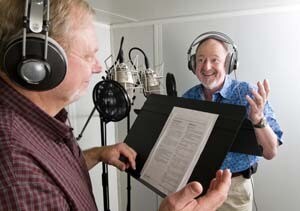

Two individuals wearing headphones stand in a recording booth, speaking into microphones with a music stand holding printed pages between them.

 Medicine...

Medicine is constantly advancing – that is a great thing about life in the 21st century. But it doesn’t just happen. Dedicated biomedical scientists are making discoveries that translate into those new medical advances.

Biomedical science is broad, encompassing everything from social science to microbiology, biochemistry, epidemiology, to structural biology and bioinformatics to name just a few areas. And, it can involve basic fundamental biology, the use of AI and chemistry to clinical studies that evaluate new medicines in patients.

No matter the research focus, the goal is always the same, to advance human health. It may take a few months, a few years or for fundamental science, a few decades. Few people make the connection that biomedical science is medicine and that biomedical scientists are working today on the medicine of tomorrow. Our weekly 500-word newspaper columns and 2-minute radio shows and podcasts provide insights into a broad range of biomedical science topics.

Medical Discovery News is dedicated to explaining discoveries in biomedical research and their promise for the future of medicine.

Podcasts

Alternatively, you can copy and paste the following web address (URL) into iTunes as a new subscription:
https://www.medicaldiscoverynews.com/shows/audio/mdnews.rss

You can also search and subscribe to "Medical Discovery News" in the podcast section of iTunes.

The www.medicaldiscoverynews.com web site and Medical Discovery News radio program (Program) are made possible by The University of Texas Medical Branch at Galveston (UTMB)as a community service and are intended to advance UTMB's mission of providing scholarly teaching, innovative scientific investigation, and state-of-the-art patient care in a learning environment to better the health of society and its commitment to the discovery of new innovative biomedical and health services knowledge leading to increasingly effective and accessible health care for the citizens of Texas.

All information provided on the web site and in the Program is for informational purposes only and is not intended for use as diagnosis or treatment of a health problem or as a substitute for consulting a licensed medical professional. Any information obtained by participating as a web site visitor or program listener is not intended to and should not be considered to constitute medical advice.

Thoughts and opinions expressed on the Program or on the website are those of the authors or guests and do not necessarily reflect the opinions of UTMB. The provision of links to other websites is not to be construed as written or implied sponsorship or endorsement of such websites by UTMB.

Please contact Dr. David Niesel or Dr. Norbert Herzog via email with any concerns, suggestions or comments.

All rights are reserved to information provided on the website or other information sources. No part of these programs can be reproduced stored in a retrieval system or transcribed in any form or by any means for personal or financial gained without the express written permission of Drs. Niesel and Dr. Herzog.