Recent Episodes
Cats as Living Heat Maps
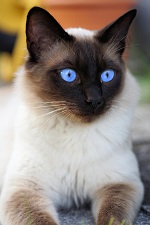
I always knew cats were weird having owned many including one who's queen of my house. So, at a recent vet visit, I was surprised to learn that Siamese cats are actually albinos. Hey wait - Siamese cats have colored faces, paws, and tails. True, Dave. But that's because their albino traits are temperature sensitive. Just like a cat, huh, nothing's straight forward!
Genes determine cats' hair length. Short is dominant but all lengths shed the same. Coloring is more complex and involves eight genes. Modifier genes direct the patterns such as the classic tuxedo or the chest bib. Modifiers can also alter the action of a color gene. For example, in albino cats, the modifier inhibits the pigmentation process so that cats end up with white fur. But what happens in Siamese cats is even more interesting.
The modifier is active but only when close to the body core where temperatures range from one hundred to one hundred four degrees. At lower temperatures, the modifier is not active and that's where you'd find color. Sure, that makes sense! That's why a Siamese cat's colors are all far from the body core such as the paws, ear tips and tail!
So, you're saying a cat is a living heat map of their body temperature. In fact, those that live outdoors darken in the winter and lighten up in the summer. Who knew that little ball of fur was so complex? And let's not forget opinionated and demanding! Long live the Queen!
More Information
Siamese Cats Are Temperature-Sensitive Albinos, a.k.a. Walking Heat Maps
If my cat wore socks, his fur would change color. No, seriously. It really would. And I have the pictures to prove it. Okay, maybe not of him in socks. Because that's just not going to happen. Ever. But I really could get his fur to change color. And anyone owned by a Siamese could do the same thing. It's all thanks to a special gene they have in common: an albino gene. What? Wait. Siamese aren't albinos. Actually, they are. Temperature-sensitive albinos...
Basic Genetics as Revealed by Cats
Although there is not complete agreement on the origin of the domestic cat, Felis catus, it is generally believed that domestication occurred in Egypt some 3500 years ago. The most likely wild African candidate for the ancestral cat is the African wild cat (Felis libyca). However, the European wild cat (Felis silvestris) may also have contributed to the genetic composition of the domestic cat by hybridizing with the African wild cat...