Medical Discovery NewsBridging the World of Medical Discovery and You

Recent Episodes

Lab on a Chip

MP3 WAV

  • You're on a long run and half way through want to check your electrolyte levels. Or you take a powerful cholesterol lowering drug and need a regular liver enzyme test. Wouldn't it be great if you had a portable lab ' like diabetics with their blood glucose meters?

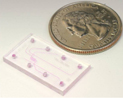
    Except, the latest invention is a lab on paper the size of a stamp. Dr. George Whitesides of Harvard University says paper tests aren't new because for decades women have used pregnancy tests. But unlike the stick, his "stamp-lab" can detect complex diseases instantly at a penny a piece, and like the home pregnancy test, do it reliably without a doctor to interpret the results.

    Whitesides uses microfluidics, which is the science of moving fluids on a tiny scale. Surprisingly, his paper test isn't made with much more than filter paper and an office printer.

    A modified printer can copy over one hundred patterns per sheet using melted black wax. The dried patterns become channels that guide fluid samples along the test strip. In these channels chemicals are applied which react in the presence of specific biological substances.

    One particular test detects aspartate transaminase or AST, which is released by dying liver cells. As a drop of blood is applied to the test strip, an outer membrane allows only plasma through.

    Several pieces of the test paper are actually stacked and taped, so when the plasma enters the second layer and mixes with chemicals there, a reaction takes place if AST is present. If so, the third layer containing a normally blue dye, turns colorless ' testing positive for liver damage.

    This test is aimed at the millions of Africans whose drug therapies for AIDS and tuberculosis can damage the liver. But, once the tests can diagnose everything from malaria to maybe even cancer, people won't have to wait until they're too sick before seeing the doctor.

More Information

George Whitesides: A lab the size of a postage stamp [Video]
George Whitesides discussed his research at the TEDxBoston conference, where this "TED Talks" video was recorded. From the TED description: "Traditional lab tests for disease diagnosis can be too expensive and cumbersome for the regions most in need. George Whitesides' ingenious answer, at TEDxBoston, is a foolproof tool that can be manufactured at virtually zero cost."

Far From Any Lab, Paper Bits Find Illness
The New York Times published this article on Dr. Whitesides' research as part of its "Small Fixes" special section on low-cost innovations that can save thousands of lives.

The Nonprofit 'Diagnostics For All' Provides a Lesson For Us All
Dr. Whitesides took his technology and founded the non-profit Diagnostics For All, which is dedicated to providing low-cost, easy-to-use diagnostics for the 60% of the developing world which doesn't have access to hospitals or medical facilities. From this editorial at Genetic Engineering & Biotechnology News: "[...] perhaps the greatest demonstration of intelligence is not in the technology itself, but rather what Dr. Whitesides decided to do with it."

Two individuals wearing headphones stand in a recording booth, speaking into microphones with a music stand holding printed pages between them.

 Medicine...

Medicine is constantly advancing – that is a great thing about life in the 21st century. But it doesn’t just happen. Dedicated biomedical scientists are making discoveries that translate into those new medical advances.

Biomedical science is broad, encompassing everything from social science to microbiology, biochemistry, epidemiology, to structural biology and bioinformatics to name just a few areas. And, it can involve basic fundamental biology, the use of AI and chemistry to clinical studies that evaluate new medicines in patients.

No matter the research focus, the goal is always the same, to advance human health. It may take a few months, a few years or for fundamental science, a few decades. Few people make the connection that biomedical science is medicine and that biomedical scientists are working today on the medicine of tomorrow. Our weekly 500-word newspaper columns and 2-minute radio shows and podcasts provide insights into a broad range of biomedical science topics.

Medical Discovery News is dedicated to explaining discoveries in biomedical research and their promise for the future of medicine.

Podcasts

Alternatively, you can copy and paste the following web address (URL) into iTunes as a new subscription:
https://www.medicaldiscoverynews.com/shows/audio/mdnews.rss

You can also search and subscribe to "Medical Discovery News" in the podcast section of iTunes.

The www.medicaldiscoverynews.com web site and Medical Discovery News radio program (Program) are made possible by The University of Texas Medical Branch at Galveston (UTMB)as a community service and are intended to advance UTMB's mission of providing scholarly teaching, innovative scientific investigation, and state-of-the-art patient care in a learning environment to better the health of society and its commitment to the discovery of new innovative biomedical and health services knowledge leading to increasingly effective and accessible health care for the citizens of Texas.

All information provided on the web site and in the Program is for informational purposes only and is not intended for use as diagnosis or treatment of a health problem or as a substitute for consulting a licensed medical professional. Any information obtained by participating as a web site visitor or program listener is not intended to and should not be considered to constitute medical advice.

Thoughts and opinions expressed on the Program or on the website are those of the authors or guests and do not necessarily reflect the opinions of UTMB. The provision of links to other websites is not to be construed as written or implied sponsorship or endorsement of such websites by UTMB.

Please contact Dr. David Niesel or Dr. Norbert Herzog via email with any concerns, suggestions or comments.

All rights are reserved to information provided on the website or other information sources. No part of these programs can be reproduced stored in a retrieval system or transcribed in any form or by any means for personal or financial gained without the express written permission of Drs. Niesel and Dr. Herzog.