Recent Episodes
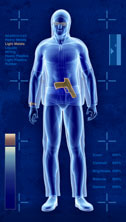
Naked Truth About Scanners
Norbert and I both travel quite a bit for the university' so we've seen lots of changes in airports, from new fees to increased security.
The newest addition is whole body X-ray-based scanners, and some groups are adamantly opposed to them.
Two new imaging technologies are being used: millimeter wave and backscatter. Millimeter wave scanners use radio waves which have no proven adverse health effects.
The other, Backscatter, uses extremely low levels of X-rays to detect objects under a person's clothing. It's this technology that some groups argue is harmful to our health.
Backscatter works by mating two scanners ' one does the front of the body while another scans the back. They bounce low-radiation X-rays off a passenger to produce photo-quality images, as if they were undressed. But the images are obscured for the operator to protect passengers' privacy.
So, just how much radiation is used?
The government established each screening should not exceed 25 microrems. By comparison, the scanners emit just 1.48 microrems per screening. At that rate, it'd take 17-thousand screenings a year to exceed the 25-thousand microrem limit the government set for any given year.
Experts say a passenger would need about 200-thousand scans to equal one CT scan. That's two flights a day for over 270 years! Opponents argue this comparison to CT scans is misleading, because backscatter doesn't distribute the radiation through the entire volume of the body.
Rather, it's largely deposited into the skin and adjacent tissue, which means the skin is getting a lot of radiation. Future research will undoubtedly settle this argument.
The final question, of course, is whether the imagers are excessively invasive. That depends on the individual.
I'm personally okay with a technician seeing a computer modified image of me in exchange for the possibility of a safer flight.
More Information
This is a very contentious topic and a great deal of the information on the web is not provided by reliable or informed sources. We caution our listeners to make sure that you are getting accurate and reliable information. We have provided a few links to additional information from sources we found to be credible and are independent of the Transportation Safety Administration to avoid that conflict of interest.
For a comprehensive report that was prepared by the Applied Physics Laboratory (APL) at Johns Hopkins University. The Transportation safety committee directed the APL to conduct an independent radioation safety engineering assessment of one of the brands (AIT Backscatter device) of whole body scanners. That report can be read here.
The American Cancer Society has a web page entitled Radiation Exposure and Cancer that explains what radiation is, what types of radiation exist and the risks of exposure. This includes airport scanner. This is a good place to start gathering information.
For more information...
The Food and Drug Administration provides a web page entitled Products for Security Screening of People that provides information about both metal detectors and whole body scanners. There is information about the radiation dose and safety. There are also many links for additional information.
For more information...
Idaho State University has some excellent information about the risks of radiation including listings of the radiation doses from various medical, industrial and environmental sources. They also provide numerous links for additional information.
Time magazine has a nice article that highlights the debate about the use of the backscatter scanners at airports.
Radiation Risk Calculator is dedicated to improving the understanding of radiation risks from medical imaging. Calculate your dose and estimate cancer risk from studies including CT scans, x-rays, nuclear scans and interventional procedures. You can find this calculator here.