Recent Episodes
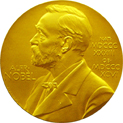
Nobel in Physiology or Medicine
It's astounding that the complex human body starts from a single cell – the fertilized egg. Once fertilized, this single cell rapidly divides to form a handful of cells that will become all the cell types needed to create a new human being.
For years scientists assumed once these embryonic stem cells differentiate to become specialized cells such as liver or skin cells, they can't go backwards into an immature state. But the two winners of the 2012 Nobel in Physiology or Medicine disproved that assumption and revolutionized our understanding of human development. Not only did they show that inside each of our mature, specialized cell is the genetic information for the body's other cells, mature cells can also revert to an embryonic-like state.
One of the winners, John B. Gurdon, actually proved this idea fifty years ago but was met with much skepticism. He replaced the nucleus of a frog egg cell with the nucleus of the frog's mature intestinal cell. If the mature cell nucleus still carried the genes for development, once fertilized, the egg would become a tadpole, and it did.
In 2006, Shinya (sheen-ya) Yamanaka, the other Nobel winner, furthered Gurdon's work by finally showing mature cells can be programmed to differentiate into immature stem cells. He identified four genes in mouse embryos that when introduced into mature skin cells reactivated the genes responsible for early development.Since then, he's proved the same with human skin cells. Yamanaka's method is used in labs worldwide and its implications are that one day people's own cells can be regrown into healthy cells to treat their own disease.
More Information
The Nobel Prize in Physiology or Medicine 2012
Visit this website for information about all this year's winners, and a history of the Nobels and previous winners. This is a rich educational site where you can learn about the people and their discoveries that have framed the advancement of science for over 100 years.
Stem Cell Scientists Awarded Nobel Prize in Physiology and Medicine
Great, layman-friendly article from Time Magazine on this year's winners of the Nobel in Physiology or Medicine.
The Original Journal Articles:
Gurdon, J.B., (1962). The developmental capacity of nuclei taken from intestinal epithelium cells of feeding tadpoles. Journal of Embryology and Experimental Morphology 10:622:-640.
Takahashi, K. and S. Yamanaka.(2006). Induction of pluripotent stem cells from mouse embryonic and adult fibroblast cultures by defined factors. Cell 126:663-676.






