Recent Episodes
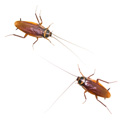
Right-Handed Roaches
The majority of people in the world today are right handed. We've known that and believed for quite some time that the preference for right handedness across populations was unique to humans.
But it's not so.
In the last five years, studies have shown certain primates, like chimpanzees, show a preference for right handedness in certain tasks. But here's the biggest surprise: researchers at Texas A-and-M University just discovered that cockroaches are righties.
What? Cockroaches? I don't like having anything in common with roaches.
It's true. Researchers in this study released roaches into a Y-shaped tube where scents of vanilla or ethanol would entice the insects toward the split in the tube. No matter the scent, over half, or 57 percent of the time, roaches preferred to fork right.
Even when researchers chopped off one of the bugs' sensitive antennae, used for touch and smells, the roaches had a right side bias. The insight could help bioengineers who hope to use cockroaches for search and rescue missions or to improve pest control.
That's great except we're still unclear what causes handedness, even in humans. Handedness is defined as one hand showing greater coordination and dexterity. That's true in all cultures, in every part of the world.
That's why a popular theory attributes handedness to differences in the two hemispheres of the brain. Except for now, that's conjecture. But there may be a genetic component. And if so, it's not simple Mendelian genetics, which means it's not a single gene that defines this trait.
A widely accepted theory roots handedness in people to their environment and that the choice for handedness occurs early in childhood development. That still doesn't explain why cockroaches show side preference... could it be telling us handedness is much more common than we ever suspected?
More Information
ScienceShot: Cockroaches Prefer Right Turns
A short article in the well respected scientific journal, Science describing the right leaning tendencies of American cockroaches. Easy to read for scientists and non-scientists. More
Side Dominance of Periplaneta americana persists through antenna amputation
Original scientific journal article describing experiments that were used to determined the "handedness of American cockroach from a leading journal in the field. Journal
of Insect Behavior DOI 10.1007/s10905-010-9246-4 More
Why are more people right handed?
Brief "Scientific American" article about the reasons for handedness in humans. Easy to read for scientists and non-scientists. More