Medical Discovery NewsBridging the World of Medical Discovery and You

Recent Episodes

Robot Surgeons

MP3 WAV

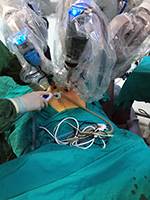
  • Most of us haven't had surgery and even if we had, no robots were likely involved. But that will change. Recently one robot assisted surgery really stood out when a robot precisely cut a hole in a skull. That in itself wasn't remarkable except that it took just two and a half minutes compared to a human surgeon's two hours. This was a game changer.

    Robot assisted surgery is now used in orthopedics, obstetrics, otolaryngology, and other specialties. The main reason is that it helps cut down surgical and recovery time, results in fewer errors, and costs less. In the case of neurosurgery, cutting down the time that a hole is open in a patient's skull lowers the risk of infection.

    The drill is computer controlled and guided by a two dimensional CT scan that can create a 3D image of the area. The surgeon then indicates where the hole should be made as well as the axis, radius and depth and then the software calculates the ideal path for the drill to take. This path includes a margin of safety around all important structures that must be avoided. Safety features include an emergency off switch in case of a difficulty such as an alert from the device indicating a facial nerve is near.

    The device was tested on plastic blocks then on a cadaver. When compared with a manual drill, the robot drill was more accurate and fifty times faster. The bonus is the robotic drill device is relatively inexpensive, at less than a hundred thousand bucks and is already headed for production. It's among the growing field of robot assisted surgery which no doubt will help improve patient outcomes.

More Information

This Robot Completes a 2-Hour Brain Surgery Procedure in Just 2.5 Minutes
Researchers believe their surgery-assisting robot is capable of performing complex brain surgeries. The machine can reduce the time of surgeries by cutting down the time it takes to cut into the skull from two hours to two and a half minutes...

History and the future of Robotic Surgery
The first documented use of a robot-assisted surgical procedure occurred in 1985 when the PUMA 560 robotic surgical arm was used in a delicate neurosurgical biopsy, a non-laparoscopic surgery...

Computer-aided design/computer-aided manufacturing skull base drill
Automation in the field of surgery has been growing in the past decade. Medical robots have been built to assist in critical surgeries in diverse specialties such as orthopedic surgery (hip replacement), spine surgery (pedicle screw placement, vertebroplasty), and otorhinolaryngology (implantation of hearing aid devices), among others. Despite the advances in medical robotics, many surgical procedures continue to be performed manually by surgeons and are therefore more time consuming, adding to surgical expense, and are susceptible to human error. In many cases, robot assistance could reduce the overall duration of surgeries as well as minimize human error and the cost of surgery...

Two individuals wearing headphones stand in a recording booth, speaking into microphones with a music stand holding printed pages between them.

 Medicine...

Medicine is constantly advancing – that is a great thing about life in the 21st century. But it doesn’t just happen. Dedicated biomedical scientists are making discoveries that translate into those new medical advances.

Biomedical science is broad, encompassing everything from social science to microbiology, biochemistry, epidemiology, to structural biology and bioinformatics to name just a few areas. And, it can involve basic fundamental biology, the use of AI and chemistry to clinical studies that evaluate new medicines in patients.

No matter the research focus, the goal is always the same, to advance human health. It may take a few months, a few years or for fundamental science, a few decades. Few people make the connection that biomedical science is medicine and that biomedical scientists are working today on the medicine of tomorrow. Our weekly 500-word newspaper columns and 2-minute radio shows and podcasts provide insights into a broad range of biomedical science topics.

Medical Discovery News is dedicated to explaining discoveries in biomedical research and their promise for the future of medicine.

Podcasts

Alternatively, you can copy and paste the following web address (URL) into iTunes as a new subscription:
https://www.medicaldiscoverynews.com/shows/audio/mdnews.rss

You can also search and subscribe to "Medical Discovery News" in the podcast section of iTunes.

The www.medicaldiscoverynews.com web site and Medical Discovery News radio program (Program) are made possible by The University of Texas Medical Branch at Galveston (UTMB)as a community service and are intended to advance UTMB's mission of providing scholarly teaching, innovative scientific investigation, and state-of-the-art patient care in a learning environment to better the health of society and its commitment to the discovery of new innovative biomedical and health services knowledge leading to increasingly effective and accessible health care for the citizens of Texas.

All information provided on the web site and in the Program is for informational purposes only and is not intended for use as diagnosis or treatment of a health problem or as a substitute for consulting a licensed medical professional. Any information obtained by participating as a web site visitor or program listener is not intended to and should not be considered to constitute medical advice.

Thoughts and opinions expressed on the Program or on the website are those of the authors or guests and do not necessarily reflect the opinions of UTMB. The provision of links to other websites is not to be construed as written or implied sponsorship or endorsement of such websites by UTMB.

Please contact Dr. David Niesel or Dr. Norbert Herzog via email with any concerns, suggestions or comments.

All rights are reserved to information provided on the website or other information sources. No part of these programs can be reproduced stored in a retrieval system or transcribed in any form or by any means for personal or financial gained without the express written permission of Drs. Niesel and Dr. Herzog.