Recent Episodes
The Stuff of Life Came from Outer Space
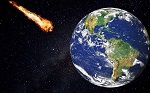
Lower the lights and cue the spooky music! Researchers have strong evidence that the molecules comprising the "stuff of life" can be found in space. Yes, this increases the possibility that we are not alone. A study in the prestigious journal Nature Communications reports that that all five building blocks of DNA and RNA have been found in meteorites. This is an "ET phone home" moment.
DNA and RNA are made of long strings of nucleic acids to encode our genes, which together represent the entire blueprint of who we are. Nucleic acids contain sugar molecules, phosphorus and molecules called nucleobases. There are four of these bases that make up DNA called adenine, guanine, cytosine and thymine. In RNA, the same bases are used except uracil substitutes for thymine. You may remember from high school biology that adenine pairs with thymine and guanine pairs with cytosine in the DNA double helix. These bases form the code that provides the instructions for assembling our bodies.
For 50 years, scientists were aware of the nucleobases adenine, guanine and uracil in meteorites that had fallen to Earth. The recent discoveries of thymine and cytosine have re-ignited the fundamental debate of how life began on Earth.
Many argue that molecules found on meteors simply represent contamination that occurs when the meteor strikes the Earth. However, the researchers showed that unique forms of the nucleobases called isoforms were present in the meteorite that were not present in the soil where the meteorite landed. This suggests that the nucleobases are extraterrestrial. We have proof that molecules associated with biological life exist on other planets surrounding distant stars. More than 5,000 such planets have now been identified orbiting stars, and many are Earth-like. By analyzing light passing though the atmosphere of these exoplanets, scientists have detected many molecules associated with life. More evidence that we may not be alone!
Did these molecules of life arise in the primordial soup of organic molecules while Earth was forming as a planet? Or did they arrive on meteors or comets that fell to Earth? There have been many theories that the early Earth environment made it easy for organic molecules to form. High-energy lightning strikes into this mix of organic molecules may have jump-started life. Experiments in the laboratory using electrical discharges into solutions of simple molecules has shown that this is possible.
Or perhaps Earth was seeded with organic molecules from some distant star system through the impact with meteors, asteroids or comets. Either way, life still evolved on Earth, but the generation of biological life may have been accelerated.
We may be able to prove an extraterrestrial source with missions to asteroids or comets. This will not answer the question of how life began on Earth, but may further provide intrigue to an extraterrestrial origin. Maybe we are all essentially immigrants from other worlds.
More Information
All of the bases in DNA and RNA have now been found in meteorites
More of the ingredients for life have been found in meteorites. Space rocks that fell to Earth within the last century contain the five bases that store information in DNA and RNA, scientists report April 26 in Nature Communications...
Identifying the wide diversity of extraterrestrial purine and pyrimidine nucleobases in carbonaceous meteorites
The lack of pyrimidine diversity in meteorites remains a mystery since prebiotic chemical models and laboratory experiments have predicted that these compounds can also be produced from chemical precursors found in meteorites. Here we report the detection of nucleobases in three carbonaceous meteorites using state-of-the-art analytical techniques optimized for small-scale quantification of nucleobases down to the range of parts per trillion (ppt)...
Life on Earth may have begun in hostile hot springs
Understanding how complex molecules formed on our planet could guide the search for life elsewhere in the solar system...