
Medical Discovery NewsBridging the World of Medical Discovery and You

Recent Episodes

There is No Tickling Yourself

MP3 WAV

  • Do you know why you can't tickle yourself, Dave? Kind of. Surprise is a part of it, right? That we don't know when it's going to happen and for how long. You know, if we could actually tickle ourselves, how crazy would it be to accidently tickle myself and start laughing hysterically. Oh man, that would be weird.

    So, you're right, surprise is lost when we touch ourselves, but also, our brains reduce the sensitivity we feel in that patch of skin. Strange, right? Yeah. And in this study, healthy volunteers were asked to lay in an fMRI machine which can record images of brain activity. People either stroked their own arms or were stroked by researchers in the same way and brain images would reveal if the brain processed them differently.

    With self-touch, activity in several parts of the brain was reduced compared to touch by someone else. And amazingly this difference in reactions started in the spinal column even before the brain had processed the signals. That's similar to our ability to process what we see as soon as an image hits the retina. This study supports a theory in brain research that suggests the brain tries to predict the sensory consequences of our actions.

    So, here the brain seems to play down sensory perceptions from our own bodies and play up its expectation of the sensation from someone else. For example, in another experiment, a person's arm was touched with filaments of varying thickness while self-stroking or being stroked by someone else. Again, the brain played down sensations of self-stroking.

    So now if your kids ask why they can't tickle themselves you have some answers, although they're likely to roll their eyes sometime partway into your explanation.

More Information

Here's why you can't tickle yourself
Run a hand down your forearm, or press your fingers together'now imagine someone else taking the same actions. The two sensations feel different, even though the touch is the same. The reason why makes intuitive sense: someone else is touching you, and you have no direct information about whether the touch will continue or change. It's why most people can't tickle themselves, because there's no element of surprise. But a new study from researchers at Sweden's Link'ping University reveals that there's more going on than suspense...

This Is Why You Can't Tickle Yourself
It feels different when other people touch you, compared to when you touch yourself. This is obvious when you try to tickle yourself and it doesn't make you laugh, or when it doesn't feel as good to massage your own shoulders as when someone else does it...

Distinction of self-produced touch and social touch at cortical and spinal cord levels
Differentiation between self-produced tactile stimuli and touch by others is necessary for social interactions and for a coherent concept of 'self.' The mechanisms underlying this distinction are unknown. Here, we investigated the distinction between self- and other-produced light touch in healthy volunteers using three different approaches: fMRI, behavioral testing, and somatosensory-evoked potentials (SEPs) at spinal and cortical levels. ..
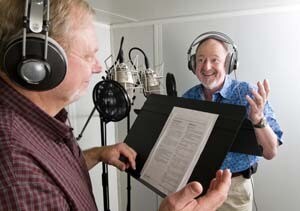

Two individuals wearing headphones stand in a recording booth, speaking into microphones with a music stand holding printed pages between them.

 Medicine...

Medicine is constantly advancing – that is a great thing about life in the 21st century. But it doesn’t just happen. Dedicated biomedical scientists are making discoveries that translate into those new medical advances.

Biomedical science is broad, encompassing everything from social science to microbiology, biochemistry, epidemiology, to structural biology and bioinformatics to name just a few areas. And, it can involve basic fundamental biology, the use of AI and chemistry to clinical studies that evaluate new medicines in patients.

No matter the research focus, the goal is always the same, to advance human health. It may take a few months, a few years or for fundamental science, a few decades. Few people make the connection that biomedical science is medicine and that biomedical scientists are working today on the medicine of tomorrow. Our weekly 500-word newspaper columns and 2-minute radio shows and podcasts provide insights into a broad range of biomedical science topics.

Medical Discovery News is dedicated to explaining discoveries in biomedical research and their promise for the future of medicine.

Podcasts

Alternatively, you can copy and paste the following web address (URL) into iTunes as a new subscription:
https://www.medicaldiscoverynews.com/shows/audio/mdnews.rss

You can also search and subscribe to "Medical Discovery News" in the podcast section of iTunes.

The www.medicaldiscoverynews.com web site and Medical Discovery News radio program (Program) are made possible by The University of Texas Medical Branch at Galveston (UTMB)as a community service and are intended to advance UTMB's mission of providing scholarly teaching, innovative scientific investigation, and state-of-the-art patient care in a learning environment to better the health of society and its commitment to the discovery of new innovative biomedical and health services knowledge leading to increasingly effective and accessible health care for the citizens of Texas.

All information provided on the web site and in the Program is for informational purposes only and is not intended for use as diagnosis or treatment of a health problem or as a substitute for consulting a licensed medical professional. Any information obtained by participating as a web site visitor or program listener is not intended to and should not be considered to constitute medical advice.

Thoughts and opinions expressed on the Program or on the website are those of the authors or guests and do not necessarily reflect the opinions of UTMB. The provision of links to other websites is not to be construed as written or implied sponsorship or endorsement of such websites by UTMB.

Please contact Dr. David Niesel or Dr. Norbert Herzog via email with any concerns, suggestions or comments.

All rights are reserved to information provided on the website or other information sources. No part of these programs can be reproduced stored in a retrieval system or transcribed in any form or by any means for personal or financial gained without the express written permission of Drs. Niesel and Dr. Herzog.