Medical Discovery NewsBridging the World of Medical Discovery and You

Recent Episodes

Virgin Births on the Rise

MP3 WAV

  • Let's start with a quiz! What do the water flea, the marbled crayfish and the boa constrictor have in common? No, they're not merely the nicknames of your daughter's high school boyfriends. All these animals can produce offspring without a fertilized egg!

    This asexual reproduction, called parthenogenesis, comes from the Greek meaning "virgin birth". We're discovering that more species are capable of this than we ever knew.

    Nearly all reproduction requires the union of a sperm and an egg, but in parthenogenesis only the female chromosomes are involved, producing, in most cases, identical clones of the mother. Species that strictly reproduce this way, such as the New Mexico whiptail lizard, risk genetic mutations in the long run without a diverse gene pool. But one species found a clever way to mix up its genes by incorporating DNA from its environment.

    For over 40 million years the microscopic bdelloid rotifers reproduced asexually by ingesting DNA present in their freshwater pools. Over the past decade, scientists discovered, quite by accident, that several animals they kept in captivity were capable of parthenogenic reproduction.

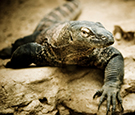
    Two female Komodo dragons kept separate from males produced healthy clones even though in the wild they produce sexually. A hammer head shark and a boa constrictor, both in captivity, also produced clones.

    We don't know what triggered these species to begin non-sexual reproduction, and we haven't seen it in mammals. But understanding this process may one day help save endangered species.

More Information

Slideshow: Virgin Birth Not So Miraculous in Animal Kingdom
Science — "For billions of Christians around the world, the holidays are a time to celebrate Jesus' birth to the Virgin Mary. But for many animals, virgin birth is far from a miraculous event. Researchers have discovered a growing number of species that reproduce without assistance from the opposite sex."

Birth of parthenogenetic mice that can develop to adulthood.
Nature. 2004 Apr 22;428(6985):860-4.
Kono T, Obata Y, Wu Q, Niwa K, Ono Y, Yamamoto Y, Park ES, Seo JS, Ogawa H.

Can artificial parthenogenesis sidestep ethical pitfalls in human therapeutic cloning? An historical perspective.
J Med Ethics. 2005 Dec;31(12):733-5.
Fangerau H.


Two individuals wearing headphones stand in a recording booth, speaking into microphones with a music stand holding printed pages between them.

 Medicine...

Medicine is constantly advancing – that is a great thing about life in the 21st century. But it doesn’t just happen. Dedicated biomedical scientists are making discoveries that translate into those new medical advances.

Biomedical science is broad, encompassing everything from social science to microbiology, biochemistry, epidemiology, to structural biology and bioinformatics to name just a few areas. And, it can involve basic fundamental biology, the use of AI and chemistry to clinical studies that evaluate new medicines in patients.

No matter the research focus, the goal is always the same, to advance human health. It may take a few months, a few years or for fundamental science, a few decades. Few people make the connection that biomedical science is medicine and that biomedical scientists are working today on the medicine of tomorrow. Our weekly 500-word newspaper columns and 2-minute radio shows and podcasts provide insights into a broad range of biomedical science topics.

Medical Discovery News is dedicated to explaining discoveries in biomedical research and their promise for the future of medicine.

Podcasts

Alternatively, you can copy and paste the following web address (URL) into iTunes as a new subscription:
https://www.medicaldiscoverynews.com/shows/audio/mdnews.rss

You can also search and subscribe to "Medical Discovery News" in the podcast section of iTunes.

The www.medicaldiscoverynews.com web site and Medical Discovery News radio program (Program) are made possible by The University of Texas Medical Branch at Galveston (UTMB)as a community service and are intended to advance UTMB's mission of providing scholarly teaching, innovative scientific investigation, and state-of-the-art patient care in a learning environment to better the health of society and its commitment to the discovery of new innovative biomedical and health services knowledge leading to increasingly effective and accessible health care for the citizens of Texas.

All information provided on the web site and in the Program is for informational purposes only and is not intended for use as diagnosis or treatment of a health problem or as a substitute for consulting a licensed medical professional. Any information obtained by participating as a web site visitor or program listener is not intended to and should not be considered to constitute medical advice.

Thoughts and opinions expressed on the Program or on the website are those of the authors or guests and do not necessarily reflect the opinions of UTMB. The provision of links to other websites is not to be construed as written or implied sponsorship or endorsement of such websites by UTMB.

Please contact Dr. David Niesel or Dr. Norbert Herzog via email with any concerns, suggestions or comments.

All rights are reserved to information provided on the website or other information sources. No part of these programs can be reproduced stored in a retrieval system or transcribed in any form or by any means for personal or financial gained without the express written permission of Drs. Niesel and Dr. Herzog.