One of UTMB’s most frequent collaborators in One Health is Dr. John A. Lednicky, MS, PhD, a Research Professor at the University of Florida’s College of Public Health and Health Professions. One might regard Dr. Lednicky as a polymath —a modern-day Renaissance scientist — due to his remarkably interdisciplinary expertise and his unconventional path towards embracing the One Health approach.
-

John Lednicky, a key UTMB Collaborator and One Health Polymath
-

Dr. Haiping Hao at UTMB's Next Generation Sequencing (NGS) Core
Dr. Haiping Hao, PhD, serves as Director of UTMB’s Next Generation Sequencing (NGS) Core and is an Assistant Professor in the Department of Biochemistry & Molecular Biology. He has significantly advanced the application of viral genome sequencing in public health by applying NGS to track mutations and inform public health responses for pathogen surveillance. His work led to the rapid detection of SARS-CoV-2 variants, real time outbreak monitoring and understanding of zoonotic spillovers, in line with the One Health framework. His recent work sequencing H5N1 samples from cattle in Texas demonstrates the power of genomic tools across species and settings to anticipate disease dynamics and support vaccine development.
-
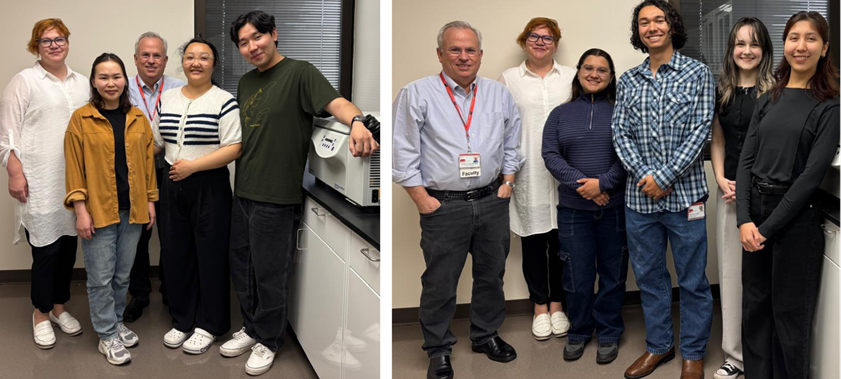
Global Collaboration and Local Impact: UTMB’s One Health Laboratory Advances Research and Mentorship
The University of Texas Medical Branch (UTMB)’s One Health Laboratory is making significant strides in interdisciplinary research, mentorship, and international collaboration — bringing together students and scientists. Currently, under two national training grants, graduate students from Mongolia and undergraduates from Galveston College are being trained in virology and molecular techniques.
-
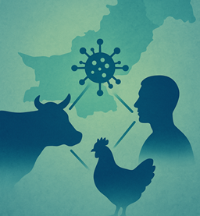
When Viruses Cross Species: UTMB Collaborative Study in Pakistan Finds Evidence for an Unusual Cattle Virus Infection in a Sick Man
In an unprecedented discovery, a recent UTMB-led One Health study in Pakistan identified molecular evidence of a bovine adenovirus in a human respiratory sample—a finding that underscores the silent, often invisible ways that viruses can move between species.
-

Understanding How Epidemics Start in the Field: A Conversation with Dr. Weaver
What do mosquitoes, West Africa, and cutting-edge virus research have in common? For Dr. Scott Weaver, they’ve shaped a lifelong journey into the heart of epidemic science. Dr. Weaver’s story blends fieldwork, One Health thinking, and decades of partnership with scientists across Senegal, Nigeria, and Sierra Leone. In this article, he reflects on building research infrastructure, discovering new viruses, and why the key to controlling epidemics starts with understanding them—right where they emerge.
-

Integrating Mental Health into the One Health Framework
This article looks at integrating mental health into the One Health framework, with evidence that environmental stressors (pollution, climate change and infectious disease), affect neurological and behavioral outcomes in humans and animals. It calls for interdisciplinary research to understand these interactions and support public health interventions.
-
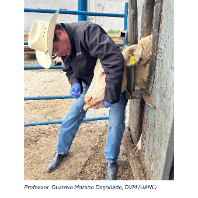
New UTMB Research Collaboration with Veterinarians in Mexico Leads to the Detection of a Likely Newly Recognized Viral Pathogen in Cattle
Recently UTMB has begun collaborations with a leading veterinary school, Universidad Autónoma de Nuevo León (UANL), located near Monterrey, Mexico. These One Health Research collaboration have quickly resulted in a virus discovery that could change the care of cattle throughout the world. Dean and Professor Gustavo Hernández Vidal, MVZ, MSc, PhD, commented, "The collaboration between UTMB and the Faculty of Veterinary Medicine at UANL represents a significant advancement in transdisciplinary One Health research. The identification of this novel virus has the potential to enhance our understanding of infectious diseases in cattle, ultimately contributing to improved veterinary practices and global livestock health."
-

Bridging Borders and Battling Worms: Dr. Clinton White’s Global One Health Mission
Dr. Clinton White is a renowned researcher, educator, and clinician specializing in neurocysticercosis and other parasitic infections, with a career shaped by global collaborations and a strong commitment to tropical medicine. His expertise in neurocysticercosis grew from early encounters at Ben Taub County Hospital to international research efforts, leading to influential management guidelines and eradication strategies in Peru. Currently, he continues his work through clinical teaching, research collaborations, and clinical trials, emphasizing education and a One Health approach to combating infectious diseases worldwide.
-
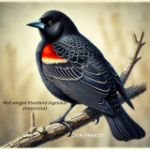
Dr. Meredith Anderson: Investigating Pesticide Exposure in Birds and its Public Health Impact
Dr. Meredith Anderson, DVM, PhD candidate at the Schubot Center for Avian Health at Texas A&M is studying the impact of neonicotinoid pesticides on bird health, immunity, and their role in spreading zoonotic diseases. Her research is looking at how pesticide exposure weakens birds’ immune systems making them more susceptible to infection and altering their ability to transmit diseases like West Nile virus and Salmonella Typhimurium. Neonicotinoids are used in agriculture and urban landscaping and contaminate the environment through treated seeds, soil, water and insect prey. Her studies have already shown patterns of pesticide exposure in juvenile birds and certain species (American robins and red-winged blackbirds) are at increased risk. As she continues her research, she hopes her findings will inform conservation efforts and policy decisions to reduce environmental contamination.
-

H5N1 in Cattle: Outbreak Investigations and Two Experts who Conduct Them
In this article, I discuss the extraordinary work of two UTMB laboratory scientists in identifying and characterizing highly pathogenic avian influenza viruses that impacted a Texas dairy farm in March of 2024. Like many foreign scholars working at UTMB, Drs. Lyudmyla Marushchak and Judith Oguzie trained in countries far from the United States. Yet their interesting backgrounds and training have made them well-suiting for studying emerging zoonotic respiratory viruses that infect humans and animals.
Categories
- OH Project Spotlight (82)
- The Latest in One Health (49)
- UTMB OH Updates (37)
- Welcome to One Health (38)