Lesson learn from US outbreak of Avian Influenza in Cattle
-
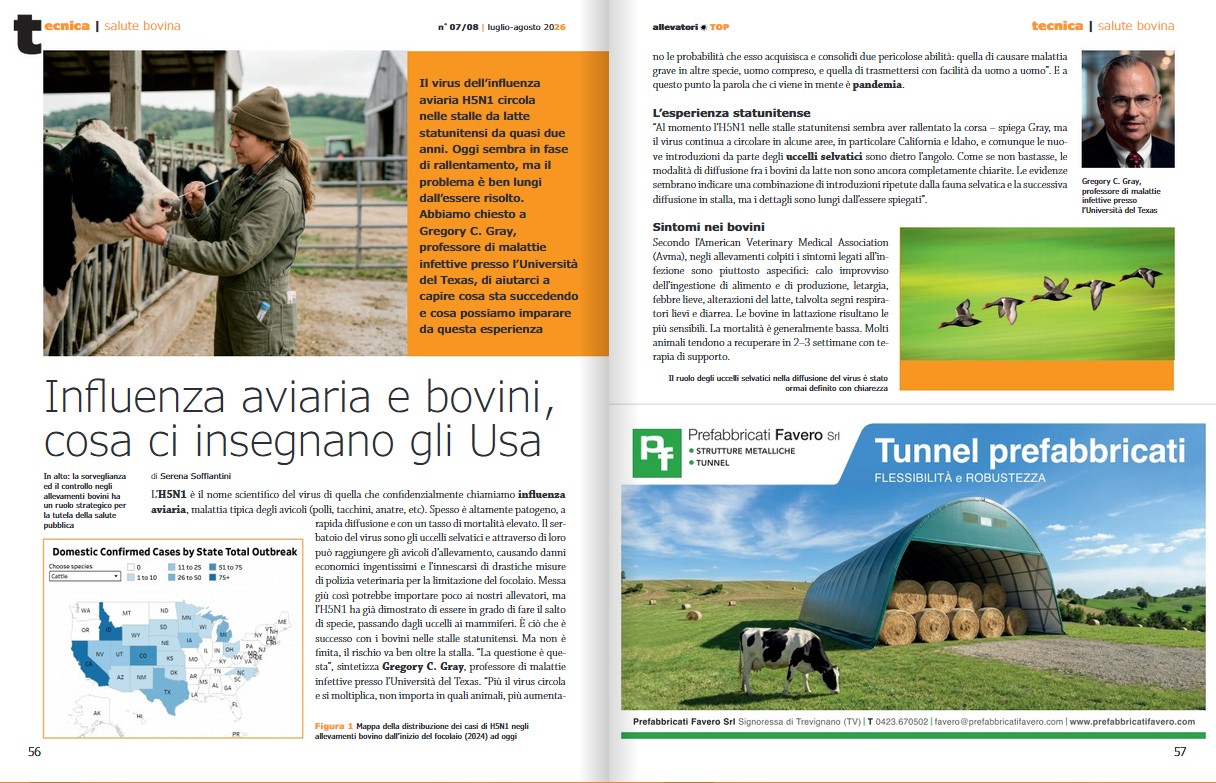
Avian Influenza and Cattle: What the U.S. Experience Teaches Us - August 2026 Allevatori Top (Italian News Magazine and website dedicated to farming and agriculture)
-
It’s time to vaccinate US dairy cattle against bird flu
Gregory C. Gray, MD, MPH, FIDSA, wants to get the word out: The time is now to vaccinate U.S. dairy cattle against bird flu.
-
H5N1 "Entrenched" in North America: The growing case for vaccinating Indiana's herds
Indiana considers about vaccinnating their herds
-
Why experts say now is the time to vaccinate US dairy cattle against bird flu
A new commentary published recently in The Journal of Infectious Diseases by Dr. Gregory Gray et al
-
Deciphering D: A mysterious influenza strain infects livestock around the world. Scientists worry it can become a threat to humans as well
Jon Cohen joined Dr. Gregory Gray and Dr. Gustavo Hernandez-Vidal's research team on an expedition to cattle farms in Monterrey Mexico exploring the study of influenza D.
-
Scientists say these two viruses may become the next public health threats
Dr. Gregory Gray and Dr. John Lednicky's article on influenza D virus and canine coronavirus being an emerging respiratory threat has been featured in a recent news article.
-
Flu season is ramping up, and some experts are "pretty worried"
Dr. Gregory Gray was interviewed, along with other influenza experts, on the ramping up of this flu season.
-
Bats might be the next bird flu wild card
Vampire bats in Peru show signs of past H5N1 infection
-
Mutated flu strain could cause a more severe flu season. Here's what to know
A mutated strain of the flu virus is surging around the world. CBS News medical contributor Dr. Jon LaPook explains what to know about symptoms and the vaccine.
-
Bird flu confirmed in Galveston County
With the help of UTMB One Health Laboratory, Galveston County Health District is testing local birds confirmed with H5 bird flu.
-
Texas Research Team is Using the One Health Approach to Mitigate Complex Human, Animal, and Environmental Threats
Dr. Gregory Gray wrote an article for the Citizens' Environmental Coalition Weekly Newsletter for Houston Environmental News. In this widely circulated article Dr. Gray highlights the work the One Health Research and Training Team at UTMB does to address complex health problems.
-
Ducks return to a Long Island farm that lost its entire flock to the bird flu
UTMB’s Dr. Gregory Gray was included in this story on bird flu. "It's not like in the movies," Gray says of bird flu infecting humans. "It's going to take continual spillover events for it to get a foothold."
-
The US hasn’t seen a human bird flu case in 3 months. Experts are wondering why
Dr. Gregory Gray and other experts provide prospective on decreasing cases of bird flu in humans.
-
UTMB and veterinarians from Mexico identify potential new viral pathogen in cattle
New UTMB research collaboration with veterinarians in Mexico leads to the detection of a likely newly recognized viral pathogen in cattle.
-
New UTMB Research Collaboration with Veterinarians in Mexico Leads to the Detection of a Likely Newly Recognized Viral Pathogen in Cattle
UTMB OH Newsletter article gets featured in newsletter for farmers.
-
Everything you need to know about bird flu
How dangerous is it? Where did it come from? H5N1 influenza’s origins stretch back to the 1990s, and key events paved the way for the outbreak we’re seeing today. Dr. Gray provides insight.
-
Bird flu continues ‘odd’ transmission between mammals
Dr. Gregory Gray joined the Texas Standard to discuss the latest bird flu development – its jump to sheep in the UK. “Well, it’s odd in the sense that there’s been so many spillovers to new species, so the viruses have adapted characteristics that make that possible,” Gray said.
-
FAO urges nations to ramp up actions to blunt impact of H5N1 avian flu
In new research developments, a team based at the University of Texas Medical Branch, Galveston, compared the virus characteristics of the bovine H5N1 strain with an older H5N1 strain collected from a wild bird in Mongolia in 2005. The findings appear in Scientific Reports. The investigators conducted their experiments using mice and panels of human lung cells. The cattle H5N1 strain showed superior growth and more rapid replication in the human lung cells. In mice, the bovine strain showed greater pathogenicity, rapid lung pathology, high virus titers in the brain, and high mortality following challenge via different infection routes. "In summary, this study demonstrates the profound pathogenicity and suggests a potential innate immune escape mechanism of the H5N1 virus isolated from a dairy cow in Texas," the authors wrote.
-
Explainer: How bird flu has sent US eggs prices skyrocketing
"It sure seems to me that we're going to have to start using vaccines if we want to start putting this fire out," UTMB’s Dr. Gregory Gray tells Reuters for a story on how the spread of the avian flu is affecting egg prices. Egg farmers are urging the USDA to approve the use of a vaccine to protect laying hens from the virus. This news was shared by outlets across the nation and internationally.
-
Bird flu outbreak tests new U.S. agriculture secretary as Texas farmers remain on edge
Bird flu continues to spread and farmers in Texas are worried, the Chronicle reports. So far, human cases have only involved workers in the poultry industry but that could change. "The concern is the virus might become highly transmissible among humans, with high morbidity and mortality rates," Dr. Gregory Gray tells the Chronicle. Similar stories ran in outlets across the country and internationally.
-
Some people didn’t know they had a bird flu infection, study of veterinarians suggests
A new study shows that bird flu has silently spread from animals to some veterinarians, the AP reports. “This means that people are being infected, likely due to their occupational exposures, and not developing signs of illness and therefore not seeking medical care,” UTMB’s Dr. Gregory Gray said. This news was picked up by outlets across the nation and internationally.
-
After delay, CDC releases data signaling bird flu spread undetected in cows and people
After going quiet on bird flu, CDC scientists have published a report on its spread among veterinarians
-
Second bird flu strain found in US dairy cattle, agriculture agency says
"Now it looks like we have new strains of virus that may escape some of the immunity associated with the other strains of viruses that could exacerbate the epidemics among animals and wildlife," UTMB’s Dr. Gregory Gray tells Reuters after a new strain of bird flu has been detected in U.S. dairy cattle. This news was also reported in VOA, Dairy Herd Management, AgWeek, and other national and international outlets.
-
CDC calls for expanded testing for bird flu after blood tests reveal more farmworker infections
-
Bird flu: US places milk under surveillance (French)
-
How Raw Milk Could Spark a Pandemic
-
CDC calls for expanded testing for bird flu after blood tests reveal more farmworker infections
-
NPR's All Things Considered: Here's why bird flu fears are intensifying
-
As Bird Flu Spreads, Additional Human Infection Is Reported in Missouri
-
As Bird Flu Spreads, Two New Cases Diagnosed in California
-
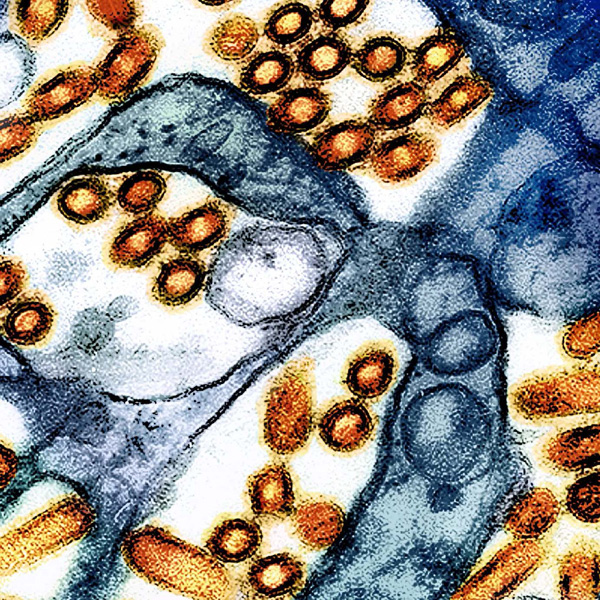
How U.S. Farms Could Start a Bird Flu Pandemic
The virus is poised to become a permanent presence in cattle, raising the odds of an eventual outbreak among people... So far, this virus, H5N1, does not easily infect humans, and the risk to the public remains low. But the longer the virus circulates in cattle, the more chances it gains to acquire the mutations necessary to set off an influenza pandemic. Source: The New York Times - How U.S. Farms Could Start a Bird Flu Pandemic
-
H5N1 avian flu found in Texas dairy cattle and milk, sparking concerns about underreported infections
-
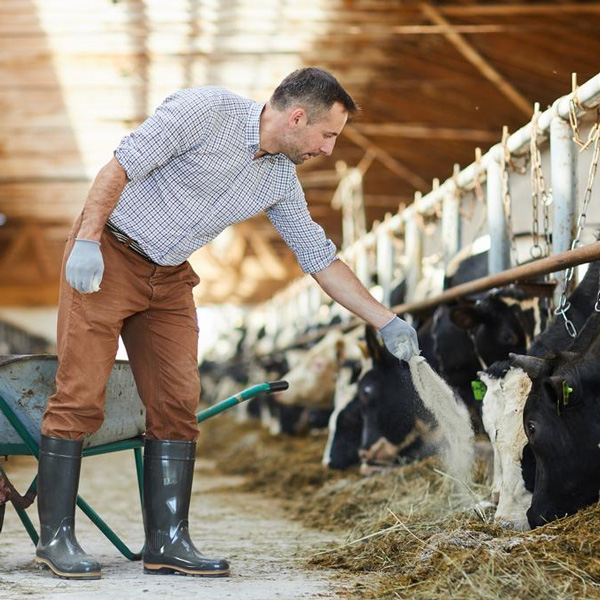
Bird flu on the rise among livestock workers
With underreported cases, health officials risk are slow to notice how contagious the H5N1 avian virus is becoming. Large surge of infections outside of farmworker communities can set off the government’s flu surveillance system, but it could be too late to contain. Source: NPR - Bird flu cases among farm workers may be going undetected, a study suggests
-
Bird Flu Cases Are Going Undetected, New Study Suggests. It’s a Problem for All of Us
-
Cattle may become a permanent host for bird flu
-
Safeguarding Against H5N1 Influenza Spillover: Protecting Human, Animal, and Environmental Health
-
How Poor Tracking of Bird Flu Leaves Dairy Workers at Risk
-
Bird flu in US cows: where will it end?
-
Human Bird Flu Cases May Be Going Unreported
-
This Texas veterinarian helped crack the mystery of bird flu in cows
-
The U.S. may be missing human cases of bird flu, scientists say
-
This Texas veterinarian helped crack the mystery of bird flu in cows
-
The U.S. government is taking action to stop ‘cow flu.’ Is it too little, too late?
-
This Cow and Pig Influenza Virus Could Infect Humans: What We Know So Far
-
What to Know About the Bird Flu Outbreak in Dairy Cows
-
Bird Flu & Dairy Cattle: Insights from Epidemiologist and Livestock Analyst
-
Bird flu’s outbreak in cattle spreads
-
This Cow and Pig Influenza Virus Could Infect Humans: What We Know So Far
Scientific American - Influenza D is only known to sicken cattle and pigs, but it "has everything it needs" to jump into people
-

Preparing for pandemics: The One Health approach
For three days this week, decision-makers of the World Health Organization gather for a special global assembly. With COVID-19 and its variants still very much in the news, the pandemic tops the agenda. And one of the policy briefs up for discussion concerns a concept called "One Health," which considers that the health of all living beings results from the interface between humans, animals and their environment. Université de Montréal professor Hélène Carabin, an epidemiologist in the Faculty of Veterinary Medicine and the School of Public Health, is the co-lead author of the 30-page brief, titled "One Health as Pillar for a Transformative Pandemic Treaty." With six colleagues from the University of Ottawa, University of New Brunswick and universities in Germany, Norway and Ghana, Carabin argues for making animals and the environment part of the human equation in planning for future epidemics.
-

Your kid is (probably) not going to get monkeypox
August 13, 2022, The Slate news website interviewed Dr. Susan McLellan, an infectious disease specialist at the University of Texas Medical Branch at Galveston. “At this point, if it was so easy to jump into the child population, it seems like it would have done so,” she said. “There might be isolated outbreaks, but I’m not super worried about elementary schools and day cares turning out to be hugely important.” Dr. McLellan also spoke to the Fort Worth Star-Telegram on the same topic. “Worrying about it on the bus I think is silly,” McLellan said. “Worry more about being hit by the bus.”
-

Dog with monkeypox sparks questions about human-to-animal transmission
Newsweek, August 19, 2022 - Dr. Gary Kobinger, director of the Galveston National Laboratory at the University of Texas Medical Branch, told Newsweek, "It is expected that current vaccination regiments that show protection in other animal species, and/or humans, will also work in dogs. This could be one prevention measure to confirm (in dogs) and use."
-
Ghana declares first-ever outbreak of Marburg virus disease
Accra/Brazzaville - Ghana has announced the country’s first outbreak of Marburg virus disease, after a World Health Organization (WHO) Collaborating Centre laboratory confirmed earlier results.
-

Tracking coronavirus in animals takes on new urgency
By Ariana Eunjung Cha - Washington Post - Researchers Sarah Hamer and Lisa Auckland donned their masks and gowns as they pulled up to the suburban home in College Station, Tex. The family of three inside had had covid a few weeks earlier, and now it was time to check on the pets.
-
Are Deer In COVID's Crosshairs?
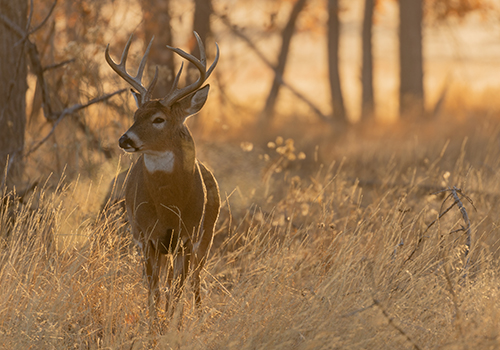
A new study by Texas A&M University's College of Veterinary Medicine and Biomedical Sciences has revealed that captive white-tailed deer in Texas are susceptible to SARS-CoV-2, the virus that causes COVID-19. With more than 90% of the captive deer at one facility testing positive for the virus, the authors indicate their findings likely reflect deer-to-deer transmission. With deer hunting a major recreational activity and economic benefit to the Texas economy, understanding more about the nexus of hunters, deer and the possibility of zoonotic disease transmission is important in ensuring the industry's overall safety and sustainability. There are more than 10,000 captive cervid facilities throughout the U.S. where deer are bred, according to The Wildlife Society, and more than 500 of these facilities are in Texas.
-

The Ghost Wolves of Galveston Island
A population of strange canids in Texas could hold the key to reviving the highly endangered red wolf.
-
America Is Likely Undercounting Infections Amid COVID Surge That's Nearly Doubled Cases
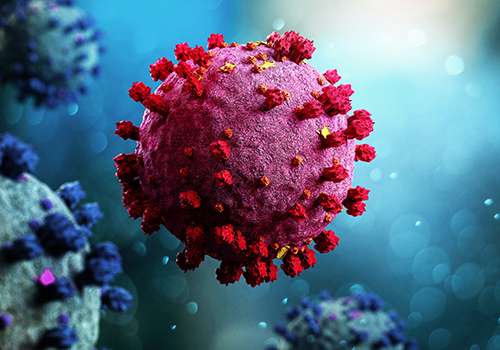
The latest surge in coronavirus cases is likely higher than what's been reported, thanks to the popularity of at-home tests and some people not getting tested because they're struggling to get an appointment or avoiding long wait times.