A campus-wide forum for ideas in motion
The Center for Health and Clinical Outcomes Research (H-COR) Works-in-Progress Seminar Series kicked off with an energizing session that reflected the spirit of the series. It is a place where emerging research benefits from early input, collaboration, and constructive critique from colleagues across disciplines. Held monthly, the hybrid seminars invite participants from across UTMB to learn, ask questions, and help strengthen projects before they are fully finalized.
Spotlight topic: diabetes, dementia, and amputation over the life course
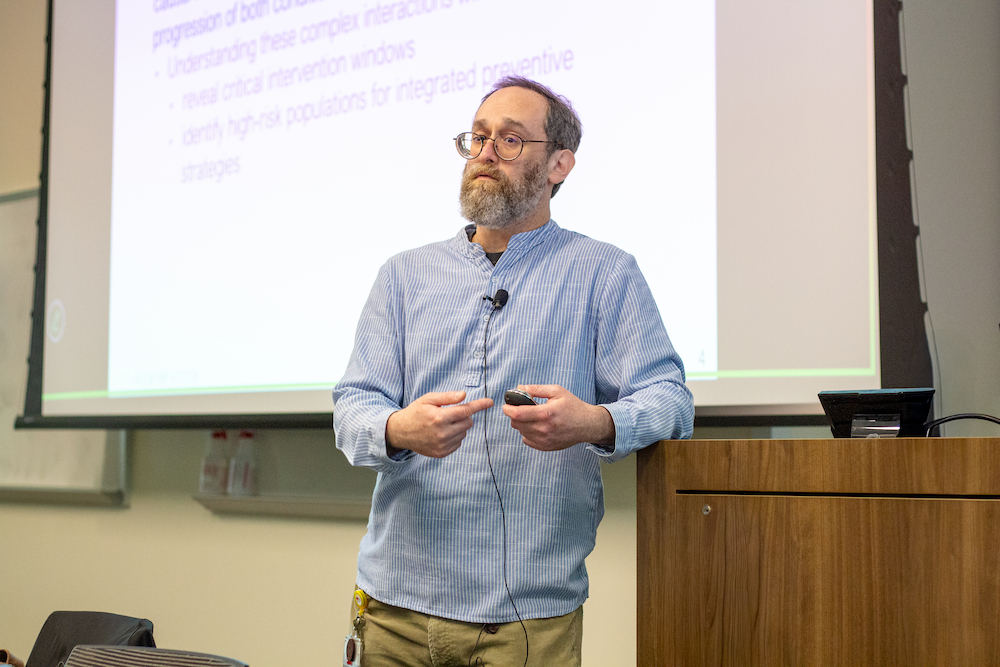
For the inaugural seminar, Daniel Jupiter, PhD (Neurology) presented a developing proposal focused on the co-occurrence of type 2 diabetes, lower-extremity amputation, and dementia. The work is being developed with Neil Mehta, PhD, Chair of Epidemiology and Director of H-COR, and aims to better understand how these high-burden conditions may cluster or unfold over time.
Dr. Jupiter offered a high-level look at the project’s direction, including population-level patterns, patient trajectories, and geographic variation. He also described how the team is exploring the use of large-scale, existing data sources, including electronic health record-derived datasets and claims-based resources, to study these relationships using real-world evidence.
Where the seminar shines: discussion that improves the work
The most valuable portion of the session came during discussion, when participants surfaced questions and suggestions that helped sharpen the project’s focus and feasibility.
Several attendees raised practical points about matching the right dataset to the right aim, especially for county-level and geographic analyses. This included a suggestion to prioritize Medicare claims data to support stronger geographic coverage and continuity of care. Others encouraged the team to consider additional clinical markers beyond HbA1c, such as kidney function and lipid measures, with an eye toward more informative risk prediction and more actionable insights.
Participants also emphasized careful framing around causality. They noted the importance of distinguishing whether amputation might contribute to downstream outcomes or whether it primarily signals underlying disease severity. Additional comments highlighted common real-world challenges in observational research, including the timing of dementia recognition in clinical records, differences between Medicare Advantage and fee-for-service populations, and the need to consider changing treatment eras, including shifts during COVID and the growing use of GLP-1 medications.
That exchange is exactly what the Works-in-Progress format is meant to foster. These sessions create a supportive environment where strong ideas become stronger through the collective expertise of the UTMB community.
The H-COR Works-in-Progress Seminar Series is held monthly and open to researchers across UTMB. For more information, visit the H-COR website.