
Arlene Ruiz knows all too well the devastation that Duchenne muscular dystrophy can wreak. She lost a brother to the insidious, debilitating condition that causes progressive muscle damage and weakness.
She saw him deteriorate, saw his posture change, his body betray him. She saw his pain as his muscles—his arms, his legs, eventually his heart—slowly broke down, weakened. His frustration as things that should come naturally—that had always come naturally—became an increasingly challenging battle that he was destined to lose. Running. Walking. Sitting up. Breathing.
She knows that Duchenne muscular dystrophy is rare. That it is genetic. And that those who have it typically don’t survive past their 30s.
Genetic.
The word clung to Arlene and her husband, Jose E. Ruiz, like an albatross. What if the death sentence had been passed down to their son, Jose, a happy, active boy whose mood and mobility seemed to be decreasing daily?
The couple’s worst fear materialized in 2023, when Jose was indeed diagnosed with Duchenne muscular dystrophy at age 11. Suddenly, “what if?” turned into “what now?”
That “what now” led the Ruiz family to The University of Texas Medical Branch.
Dr. Joseph Ray, division chief of Medical Genetics and Metabolism at UTMB, and Dr. Erin Cooney, associate professor of Medical Genetics and Metabolism, started on what would turn out to be a 16-month journey to treat Jose with a single, three-hour infusion of a groundbreaking therapy that could save his life.
The journey was arduous because it required months of supervision, monitoring, adjusting, and otherwise preparing Jose for the treatment. It was also important for insurance to agree to reimburse the hospital for the cost.
That cost? $3.2 million for a one-time infusion of Elevidys, a drug developed by Sarepta Therapeutics.
Saving lives can be expensive—drugs like these require massive investment in research and development as well as complex manufacturing processes and precise coordination among clinicians, pharmacists, insurers, administrators, and regulatory bodies.
But Ray and his team pushed through. They were ready. And as Arlene watched her son slowly head toward the painful path that her brother was forced to follow to his death… so was she.
Betrayed by their own DNA
Duchenne muscular dystrophy is caused by a genetic mutation that prevents the body from producing a protein called dystrophin.
Dystrophin acts like a shock absorber when muscles contract. Without it, muscles become progressively damaged and weakened. They also lose the ability to repair themselves after an injury.
The disease primarily affects males, with 1 in 3,500 to 5,000 boys born with it worldwide. In rare cases, it can also affect females.
“Over time the patient accumulates scar tissue in his muscles that translates into overall weakness,” Ray says. “The way we traditionally treat these patients is with steroids, which essentially help reduce the body’s inflammatory response so you don’t replace your muscle tissue with scar tissue this quickly.”
Patients with Duchenne muscular dystrophy have shortened lifespans. They usually lose the ability to walk by the time they’re teenagers. The debilitating process continues until it affects their arms and eventually their heart muscles and the muscles involved in breathing. Patients usually require ventilators by the time they reach their 20s and then die in their 30s.
The treatment halts that process by giving patients a functioning copy of the genetic material that isn’t working in their body, thereby restoring stability to their muscles.
Gene therapy works by using a harmless, modified virus called an adeno-associated virus as a delivery system. A biomedical FedEx of sorts. Scientists remove the virus’ own genetic material and replace it with healthy copies of the missing gene—in the case of Duchenne muscular dystrophy, a shortened but functional version of the dystrophin gene.
"We’re not attacking the cell,” Cooney explains. “We are trying to provide the cell with a package of genetic information that it lacks.”
At about 2.4 million DNA letters long, the full dystrophin gene is one of the largest genes in the human body. However, the adeno-associated virus used to deliver gene therapy can only carry about 4,700 DNA letters. So, trying to squeeze the complete gene into an adeno-associated virus is like trying to ship a grand piano in a bicycle basket. Physics just says no, which is why a shortened version is used.
After infusion, the virus docks onto the cell and injects the DNA. Because the DNA is human, the cell doesn’t recognize it as being foreign and simply starts making the protein as if it was there all along.
“This technology is essentially stuff that you already have inside your body,” Ray says. “And having the technology to be able to direct it, to repair your own genetic material is going to change the face of a lot of things.”
Two hours toward a longer life

Infusion day for Jose started at the pharmacy in the League City Hospital Campus, where the pharmacy team prepared the precious cargo for transit over to the UTMB Health Bay Colony Pediatrics Specialty Center just a few minutes away. The excitement in the air was palpable, as if a celebrity was about to enter the room. And in a way, that was the case, although this particular celebrity—Elevidys—was far more important than Taylor Swift or the cast of “Wicked.”
After about an hour of prep time, the medication was packed in a cooler. A UTMB Police officer carried it gingerly to his patrol car, made a U-turn from I-45 North onto the southbound lanes and pulled up outside of the clinic.
There it was met with applause and cheers by Jose, his family and friends, and members of his care team who had gathered on the clinic’s second-floor balcony. The officer handed the cooler off to Ray and Senior Pharmacy Manager Gaurav Goyal. Followed by a procession of family, friends, and well-wishers, they took it with much fanfare to the second floor of the clinic, which was buzzing with excitement.
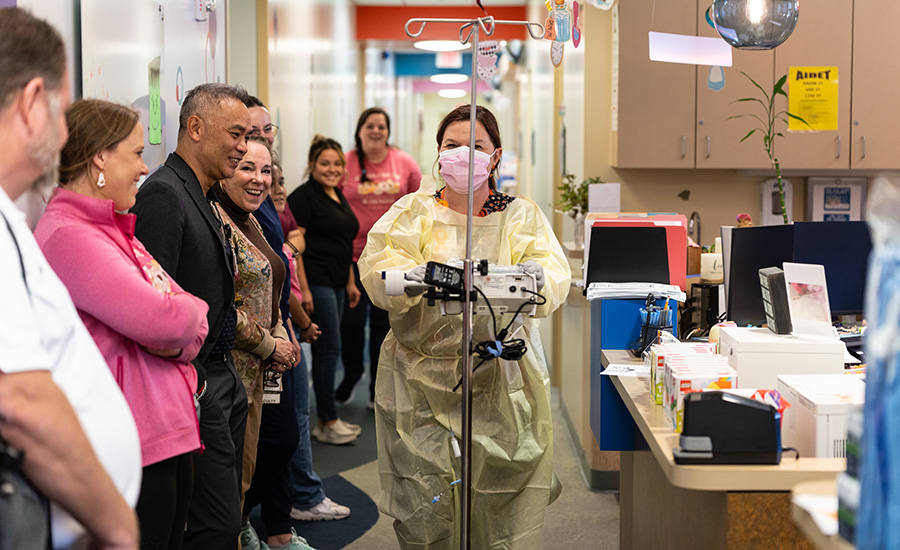
“Welcome to Wonderland” read a sign near the nurses’ station—and it couldn’t have been more appropriate.
Walking with his parents to the infusion room, Jose broke into a wide grin when he was met with cheers and applause from UTMB staff. Mom and Dad also smiled, but their smiles were less broad, slightly subdued, with concern for the outcome, for Jose’s future, showing around their eyes. Cautious optimism.
As Jose and his parents situated themselves in the room where the infusion would take place, clinic staff milled about watching nurse Julie Hanson prepare the medication, then lined the hallway, applauding—many of them barely holding back tears—as she walked it to the infusion room.
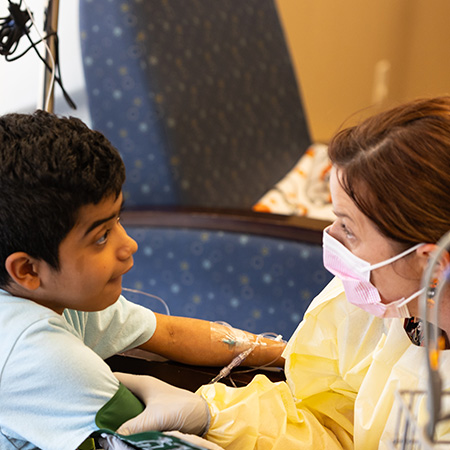
Cool as a cucumber, Jose sat and watched “Jurassic Park” as millions of dollars worth of medication was being pumped into his veins. Ray assured him that by the time he was done watching that and one other movie, it would all be over.
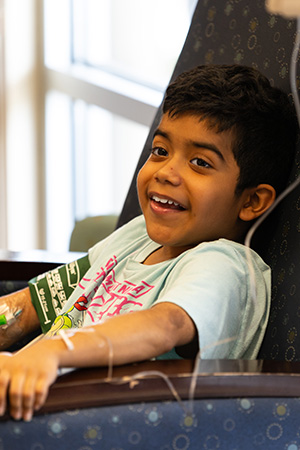
Despite the excitement around him, Jose was taking the whole thing in stride. He settled in and stretched out his thin arm for the needle to be inserted. Mom and Dad watched quietly from their seats across from their son, who answered the question, “Are you nervous?” with a smile and a confident, “No.”
From managing loss to changing the game
While Jose’s treatment was the first, it wouldn’t be the last time the infusion room in the pediatrics specialty center would light up with such joy and with the unabashed hope that young lives were being saved and medical history was being made.
Since October 2024, dozens of patients have received life-saving genetic intervention at UTMB. In addition to Elevidys, the team has used Zolgensma and Itvisma to treat spinal muscular atrophy and is currently recruiting hemophilia A patients for treatment with a medication called Roctavian. UTMB also became the fourth site in the United States to offer Zevaskyn for people born with the serious skin condition epidermolysis bullosa.
"We really anticipate having at least 30 available gene therapies by 2030 and probably hundreds in the coming decades,” Cooney says.
The UTMB team continues to advocate for more measures to detect these devastating conditions as early as possible. Among them: having more diseases added to the screening for newborns because the best prognoses come from early detection and treatment.
Spinal muscular atrophy was added to the Texas newborn screen in the summer of 2021. The law to add Duchenne muscular dystrophy to the Texas newborn screen was passed in May 2025, but it will probably be 2030 before it’s officially added as it takes years to implement universal screening programs.
Three recent Duchenne muscular dystrophy patients—brothers ages 8, 18, and 21—are a moving testimony to the importance of early detection.
“We treated the little brother, who is 8 years old and relatively asymptomatic, and he’s doing markedly better than the 18-year-old, who we just treated,” Ray says. “And then the 21-year-old didn’t qualify because he had antibodies against the drug. So, you have three different spectrums of the disease and experience of the drug in one family.”
If all the boys’ conditions had been picked up on the newborn screen, he says, “all of their experiences would have been very similar to the youngest boy, who is doing the best out of the three of them.”
Breaking a genetic curse
As devastating as Jose’s diagnosis was, Arlene Ruiz says she wasn’t surprised. Looking back, she recalled, he started walking later than expected. And when he did walk, it was on his toes rather than on his whole foot. As he grew, she watched her “cheerful, playful” boy retreat more into himself and become increasingly less able to do “normal, everyday stuff,” like walking, running, and playing. She knew what muscular dystrophy looked like.
Jose’s parents have had to make hard decisions about his care and his exposure to treatment while interacting with an array of strangers, from specialists to nurses to case managers, and tending to their son’s fear of needles.
However, those were decisions they’re happy to have had the opportunity to make. When one of Arlene’s brothers died from Duchenne muscular dystrophy at age 20 in 2005 and another from Becker muscular dystrophy at age 24 in 2011, things were different. There were no decisions like this to make. There were no treatments. There was no hope.
"When Dr. Ray called me back into the office, he was already like, ‘OK, so I do have bad news, but I do also have some good news,’” Arlene says of the day she got Jose’s diagnosis. “And he gave us options. He gave us hope.”
Among those options were weekly injections of Exondys 51, which helps patients produce a shortened but functional dystrophin protein to slow muscle degeneration.
It was an option that neither of Jose’s parents liked, especially given Jose’s fear of needles.
“My husband was more concerned,” she says. “He was like, ‘I don’t want my poor boy getting poked every week.’”
Elevidys was the other option.
“I thought we could either go down the hard path, like my brothers, or take this opportunity that might help him have a more comfortable, kind of normal life than what they had,” she says. “My mother instinct kicked in and told me, ‘Go for it; this is gonna be something good for him.’”
When molehills feel like mountains
To say Ray and Cooney are passionate about these genetic-specific treatments would be a gross understatement. They’ve been championing UTMB’s leadership in the field since joining UTMB in 2014 and 2018, respectively.
“I explained to my chair, Dr. [Joan] Richardson that this is coming down the line in the next 10 years and I wanted to be sure we were the first to offer it,” Ray says.
His expectation, at first, was that these therapies would successfully halt the disease progression where it was at the time the treatments started. But even he has been surprised to see exactly how efficient they’ve been in reversing some of the effects of the disease and offering even more hope to patients and their families.
“I’ve been pleasantly surprised to see some of these patients have some improvement, which was not an expectation that I had set for them,” he says. “It’s as much a surprise for me as it is for them—to the point that I’ve started talking to the parents and explaining that we’ve seen some improvements.
We’re not talking mountains, but we’ve seen some pretty significant improvements.
“I mean, it would be a pretty big deal for a kid who lost the ability to walk and now can at least walk around the house,” he says.
Changing the conversation
“Before gene therapy for spinal muscular atrophy, a diagnosis was devastating and final,” Cooney says. “You would have to tell parents, ‘I’m so sorry. Take your baby home and love them … they will probably die before they turn 2 years old.’”
Cooney says she wouldn’t go so far as saying gene therapy is a ‘cure,’ but the ability to at least halt disease in its tracks has “changed everything.”
“We have kids we’re treating who are going to walk and run and go to kindergarten and have the opportunity to get married and have kids of their own, whereas before these were a death sentence,” Cooney says. “What greater story can you have?”
All signs point to the advancement of this type of precision medicine, where treatment is designed completely based on a patient’s genetic workup, to progress quickly. UTMB is poised to be at the forefront as it does.
Cooney describes the UTMB gene therapy vision as urgently practical and fundamentally future- facing, rooted in precision medicine and translational science rather than siloed specialty care.
Instead of individual practitioners and their departments assessing potential candidates, UTMB funnels every case through the genetics department, avoiding having to reinvent the wheel every time a potential candidate is identified.
Every Friday at lunch time, a team comprised of doctors, nurses, leaders from pharmacy, managed care, and the finance department convenes. About 50 people in all. And they have a list.
Looking down the list, they discuss every patient who is a potential candidate for gene therapy. Options are brought forward; plans are made. The leaders from across the health system are there to make sure not even one of those patients misses his or her opportunity to get a lifesaving drug.
“And that is what sets UTMB apart,” Cooney says. “I’ve not heard of any other system doing it the way we’re doing it, where it’s coming through a single pipeline.”
That pipeline model results in speed and confidence, allowing UTMB to be an early adopter of new therapies as they emerge.
Plans to greatly expand the hospital’s involvement in gene therapy are underway with an aspirational goal of creating an interventional genetics center at UTMB that will bring all aspects of gene therapy under one roof and allow the health system to lead the way in precision medicine.
The UTMB vision extends beyond its immediate geography as well. Cooney notes that some states, like Louisiana, still have no gene therapy providers at all—UTMB is ready to fill the gap.
At the same time, the hospital is working to identify patients who may not yet know these therapies exist.
“Equity and access are central concerns,” Cooney says. “Making sure that we’re equitable, making sure we’re reaching everybody, is going to be really important.”
The almost unimaginable power to modify a person’s genetic code, even in utero, raises a multitude of questions, of course, like the jump from cutting diseases off at the pass to engineering a baby’s gender, eye color, or hair color. Ethics also will come into play, but Cooney makes it clear UTMB will never be in the business of creating “designer babies.”
“Our focus is strictly on human disease,” she says.
UTMB is ready to not only take up the gauntlet but to lead the charge.
“There’s lots to come as far as precision medicine,” Ray says. “And it’ll happen in our lifetime. Within the next 10 to 20 years, we’ll be having a very different conversation.”
What success looks like
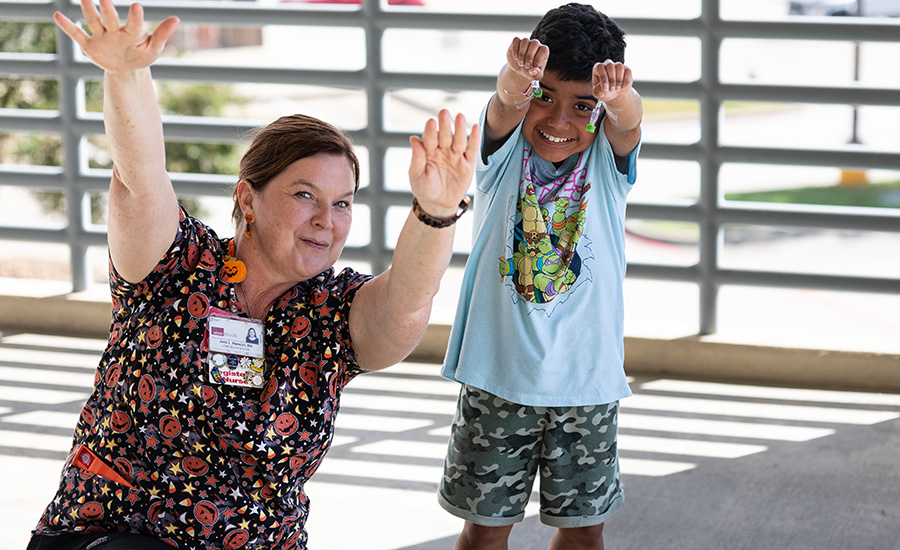
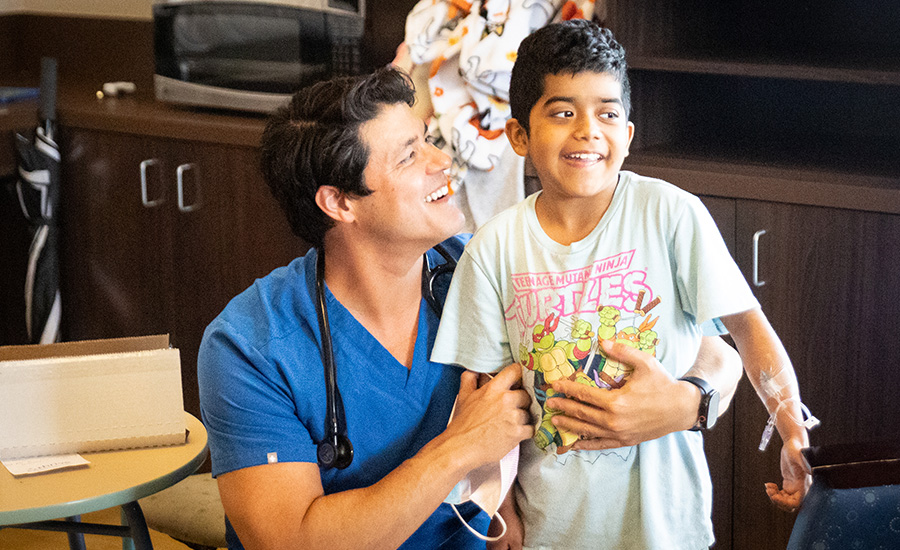
The day of Jose’s infusion ended with even more fanfare and excitement than with which it began, with nurses, family members, friends, and other visitors enthusiastically leading a “clap-out” to celebrate completion of the infusion and send Jose off with an emotional wave of smiles, tears, and well wishes.
“Today, we got to make a wish come true for a boy that wants to run and play, who loves animals, and wants to grow up to be a zoologist,” Ray says. “Today we got to celebrate a time in history and science where saving the life of a person with this rare disease is no longer a wish—it’s a dream come true.”
Jose’s reaction to the end-of-infusion celebration? Smiles, of course, but he really had only one thing on his mind.
“OK, now I’m hungry,” he told his parents.
With that, the family went out and celebrated with Jose’s choice—seafood.
About a week after the infusion, Jose was dealing with mild nausea and a low-grade fever, which was handled with anti-nausea medication and Tylenol. Other than that, Mom reported, he was playing and in good spirits and was back in school a few days later.
Success will be an ongoing process.
“At the very least we should see his muscle breakdown halt,” Ray explains. “Best-case scenario, we should actually see some improvement in his ability to do things like run, jump, squat.”
Three months later, life looks a lot like that best-case scenario for Jose, and his renewed physical confidence is opening the door to new interests.
And that’s all great news … even if it did come with an unanticipated side effect.
As part of the infusion, Ray increased the amount of steroids Jose was taking to reduce inflammation, protect his liver, and help his body adjust to the transition. The steroids helped increase his appetite, and he put on some weight in the time between the infusion and when Ray next saw him again.
“His face was really full,” Ray says with a sweet laugh. “He went from being a really skinny kid to putting on maybe 20 pounds, and I said, ‘Oh my God, I did that to you!’”
The steroids revved up Jose’s appetite, which was a good thing, a positive sign, since he had all but lost it as the disease took its toll. So now, as the steroid use is tapering off, he’s relearning how to eat more healthily.
But it’s a trade-off—a few extra pounds in exchange for a more normal life and a happier long-term prognosis—that Arlene Ruiz is happy to make.
“He doesn’t get as fatigued like he used to,” Ruiz says. “He’s up, up and running all day long, and now he’s actually enjoying playing soccer. Since he’s in seventh grade, it’s like I’m seeing the more teenager side coming out slowly.”
Thanks to this genetic treatment, rather than a short life full of pain, Jose and his parents can look forward to something better.
Now, they can ask, “what’s next?”