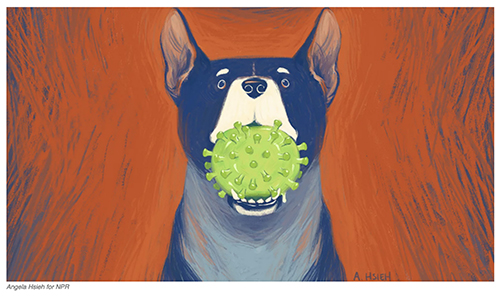
Canids have long been associated with zoonotic diseases, dating back to ancient reports of rabies. This is often the first link we make when thinking about viruses in canids. But what about other viral diseases—are wild canids also susceptible, and could they transmit these viruses to other animals or even humans? And how can we investigate this without risking our lives trying to capture them?

During the COVID-19 pandemic, numerous reports have documented SARS-CoV-2 infections in 42 animal species including a number of canids [1]. Similarly, H5N1 avian influenza has spilled over from birds to infect many mammals. However, the dynamics of virus transmission in these animals remain poorly understood [2]. A recent One Health study (Marushchak LM et al) by UTMB’s Lyudmyla V. “Myla” Marushchak, PhD and colleagues examined the presence of respiratory viruses—including Influenza A and D, as well as coronaviruses—in wild canids [3]. Rather than attempting live captures of feral carnivores, the researchers collected oral and rectal swabs from roadkill and euthanized animals near El Paso, Texas. Their pilot study included ten coyotes, four gray foxes, and one feral dog.
While it’s tragic to see so many animals struck by vehicles, this surveillance method provides an ethical and practical way to conduct wildlife disease surveillance. Viral genetic material was detected in two rectal swabs—one from a gray fox and another from the feral dog. Comparative analysis revealed that the coronaviruses detected were like strains previously identified in human samples. Attempts to culture the viruses in the lab, however, were unsuccessful.
.png?sfvrsn=5822bd55_1 "One Health Graphic Illustrated by Claudia M. Trujillo-Vargas, M.Sc., Ph.D. using BioRender.com")
This raises several questions: What is the importance of testing species we rarely encounter? Does the absence of viable viruses mean there was no active infection? And why was genetic material found if the viruses couldn’t be grown?
To answer these, we must consider the nature of both viruses and their hosts. Wild mammals are constantly on the move and often share environments with humans—like the coyotes of Galveston Island, which roam beaches frequented by people. This invisible overlap highlights the value of surveillance, even in animals we don’t regularly encounter.
Viruses also degrade quickly, especially in dead tissue exposed to environmental conditions. Using carcasses is resourceful, but not ideal. What often remains is the genetic material, which, while fragile, can persist long enough to be detected. This may explain why researchers found genetic evidence of viruses but couldn’t grow them in culture.
Ultimately, more studies using live animals are needed to confirm these findings. Fortunately, specialized traps and anesthetics make such sampling possible—no need to chase wild canids in the wilderness.
References
- Complexity Science Hub Vienna. SARS-ANI VIS. [Internet]. Vienna: Complexity Science Hub Vienna; [cited 2025 Aug 22]. Available from: https://vis.csh.ac.at/sars-ani/
- Porter SM, Hartwig AE, Bielefeldt-Ohmann H, Bosco-Lauth AM, Root JJ. Susceptibility of Wild Canids to SARS-CoV-2. Emerg Infect Dis. 2022 Sep;28(9):1852-1855. doi: 10.3201/eid2809.220223. Epub 2022 Jul 13. PMID: 35830965; PMCID: PMC9423904.
- Marushchak LV, Pulscher LA, Oguzie JU, Silva DB, Waldrup KA, Watts DM, Gray GC. Monitoring for respiratory viruses among wild canids, Texas. One Health. 2025 Jan 13;20:100974. doi: 10.1016/j.onehlt.2025.100974. PMID: 39898311; PMCID: PMC11787532.