 Over the past 2 years, Pepper has unintentionally helped Dr. Lednicky and his team at the University of Florida College of Public Health and other Health Professionals discover two previously unknown viruses. The first, a jeilongvirus, which was found in a common cotton mouse that Pepper brought home, marking the first detection of this virus within the United States [1,2]. More recently, Pepper delivered a short-tailed shrew to his owner, leading to the identification of a novel strain of an orthoreovirus [3,4]. These discoveries underscore the surprising ways domestic animals can act as sentinels for wildlife pathogens.
Jeilongviruses and orthoreoviruses are known to infect multiple mammalian species, and in some cases, they have been linked to human illnesses such as respiratory or gastrointestinal disease [2,3]. Laboratory studies show that these newly discovered strains can replicate in rodent, primates, and even human cells, suggesting a potential capacity to cross species [2,3]. While Pepper remains healthy, and no human infections have been reported from these strains, the findings highlight the importance of understanding how viruses circulate silently in local ecosystems.
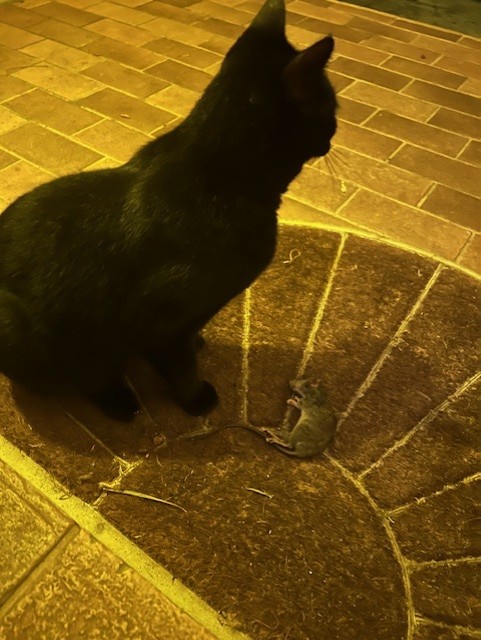 Pepper’s discoveries illustrate the One Health prospective perfectly: a domestic cat, interacting with wildlife in its neighborhood that inadvertently revealed pathogens that might have gone undetected in traditional surveillance programs [1,4]. This highlights the value of integrating veterinary, ecological, and public health perspectives to monitor, detect, and respond to emerging infectious diseases.
This case also raises practical considerations. Pets that hunt wildlife can be exposed to, or even bring home pathogens, and handling these dead animals carries risks for both humans and pets. While Dr. Lednicky, an experienced scientist, is trained and equipped to carefully and safely handle dead wildlife specimens, not all pet owners are aware of the potential hazards or proper precautions.
These discoveries suggest opportunities for broader surveillance, using domestic animals and community engagement as part of an early warning system for novel viruses. Pepper’s story is a reminder that scientific discoveries don’t always come from distant field sites. Sometimes, they arrive on 4 paws, carrying a rodent from the backyard. Through the combined curiosity of a cat and the vigilance of a dedicated researcher, we gain a window into the unseen viral world around us.
As humans continue to alter environments and interact with wildlife, stories like Pepper’s highlight the need for vigilance, collaboration, and creativity in monitoring emerging infectious diseases. As for Pepper, he may simply be doing what comes naturally but his instinctual hunting has provided the scientific community with insights that could help prevent the next outbreak of disease.
References
- Alligator. (2025, July). Pepper’s paws and pathogens: How one cat pioneers viral discovery. The Alligator. https://www.alligator.org/article/2025/07/pepper-s-paws-and-pathogens-how-one-cat-pioneers-viral-discovery
- DeRuyter, E., Subramaniam, K., Wisely, S. M., Morris, J. G. Jr., & Lednicky, J. A. (2024). A novel jeilongvirus from Florida, USA, has a broad host cell tropism including human and non-human primate cells. Pathogens, 13(10), 831. https://doi.org/10.3390/pathogens13100831
- DeRuyter, E., Williams, R. A., Subramaniam, K., & Lednicky, J. A. (2025). Coding complete sequences of the 10 genomic segments of a mammalian orthoreovirus type 3 isolated from a Blarina peninsulae shrew. Microbiology Resource Announcements, 14(7), e0021925. https://doi.org/10.1128/mra.00219-25
- UF News. (2025, July 10). Scientist’s cat, again, helps discover new virus. https://news.ufl.edu/2025/07/cat-discovers-new-virus/