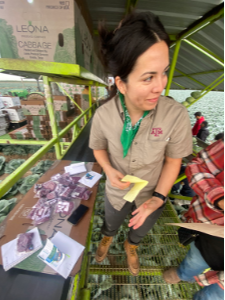
As a daughter of migrant farmworkers, Dr. Anabel Rodriguez feels “right at home” researching occupational health exposures among agricultural workers. As a field occupational epidemiologist and assistant professor at Texas A&M University, she is currently analyzing tuberculosis awareness, prevention, risk, and knowledge among Spanish-speaking dairy farmers in the Texas panhandle.
Dr. Rodriguez was formally introduced to the field of occupational epidemiology through her Master’s in Public Health program at UT Health Houston Southwest Center for Occupational and Environmental Health. Occupational epidemiology fieldwork commonly incorporates principles of One Health by connecting worker health and safety with animal safety. Her previous studies revealed that dairy workers had low knowledge and awareness of tuberculosis (TB), so she began working with her team using mobile technologies to increase education about influenza, COVID-19 and tuberculosis within this working population.
.png?sfvrsn=28776454_1 "Mobile on-farm vaccine clinics for farmworkers in South Texas")
Agricultural worker health is uniquely difficult to study for a variety of reasons. Not only is there exposure to pathogens, but it is also harder to track and collect data on migrant workers – especially in cohort-based studies. Instead, Dr. Rodriguez uses cross-sectional studies with a mixed method approach that incorporates exposure surveys with specimen collection to test for disease pathogens. Follow-up regarding the findings are typically done through phone calls to encourage an open line of communication and inquiry between the study participants and the researchers as well as navigation of healthcare systems in rural regions.
Gaining worker buy-ins is critical during fieldwork. Dr. Rodriguez values investing in producer relationships because having them as active collaborators in public health research allows for knowledge to be disseminated down to the individual worker levels. Her team also relies on community health workers to balance the tension between caring for health at both the individual and structural levels, a common seesaw in the field of public health. Her work finds that social determinants of health significantly hinder the health of agricultural workers due to the ubiquitous lack of health insurance, transportation, and affordability of care. Workers have also asked Dr. Rodriguez, “Why do I have to go to the doctor if I feel good?” indicating a lack of perceived benefits towards preventative healthcare.
When asked what lessons Dr. Rodriguez has learned about One Health in relationship to her work, she highlighted the importance of multidisciplinary collaboration. Working with local animal health authorities links the animal health component with the worker health component that provides insight into the bilateral flow of disease and nutrition.
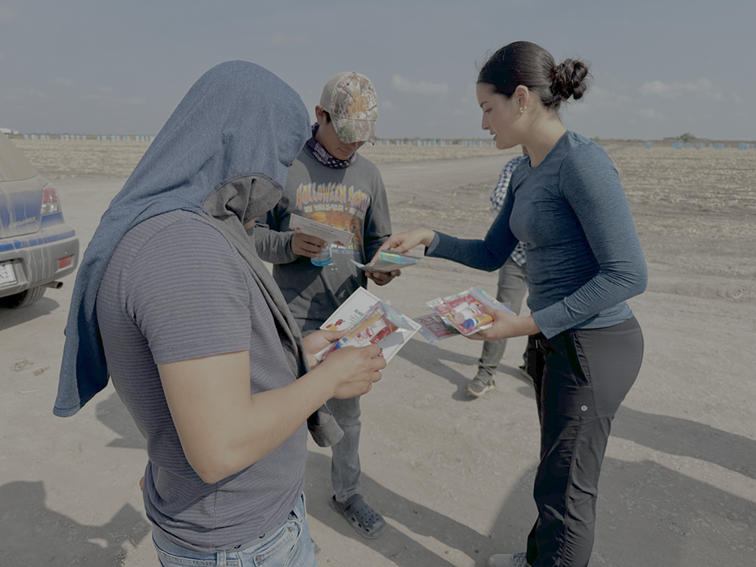
Not all stakeholders have equal power in the field of occupational health, and agricultural workers are among the most vulnerable populations. Nevertheless, Dr. Rodriguez strives to include worker’s perspectives into her academic research work. She notes that “As researchers, we have the responsibility to present the work that we produce as best as possible. In the discussion of some of these papers, I do sometimes take the liberty to add anecdotal [field] observations as learning points. Because, at the end of the day, that is what the discussion is for, to disclose gaps and what still needs to be done” Additionally, professional practice reports also provide a platform to share research findings in a manner different from peer reviewed publications, highlighting some of the more personal stories of the agricultural workers and their challenges and perspectives on zoonotic diseases.
Ultimately, Dr. Rodriguez reflects on the interconnected nature of occupational and One Health, “If cows are happy, producers are happy. And if producers are happy, then workers are happy. If workers are happy, then cows are happy. It’s a feedback loop.” Currently, Dr. Rodriguez’s team intends to increase the number of zoonotic diseases they plan to study among dairy farm workers in Texas. Her goal is to mobilize units of research, outreach, and training to improve worker health and allow public health researchers to keep innovating without compromising the knowledge given back to agricultural workers.