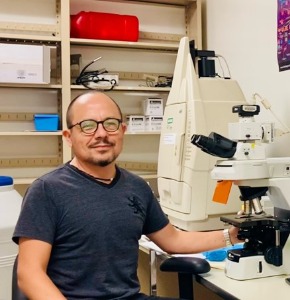
In places where electricity flickers, clean water is scarce, and medical labs are hours away, diagnosing intestinal infections can feel like chasing shadows. But for Dr. Alejandro Castellanos, an Associate Professor at the Division of Infectious Diseases, the Internal Medicine department at UTMB, those challenges are precisely the point and exactly where innovation matters most. For Dr. Castellanos, the motivation for his work is simple: accurate diagnosis shouldn’t depend on where you live. His research focuses on developing novel molecular tools that can identify pathogens in remote areas.
Part of what makes intestinal infections so difficult to manage is that many pathogens have similar symptoms. Without accurate diagnostics, communities can often face delayed treatment, and recurrent infections or outbreaks can go unnoticed. Many of these outbreaks occur in developing countries where a reliable supply of clean water is lacking. Many intestinal pathogens spread through the fecal-oral route, in which an individual consumes contaminated water or food, and animals can sometimes act as vectors or intermediate hosts. Dr. Castellanos and his collaborators strive to create tools that can detect a wide range of pathogens without electricity, temperature control, or specialized equipment. Dr. Castellanos explained, “Multiple pathogens can cause the same illness, and the treatment for each pathogen might be different, so the doctor would need to wait 2 or 3 days to receive the test result if they send the test off to a lab. It would be very useful if they had a tool in their hands at that very moment that could diagnose the patient”. Dr. Castellanos found out during a recent update with a collaborator that they had provided treatment to 300 children in rural Peru because of their project. “Wow, just because of an idea we had, 300 children got treatment, and most will fully recover, so that makes me feel really good”, Dr. Castellanos reflected.

When asked about his inspiration for pursuing this kind of work, Dr. Castellanos explained that, early in his research in molecular biology, he had always wanted to work in a lab and perform new experiments using fancy equipment. However, his whole mindset changed after he started his master’s degree in Spain. A lot of the researchers he encountered were working in the field in Africa and South America. After traveling and seeing the problems he was trying to solve in the lab firsthand, he gained an entirely new perspective. Dr. Castellanos explained, “Say you want to solve something, you need to go to the place and see it with your own eyes. Even if the science is correct, it will not be useful if they don’t have the same resources you have in the lab”. Dr. Castellanos further explained the importance of transparency and respect for the communities you are trying to help. He emphasized, “You cannot go into a community and tell them, okay, you should do this or do that. Finding common ground, like a game of soccer, is important for building trust. If they understand what you really want to do, it’s easier”.
Research like Dr. Castellanos’ is an excellent example of the One Health framework because intestinal infections reflect the tight link between human health, environmental conditions, and animal populations. By creating diagnostic tools that can be reliably used in any setting, from rural clinics to field sites, his work strengthens the ability to detect these pathogens early and accurately. By making diagnostics easily accessible, his work improves the ability to track infections, prevent their spread, and bring together human, animal, and environmental health efforts, which is exactly what One Health is all about.