
About Texas Age-Tech
The Texas Age-Tech initiative is a collaborative research program at The University of Texas Medical Branch (UTMB Health).
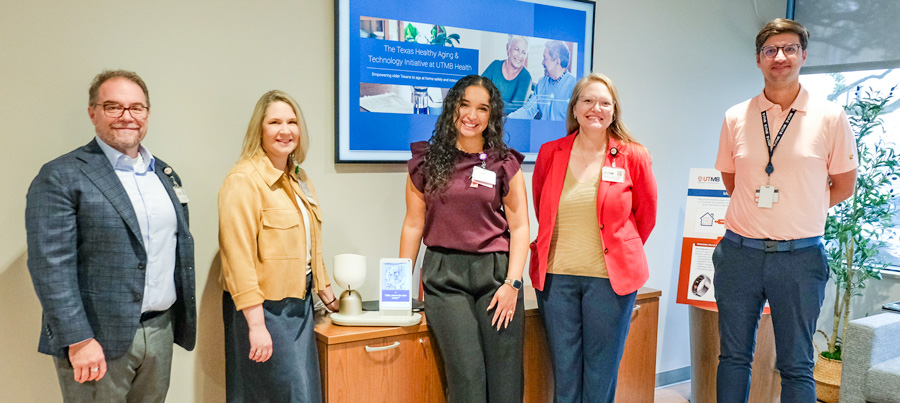
Welcome to Age-Tech, an initiative dedicated to empowering older Texans to age safely and independently in their homes. This collaborative research program is supported by a two-year, $5 million grant from the State of Texas. It aligns with UTMB President Dr. Jochen Reiser's vision for a "Healthy Aging and Technology Initiative within our institution, and the broader establishment of the research institute, to fund competitive and thoughtful grants, for the betterment of all Texans."
Our primary goal is to develop and implement intelligent, cost-effective home-based technologies, including Artificial Intelligence (AI) and robotics, to support older adults and their caregivers in "aging in place."
Contact Us
Texas Age-Tech at UTMB Health
Sealy Center on Aging (SCOA)
301 University Blvd.
Galveston, TX 77555-0177
Directions and Maps
Phone: (409) 747-0008
Email: aging.research@utmb.edu
News & Updates
- October 2026: SCOA Showcases Age Tech Innovation at Houston Day
- September 2026: Community Discussion on Technology and Healthy Aging planned for Oct 28
- August 2026: UTMB Opens Instrumented Home to Advance Healthy Aging Through Real-World Technology Testing
- May 2026: Age Tech Ideation Jam Sparks New Directions for Technology-Driven Aging Research
- September 2025: Texas Age-Tech is Launched; UTMB Pepper Center Funded through 2030
- July 2025: SCOA Welcomes New Director Dr. Missy Morrow
- June 2025: Texas Legislature Prioritizes Funding for Healthy Aging and Technology
The Challenge: Supporting Aging in Place
.png?sfvrsn=b7418a55_0)
Most older adults wish to remain in their homes as they age, but several factors can hinder this independence:
- Mental Health and Cognition: Conditions like dementia, depression, traumatic brain injury (TBI), and post-stroke effects can pose significant challenges.
- Mobility and Physical Function: Difficulties with Activities of Daily Living (ADLs), falls, fractures, and vision problems can limit independence.
- Social Connection: Loneliness, distress, living alone, and communication challenges with caregivers can impact well-being and the ability to age in place.
- Multimorbidity: Managing multiple health conditions, medications, and geriatric syndromes (e.g., frailty, incontinence) often complicates independent living.
- Acute and Chronic Medical Illness: Hospitalizations and short-term rehabilitation periods represent vulnerable times that make staying at home more challenging.

While advanced technology could address many of these needs, existing solutions are often underutilized, and there's a clear demand for new innovations to manage care at home. A unified, strategic approach is essential to integrate these technologies effectively.
.jpg?sfvrsn=dbe6db55_0)




.jpg?sfvrsn=3a438955_0)