SCOA banners

The Community Connection at the Sealy Center on AgingStay Connected. Stay Engaged. Stay Inspired.

Welcome

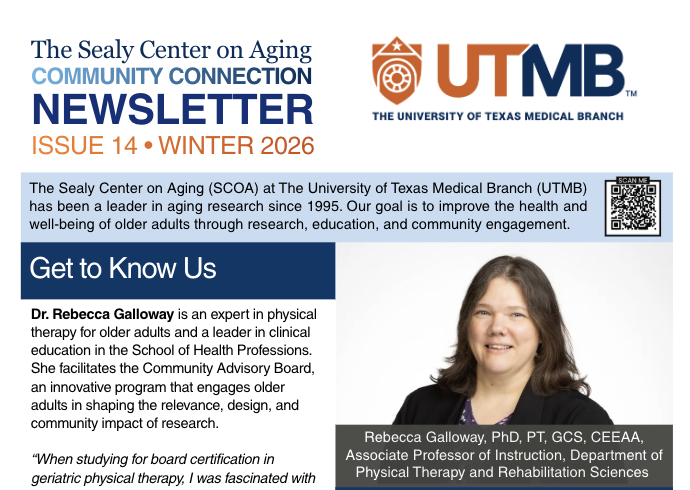
At the Sealy Center on Aging, we believe that growing older should mean growing stronger, through knowledge, community, and meaningful opportunities. That’s why we created the Community Connection, a program designed to keep older adults in Galveston County informed, engaged, and empowered.

Launched in 2022, the Community Connection has more than 1,300 subscribers who receive our quarterly newsletter by email or traditional mail. Each issue is filled with valuable updates, including:

  • Spotlights on groundbreaking aging research at UTMB Health
  • Invitations to participate in clinical studies that can improve health and wellbeing for older adults everywhere
  • Local events and programs tailored to seniors in our community
  • Volunteer opportunities, such as AmeriCorps Seniors, where you can give back and stay active

Why Join?

The Community Connection is more than a newsletter! It’s a way to stay plugged into the latest discoveries, connect with people who share your interests, and find new ways to stay involved in your local community.

We're Growing, Together!

Thanks to strong community partnerships and outreach, the Community Connection is expanding every day. Whether you hear about us through a senior center, social media, or a postcard at an event, the invitation is the same: be part of a growing network of older adults shaping the future of aging in Galveston County.

  • Sign up for the Community Connection newsletter and become part of a vibrant community of older adults making a difference.
  • Follow and engage with us on Facebook, where we share news and resources as well as event announcements that are relevant to local older adults.
  • Learn more about getting involved with AmeriCorps Seniors.
  • Visit the Learning Center, now located at the Osher Long Life Institute at UTMB Health

Newsletter Archive

Current Studies

News from the Sealy Center on Aging

Daily low-dose aspirin has little impact on stroke risk and spikes risk of brain bleeding from falls

Jan 29, 2024, 16:45 PM by SCOA

UTMB was a participating clinical location in a national study that helped researchers learn that low-dose daily aspirin does not provide significant protection against stroke resulting from blood clots and may increase the risk of bleeding in the brain or skull after head trauma. The findings, published in JAMA Network Open, provide new evidence countering past conventional wisdom recommending a daily low-dose or baby aspirin for healthy older adults.

In this study, an international team led by Australian researchers analyzed data from the ASPirin in Reducing Events in the Elderly (ASPREE) trial. ASPREE includes about 19,000 healthy older adult volunteers from Australia and the United States who were randomly assigned to take a daily 100 milligram aspirin or a placebo pill and were monitored for approximately five years.

The research team found no statistically significant difference in stroke incidence between those who took aspirin and those on the placebo. While a relatively small overall number of brain bleeds occurred in participants during the study period — 187 total, with 108 from the aspirin group and 79 from the placebo one — bleeding events were 38% higher among participants who were taking aspirin daily, regardless of their gender, age, or cardiovascular risk. Bleeding into the brain or onto its surface are common and serious results of fall-related head injuries in older adults. In this study, nearly half of these bleeding events were due to trauma.

Read more in this article from the NIH, Daily low-dose aspirin has little impact on stroke risk and spikes risk of brain bleeding from falls.

Connect with Us on Social Media