A third dose of COVID-19 vaccine provides robust protection against the omicron variant, according to research from a team of scientists at Pfizer, BioNTech and the University of Texas Medical Branch. The non-peer-reviewed study found that two doses of the Pfizer-BioNTech vaccine are insufficient to induce robust antibody neutralization against omicron, but a third increases the magnitude of neutralization. The effect remained robust at 4 months after the third dose, according to the study.
Researchers are working to understand how the brain works and the biology of behavior, writes Dr. Sally Robinson in her regular newspaper column. “These studies are beginning to help understand individuals with conduct disorders and explosive rages and also help understand school shootings, muggings and road rage,” she writes. “Children with increased irritability and anger should seek medical help.”
“Meditation is something I often prescribe in my writings and integrative medicine practice,” Dr. Victor S. Sierpina writes in his regular column for the newspaper. “It’s an evidence-based method for improving health and well-being, managing stress, pain, multiple physical and mental problems and the general chaos of life.”

February is American Heart Month and there's a lot you can do to protect your heart and stay healthy.
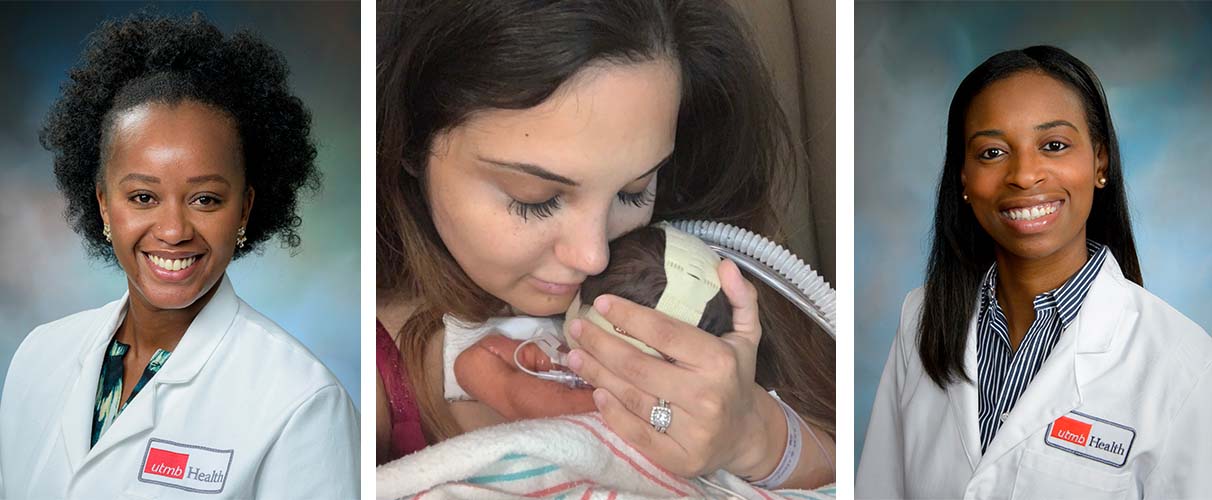
Patient Taylor Thurstonson recently shared how UTMB OBGYNs kept her and her baby boy safe during an unexpected 30-week delivery via c-section.
Patient Taylor Thurstonson recently shared how UTMB OBGYNs kept her and her baby boy safe during an unexpected 30-week delivery via c-section.
Pfizer’s COVID-19 booster appears to protect against the Omicron variant for at least four months, according to a new study. “The current vaccine is good for prevention of severe disease, hospitalization and death,” said Dr. Pei-Yong Shi, distinguished chair in innovations in molecular biology at the University of Texas Medical Branch and senior author of the study.
The University of Texas Medical Branch uses a population health analytics engine to find and address potential gaps in care, said Craig S. Kovacevich, associate vice president of community and population health at UTMB. This allows his staff to use large amounts of data they've collected, looking at the clinic, provider and patient level. “One of the other components that we have done a lot of work in is really diving into the no-shows, trying to see which patients are not showing up and then doing some deep dives," he said.
Rizwana Sultana, a pediatric sleep medicine specialist and assistant professor at the University of Texas Medical Branch at Galveston, says the design of your bedroom should be tailored specifically to you. “Use a design which appeals to you, feels comfortable and provides a sense of calm,” Sultana said.
New research from the University of Texas Medical Branch shows that a behavioral test to determine anosmia—the loss of the sense of smell—could help determine the effectiveness of SARS-CoV-2 vaccines and therapeutics. “This test may contribute to the speedy testing of antivirals and potentially to the development of therapeutics to help aid those suffering from anosmia related to COVID-19,” said Dr. Slobodan Paessler, a virologist at UTMB.
Dr. Victor S. Sierpina shared insights from a speech by Dr. Kendall Campbell, the chair of family medicine at the University of Texas Medical Branch. “We just cannot move forward without hope,” Sierpina wrote. “By joining hope with our deepest purposes, we create value for not only ourselves but for those around us.”

UTMB OBGYNs Dr. Joyce Muruthi & Dr. Kimberlyn Robinson share their tips for choosing an OBGYN. Their patient, Taylor Thurstonson, joined the chat to share her story.
Pfizer and BioNTech have begun a clinical trial for their omicron-specific COVID-19 vaccine candidate. For background, CNN also reported that a new preprint lab study suggests that antibodies against the omicron coronavirus variant remain robust four months after a third dose of the Pfizer/BioNTech vaccine. “Additional real world effectiveness data and laboratory investigations will further inform the duration of protection, potential need for an additional dose at a later time, and whether an Omicron modified vaccine is required,” said the study from researchers at the University of Texas Medical Branch, Pfizer and BioNTech. Many national and international news outlets shared the CNN story.
A new study shows high levels of coronavirus antibodies that fight the omicron variant four months after a third dose of the Pfizer vaccine, a positive sign for the durability of a booster shot’s effectiveness. Pei-Yong Shi, one of the authors of the study at the University of Texas Medical Branch, told The Washington Post that the study “shows that at least up to four months, post-dose three, there is still substantial neutralizing activity against omicron.” Several U.S. newspapers, television stations and online news outlets shared The Hill’s story.
The recent spike in COVID-19 cases caused by the less severe but more contagious omicron variant shouldn’t delude the amazing achievements that have been made against the virus, UTMB Health’s chief medical and clinical innovation officer told a virtual audience Thursday. “I think it is important to credit everyone around the world who has come together, and I cannot think of any other disease in my core memory when we have made this much progress in such a short amount of time,” Dr. Gulshan Sharman said. “I also want to get one thing straight. There is no shame is being positive and no pride in being negative. There is no stigma.”
The number of COVID-19 cases reported in Galveston County appears to have peaked, said Dr. Philip Keiser, the local health authority. The Galveston County Health District on Wednesday announced 259 new cases of COVID-19. It’s the lowest number of cases reported in a single day since Dec. 21. “There’s a part of me that’s optimistic and thinks that with omicron, this might be the game-changer,” Keiser said. “But the unexpected roll of the dice is what happens if there’s a new variant and it’s very different from omicron. There’s always this risk that we’re going to get something that’s wildly different.”
The University of Texas Medical Branch can process up to 7,000 COVID-19 tests a day, said Juan David Garcia, the administrative director of lab services at the medical branch. During the recent surge in demand, they’ve been doing about 3,000 a day. “It has been hard,” Garcia said. “We’re the first one to feel the cases.”
Global data on COVID-19 has been essential to better understand changes that COVID-19 presents. Researchers at the University of Texas at Galveston have developed a computational method that would allow researchers to keep one step ahead of new mutations that may arise. “In the future, we will be able to develop vaccines for variants before they arise,” said Catherine Schein, one of the authors.
The University of Texas Medical Branch requires at a minimum a surgical mask certified by the American Society of Testing and Materials, said Mary Ann DeMaet, the operation manager for infection control. “The variants became more contagious and easily spread,” DeMaet said. “We're seeing high transmissibility between individuals. So, we started requiring a higher-level mask. I think the cloth masks were OK in the beginning. But I think now that we know a little bit more, we probably need a higher-level mask to protect ourselves against the variants.”
One question UTMB’s Dr. Samuel Mathis often hears is about the use and importance of protein powder supplementation with a workout. “When it comes to the amount of protein we get in our diet, supplementation isn’t usually required,” Mathis writes. “In general, protein powders are safe to use, but it’s cheaper, safer and more efficient to use natural sources of protein to supplement your diet and exercise routine.”