Dr. Victor S. Sierpina wrote about how to emphasize the health effects of gardening. “At our Family Medicine Stewart Road Clinic, for example, Dr. Sagar Kamprath has been leading a group of student and community volunteers to build and grow a community garden and green space, an island of beauty, peace and nourishment before and after their doctor visits. The Osher Lifelong Learning Institute at the University of Texas Medical Branch has a large community garden lovingly cared for by volunteer seniors.”

The FDA has approved the Pfizer COVID-19 vaccine and the CDC has recommended it for children ages 5 through 11 years.
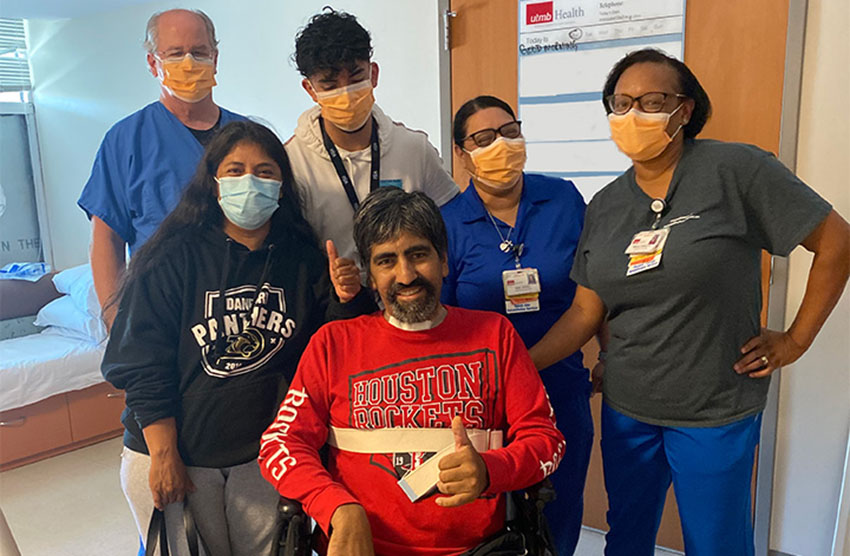
Cleora Rodriguez, 46, left the UTMB Health Angleton Danbury Campus in early November after spending more than 90 days hospitalized with COVID-19.
Dr. Megan Berman, an internist at UTMB’s Sealy Institute for Vaccine Sciences, has two partially vaccinated kids, ages 8 and 9. The family skipped their usual Thanksgiving flight to Wisconsin this year, opting instead for a drive to grandma and grandpa’s house in Texas. “If it was just me, I would be comfortable getting on a flight, knowing my risk is really low as a vaccinated person,” she said. “But we are going to be driving this year. It’s safer for the kids.”
Dr. Ben Raimer discussed his appointment as the leader of UTMB, the challenges of battling COVID-19 and his three decades at UTMB as a student, physician and administrator.
The University of Texas Medical Branch is requiring its nearly 18,000 employees, students and contract workers to get their first dose of a COVID-19 vaccine by Dec. 6 or go on leave, officials announced Friday. Medicare and Medicaid payments make up about a third of the medical branch’s revenues, roughly $685 million a year, said Dr. Timothy Harlin, executive vice president and CEO of the medical branch health system.
The American Association of Medical Assistants installed Sherry Bogar, CMA (AAMA), CN-BC, as a 2021-2022 Trustee at its annual conference in Houston. Bogar works in the UTMB Health breast cancer and surgical oncology clinic in League City and is certified as a breast cancer and oncology patient navigator. She is a founder of the medical assistant advisory council at UTMB Health. “Medical Assistants have worked for years to prove that they are an essential part of the health care team that provides compassionate and quality patient care,” Bogar said. “The past two years in the COVID-19 era have proven how invaluable we are to every part of healthcare and how many roles we are able to fill.”
Engineers have determined proper heating will eliminate the virus that causes COVID-19 from a standard disposable surgical mask without degrading the mask itself. The work by Rice University engineers and collaborators at the University of Texas Medical Branch shows masks can be decontaminated and reused multiple times before degrading.

Dr. Amber Hairfield discusses tips, tricks and methods for navigating life and meal time with a picky eater.

Dr. Colleen Silva and one of her patients Tammi Moran join Meagan to talk all things Breast Cancer.

STAT Wunderkind celebrates the heroes of science and medicine who are on the cusp of launching their careers, but not yet fully independent.
By finding this virus early, scientists now have time to study it, create tools to diagnose it and understand what it might take to stop it. Although it's not a cause for deep concern at this time, there's always the risk the virus could evolve and become a bigger problem. “We need to find these novel viruses well before they fully adapt to humans and become a pandemic problem,” wrote epidemiologist Gregory Gray, from the University of Texas Medical Branch, in an email to NPR. “Fortunately, today we have the tools to both detect and evaluate the risk of such novel viruses. We just need the political will and financial support to do so.”
Houston continues to heal from the events of last Friday's Astroworld Festival. Host Ernie Manouse talked to experts including Dr. Jeff Temple, director of the Center for Violence Prevention at UTMB. Temple fielded audience questions about psychological trauma.
The American College of Surgeons elected surgeon Dr. Linda G. Phillips as vice-chair of its board of regents in October. Phillips is the Truman G. Blocker Jr., MD, Distinguished Professor at the University of Texas Medical Branch School of Medicine and chief of Department of Surgery, division of plastic surgery. As vice-chair, Phillips will become vice-chair of the Board of Regents Finance Committee, the Executive Committee, and Regental Liaison to the Board of Governors Executive Committee.
The University of Texas Medical Branch at Galveston School of Nursing has been named an Apple Distinguished School for 2021-2024. The award comes in part thanks to the school’s iLead—or Innovative Learning Environment Accelerating Discovery—program. Through iLead, students are issued an iPad and Apple Pencil upon orientation.
While a reduction in the number of infections is good news, scientists and doctors are beginning to understand the chronic illness that lingers after COVID infection, called long-haul syndrome. Long-haul patients were infected and appeared to recover, but then chronic symptoms began and remained months after the infection. Extreme fatigue and debilitating brain fog are common symptoms, write Drs. Norbert Herzog and David Niesel of UTMB.
Dr. Vincent S. Sierpina wrote about the lack of black men entering medical school. While 33 percent of our U.S. population come from under-represented minority groups, only 7.7 percent of full-time medical school faculty come from these groups. “This is a shocking mismatch of future physicians to serve a population that looks like them with the same cultural roots, especially in a state like Texas where around 50 percent of our population is now non-white,” Sierpina wrote.
Comirnaty, better known as the Pfizer COVID-19 vaccine, has been approved by the U.S. Food and Drug Administration and recommended by the U.S. Centers for Disease Control and Prevention for children ages 5 through 11. Many parents have been waiting for this as they wish to protect their children from COVID-19. Drs. Megan Berman and Richard Rupp answer common questions they hear from parents.
Ground-breaking research from Heriot-Watt University and the University of Texas Medical Branch is set to be commercialized following a funding award from Scottish Enterprise’s High Growth Spinout Programme. The new research has identified a way of targeting an enzyme called EPAC1, which is involved in the inflammation process and is responsible for many of the most serious yet common chronic diseases.

Several key themes emerged including that seafarers routinely underreport adverse work and health conditions for fear of losing future work contracts. These adverse conditions range from working aboard dangerous vessels and routes to concealing severe and moderate injury and illness.