The results of a study by researchers at the University of Texas Medical Branch may pave the way for a new medicine delivery system that could reduce the incidence of pre-term labor and premature birth by allowing physicians to treat the ‘fetus as the patient’. The study has been published in Science Advances.
Texans are lining up to receive their COVID-19 vaccine and many more are patiently waiting their turn. The good news is that while COVID-19 can be life-threatening, the only medical risk to vaccination is for those with a history of allergic reactions to these vaccines or their ingredients.
Dr. Justin Seashore, director of the Post COVID Recovery Clinic in Clear Lake, is featured in an article discussing long-term COVID-19 care.

There is a lot we do not know about SARS-CoV-2, the virus that causes COVID-19, including how it may interact with human milk. However, researchers at the University of Texas Medical Branch are trying to figure out if breast milk has any innate ability to stop the spread of the virus that causes COVID-19, or if an infected mother can pass antibodies to her breastfeeding child.

In front of the press, President-elect Joe Biden rolled up his sleeve for the Pfizer vaccine and Dr. Anthony Fauci for the Moderna vaccine. While some tried to read something into their choices, these vaccination events were likely arranged to instill public trust in both vaccines. Regardless, the public wants to know which vaccine is best.
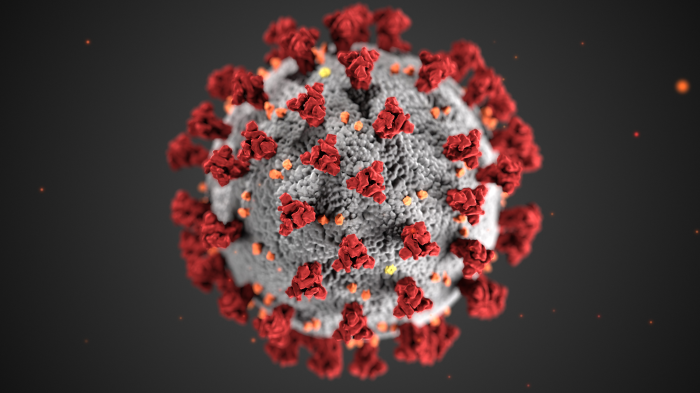
A collaborative team from The University of Texas Medical Branch at Galveston and Pfizer has shown that the common mutation N501Y from the newly emerged SRAS-CoV-2 strains does not compromise Pfizer’s COVID-19 vaccine. This is the first study to investigate if the fast-spreading new virus strains affects the vaccine’s effectiveness. The study is currently available in bioRxiv (https://doi.org/10.1101/2021.01.07.425740).
It’s music to many physicians’ ears to hear people clamoring for their COVID-19 vaccine. The virus has damaged the economy and taken far too many lives. A year ago, it was unbelievable that effective, safe vaccines could be delivered in less than a year from the first identification of a new pathogen.

January is National Birth Defects Prevention Month, so it is an appropriate time to recognize and share the knowledge that some steps can be taken to prevent certain birth defects.
Two COVID-19 vaccines have received Emergency Use Authorization in the United States. They’re commonly referred to as the Pfizer and Moderna vaccines. Both are messenger RNA (mRNA) vaccines and use a technology developed over the last decade.
In times of calamity and uncertainty, we are often told to look for the helpers. But what happens when no one is looking out for them? Domestic violence and sexual assault has increased during the COVID-19 pandemic and, with it, the demands on those who provide services and support to survivors. But while the demands are up for domestic violence and sexual assault workforce, the resources and support for these essential workers has not increased.
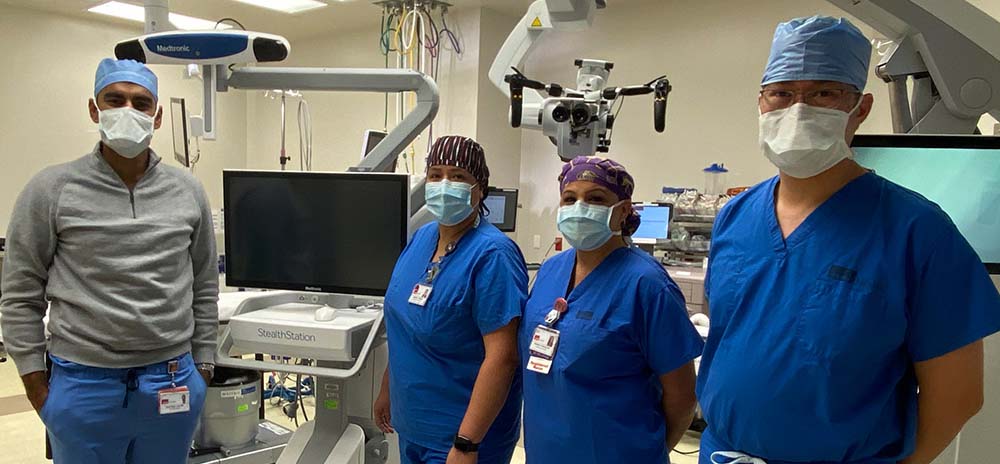
Surgeons at UTMB Health’s Clear Lake Campus recently performed the hospital’s first craniotomy for brain tumor removal and the first intracranial aneurysm clipping, which represent an expansion of services offered at the campus as the hospital continues to find new and innovative ways to provide world-class treatments to the growing communities it serves.
On Tuesday, Dec. 15, UTMB received and began administering the first doses of the COVID-19 vaccine to its “first-tier” health care workers—those frontline employees who are at elevated risk for occupational exposure to the virus.
The fantastic news about the safety and effectiveness of the Pfizer and Moderna COVID-19 vaccines has led many to ask when things will return to normal.
Learn more about pediatric sleep apnea symptoms with this Medical Minute.

Spinal stenosis, a very common neurosurgical condition, can be associated with spondylosis, ligamentous hypertrophy, and disc osteophyte complexes. Stenosis often presents as myelopathy (compression on the spinal cord) or radiculopathy (compression on the nerve root).

Overactive bladder (OAB) affects almost 50 percent of women in the United States, presenting as urinary urgency and frequency, with or without urinary leakage.
A team of physicians, environmental scientists, and students at the University of Texas Medical Branch have completed a multi-year study of cancer rates among individuals living in close proximity to oil refineries and have found statistically significant increases in several cancers among those living nearest to these facilities.
It may seem crazy, but in some clinical trials volunteers are purposely infected with diseases like the flu, cholera and malaria. These types of trials are referred to as challenge studies.
A frequent question we get is when will children be able to receive a COVID-19 vaccine.