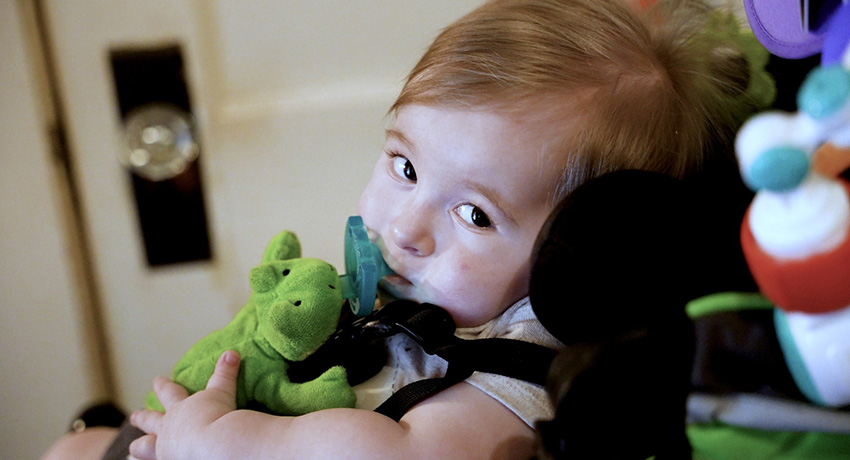
Looking back at the earliest days of her son William’s life, Linda’s memory begins not with milestones, but with a phone call. Just days after bringing him home, a routine screening turned into an urgent warning.
“We got a call from the newborn screen, and they said that it was flagged,” Linda shared.
She was notified that something was “very abnormal” and that her son might have spinal muscular atrophy, a diagnosis that prompted a referral to The University of Texas Medical Branch (UTMB) Gene Therapy Program and geneticist Dr. Erin Cooney, who helped her understand what the results meant and guided her family into specialized care.
Spinal muscular atrophy (SMA) is a rare inherited neuromuscular condition that causes muscles throughout the body to weaken. It happens because a specific gene, called SMN1, is missing or is not working correctly. Without this gene, certain nerve cells in the spinal cord cannot survive, leaving them unable to tell the muscles to move. Over time, this makes it harder to do everyday things like sitting up, walking, swallowing, or even breathing.
As of 2021, all infants born in Texas are screened for SMA, along with over four dozen other congenital genetic conditions, through a quick heel-prick blood test.
In one of its most severe forms, type 1, symptoms emerge within the first months after birth. In type 0, which is very rare, disease onset is in utero. Diagnosis through these newborn screenings and advances in treatments like gene therapy are reshaping what infancy and childhood can look like for families facing the disease.
“By making a diagnosis early, ideally within the first week of life prior to the onset of symptoms, we know that it can have an impact on outcome,” Cooney said.
William’s diagnosis came through that exact process.
“He was picked up on newborn screen and our office received information about him,” Cooney said. “We reached out in the first week of life and contacted his parents, who had never heard of us, UTMB, or spinal muscular atrophy, and we had to essentially cold call them and say, ‘Your child has this diagnosis, and we need to see you right away.’ ”
While that early connection was critical, the waiting that followed was agonizing for Linda, who could see her son growing weaker by the day.
“He was wasting away. He was very, very skinny,” she said. “No matter how much I fed him, his thighs were like the circumference of a quarter.”
Linda’s son has type 0 SMA, the most severe form of the disease, which begins before birth. Despite the diagnosis, she felt her UTMB care team was fully committed to her son’s well-being from day one.
“He had low muscle tone in the first week of life, so we knew we were in a race against time,” Cooney said. “We needed to get him treated as fast as possible.”
Linda and her husband were informed of two treatment options for William: either Spinraza, an older medication used at some other health care institutions and given every four months to help slow the progression of SMA, or Zolgensma, a one-and-done infusion available to children under 2 years old that replaces the missing or nonworking SMN1 gene with a new, working SMN1 gene.
Together, they opted for Zolgensma, and Cooney began the process of obtaining prior authorization to secure insurance coverage for the $2 million gene therapy treatment.
Treatment day
It took a few weeks to coordinate pretreatment lab work, obtain authorization, and have the drug mailed to UTMB, but William’s family was able to schedule their 1-month-old son's gene therapy for the morning of Feb. 25, 2025, at an outpatient facility — a very fast turnaround. However, even in that short window of time, William’s symptoms worsened.
“He had a weak cry. He was not vigorous. His tone was poor,” Cooney said. “I was very worried about him.”
The infusion requires two IVs in case the first fails, as the medication must be administered within a limited window once it is thawed. Typically, the procedure is uneventful. But for William, it quickly became an emergency when he stopped breathing and began turning blue before the procedure was started.
The focus immediately shifted from delivering gene therapy to saving his life. The UTMB team worked to stabilize him. He was then moved to the intensive care unit (ICU) for monitoring and later completed his gene therapy treatment there.
“For him to get sick before we could actually use the drug was heartbreaking,” Cooney said, explaining that the team essentially had to restart the process of approvals that had originally taken about a month. “I was worried that we could potentially fail him and not be able to get it inpatient.”
However, within 36 hours, they regained approval for the drug.
“It was just an incredible team effort by everyone at UTMB, his insurance, and the family believing and trusting in us with his care,” Cooney said with tears in her eyes.
On Feb. 27, 2025, when William was stable in the ICU, the care team administered Zolgensma, and the impact was almost immediate.
“I remember the next day after his gene therapy. He moved his leg, and we just were completely in awe,” Linda said. “This drug is so incredible and life-changing.”
Although his treatment was ultimately successful, Cooney emphasized William’s initial intolerance to having IVs placed was rare and caused by his early onset of symptoms.
“Most babies who receive gene therapy for SMA will be less severe than William,” she said. “He is a rare case of type 0, whereas most babies are going to be a type 1, which means they're born without symptoms.”
The road ahead
In January 2026, Linda’s family celebrated the biggest milestone of all — William’s first birthday. As her son continues to grow stronger and with more abilities than ever before, she’s grateful to UTMB for improving the quality of their lives through gene therapy.
“What compassionate care means to me is that the whole team has really good communication with the entire family and guides them every step of the way through this process, which they absolutely did,” Linda said.
In fact, that is Cooney’s goal for every patient: to provide the resources and support they need to see just how much they can achieve — together.
“We are building a pipeline here at UTMB to be able to offer gene therapy as it becomes available for rare disorders as quickly as possible,” Cooney said. “We are now offering multiple gene therapies, and we are not only providers for the state of Texas, but we're looking forward to also being providers for Louisiana as well.”
William’s rare and severe case underscored what early diagnosis and timely gene therapy can mean not just for one newborn, but for other families facing a similar diagnosis. His first year — once defined by a race against the clock — became a testament to what is possible when intervention comes in time. And for Cooney, that transformation is deeply personal.
“Gene therapy saved his life,” Cooney said. “And I will forever have a relationship with him and his family. I am honored that I got to be part of his care.”