Dr. Harold Pine is locked in. His team is assembled. Supplies are in place. Breathing slowly, he enters a calm, focused state.
Peering into a surgical microscope, he makes a tiny incision in the toddler’s eardrum, removing any trapped fluid. Then he inserts an even tinier tube, one that would barely cover Roosevelt’s ear on a silver dime. No matter how many times he performs the procedure, he repeats the same careful process.
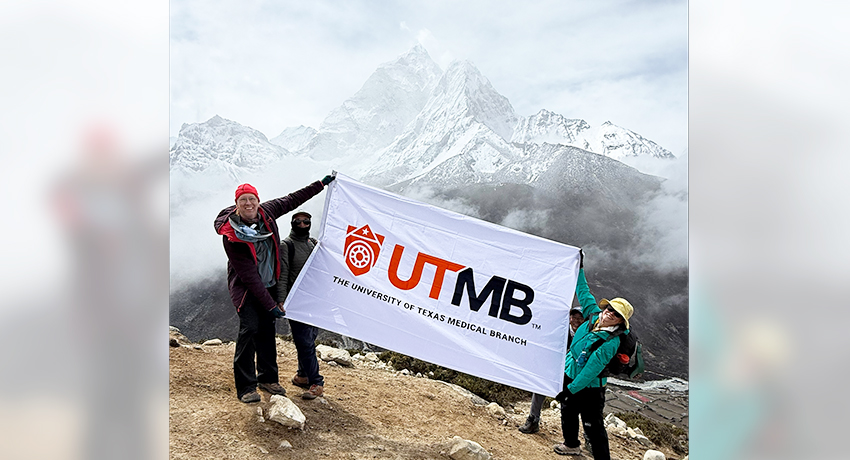
Just days later, Pine is again locked in. As before, his team is assembled and supplies are in place. Breathing slowly, he enters a calm, focused state. This time, he is not in surgery. He is on a mountain, at base camp, preparing for a climb.
Whatever he learns on that vast frozen landscape is with him in the miniature spaces of a child’s ear, nose, or throat.
“Being prepared. Staying alert. Never letting your guard down. Making decisions without complete information. Trusting your team. These are the same skills we use in the operating room,” said Pine, a board-certified ear, nose, and throat specialist and a professor of otolaryngology at The University of Texas Medical Branch (UTMB Health).
Eyes on the next summit
Having scaled five of the renowned Seven Summits, Pine plans to attempt the tallest one, Mount Everest, in 2027. But first, he will embark on a Mount Everest medical mission this month, providing round-the-clock medical care for conditions such as altitude-related illnesses, frostbite, and injuries.
“This trip is very much both preparation and purpose-driven,” Pine said. “From a climbing standpoint, it’s an opportunity to return to the Everest region, reacclimate to altitude, and reconnect with the rhythms of the mountain ahead of a summit attempt in 2027. There’s no substitute for time spent in that environment.
“At the same time, the medical mission is equally important to me. I’ll be traveling with a small team of three, including a family medicine physician and my girlfriend, Karen Lau. Together, we’ll be prepared to offer care anywhere along the trail. Providing support in remote, resource-limited settings while working alongside local teams has been one of the most meaningful aspects of my previous expeditions, and this allows us to contribute in a tangible way while also preparing for what’s ahead.”
A budding mountaineer
Pine’s love of mountaineering began with his first expedition, a Mount Kilimanjaro climb with his younger brother. During that trip, their mother’s insistence that they pack snacks taught an important lesson about preparation.
“Climbing has remained a consistent part of my life, though the scale and setting vary,” Pine said. “I make a point to stay active year-round with training, smaller climbs, and endurance work. I train at a jujitsu gym, which has been the best teacher on how to be comfortable in uncomfortable situations.
“That said, Everest is its own category. Nothing quite replicates the sustained altitude, exposure, and logistical complexity. It’s been some time since I’ve been back at that level specifically, which is part of why returning now — before a summit attempt — is so important. It’s been quite an interesting start to the season. The famed Khumbu Icefall just opened, so climbers can start their rotations up to Camp 1.”
Pine and his climbing companions are making final travel preparations for this year’s mission, which is to help other mountaineers conquer Everest.
“For this trip, the biggest challenge is always altitude — how your body responds day-to-day and respecting that it can be unpredictable no matter your experience,” Pine said. “Balancing the physical demands of the trek with the responsibility of being available medically along the route adds another layer, but it’s one we’re intentionally prepared for as a team. I’m also excited to see how Karen and I get along when the going gets tough.”
For Pine, relationships are an important component of his adventures.
“The people who matter most are the ones you think about when it gets hard,” Pine said. “You don’t climb Everest alone — you carry every person who shaped you.”
Learning life lessons through adventure
Pine carries lessons from each peak. On Mount Kosciuszko in Australia, the lesson wasn’t about difficulty, it was perspective.
“With friends, red licorice, and a nearby geocache, I was reminded that joy isn’t always found at the highest point, it’s often found along the way,” Pine said.
Climbing 18,510-foot Mount Elbrus, the highest peak in Russia’s Caucasus Mountains near the Georgia border, brought unexpected challenges. Just getting into Russia was difficult due to geopolitical tension.
“I grew up during the Cold War thinking we might one day fight Russia,” Pine said. “Instead, I found kindness.”
At over 22,000 feet, Argentina’s Aconcagua, the highest peak in the Americas, demanded discipline and provided humility.
“While descending, I stayed too long near the summit waiting for a partner,” Pine said. “My oxygen levels dropped into the 60s. I had to use supplemental oxygen just to get down.”
That experience was a powerful reminder that recognizing limits early and acting decisively can make all the difference. And like many other lessons learned in extreme environments, it applied to his professional life, too.
Always ascending
“What keeps me coming back is a combination of curiosity, challenge, and perspective,” Pine said. “Being in those environments strips things down to what really matters. There’s a clarity you find in the mountains that’s hard to replicate elsewhere.”
Even if he successfully summits Everest next year, Pine doesn’t think he’ll be finished with climbing.
“The goals may evolve, and the scale may change, but I suspect I’ll always be drawn to exploration, and to the mountains,” he said.
Pine will also continue sharing his love of mountaineering and its life-or-death lessons in the other parts of his life.
“At UTMB in the Department of Otolaryngology, we have a terrific wellness program called ‘The Second Mountain,’ where residents get to pick things outside of medicine to work on,” Pine said. “Part of my why for trying to climb Everest is to showcase that you can do amazing things outside of medicine and live a heroic life and still take great care of kids.”
Some things are always true, whether you are standing on a mountain at an elevation of 29,000 feet or in surgery on an island in Texas at 6 feet.
“In the operating room, precision matters,” Pine said. “In the mountains, presence matters. Both demand everything.”