A pair of studies published in the Aug. 12 issue of Science Translational Medicine, and featured on the cover, have uncovered a key vaccine design principle that could help provide stronger, longer-lasting protection against HIV and other challenging infectious diseases.
 Led by researchers at The University of Texas Medical Branch (UTMB) and collaborators at Scripps Research, the studies show that how vaccine targets are physically displayed to the immune system plays a critical role in determining how long immunity lasts.
Together, the research shows that the way a vaccine is designed can be just as important as what it targets. Vaccines that display many copies of the same target on the surface of tiny particles trained the immune system to remember an infection longer than vaccines displaying fewer copies.
Led by researchers at The University of Texas Medical Branch (UTMB) and collaborators at Scripps Research, the studies show that how vaccine targets are physically displayed to the immune system plays a critical role in determining how long immunity lasts.
Together, the research shows that the way a vaccine is designed can be just as important as what it targets. Vaccines that display many copies of the same target on the surface of tiny particles trained the immune system to remember an infection longer than vaccines displaying fewer copies.
The companion studies, published here and here, also explain why that happens, showing this design gives the most effective antibody-producing immune cells a better chance to grow, mature, and survive long term
“One of the biggest challenges in vaccinology isn't simply generating a specific immune response — it’s generating one that lasts,” said Robert Abbott, PhD, an assistant professor in the Department of Pathology at UTMB and co-author of the studies with William Schief, PhD, a professor in the Department of Immunology and Microbiology at Scripps Research and vice president, Protein Design, Infectious Disease Research at Moderna.
“These findings identify a fundamental design principle that could improve vaccine development against HIV, influenza, and other pathogens that have proven difficult to protect against,” Abbott said.
Why vaccine structure matters
To answer that question, the researchers designed experimental HIV vaccines that were identical except for one feature: the number of copies of a target displayed on the surface of tiny nanoparticles. By changing only that one characteristic, they were able to determine how the arrangement of vaccine targets influences the immune response.
Scientists call this concept antigen avidity: how strongly a vaccine interacts B cells, the immune cells that produce protective antibodies after vaccination. One aspect of antigen avidity, known as epitope valency, refers to the number of copies of a target displayed on each vaccine particle.
Using specialized mouse models that closely mimic human immune responses, the researchers found that vaccines displaying more copies of the target consistently produced stronger and longer-lasting immunity. Compared with vaccines displaying fewer copies, the high-valency vaccines:
- Produced more memory B cells, which help the immune system recognize a virus if it is encountered again, and remained detectable for more than a year.
- Generated more long-lived plasma cells in the bone marrow, allowing the body to continue producing protective antibodies long after vaccination.
- Maintained higher antibody levels for months after immunization.
- Kept the immune system’s antibody “training grounds,” known as germinal centers, active for up to six months, giving antibodies more time to improve their ability to recognize viruses.
- Produced a broader variety of antibody-producing B cells, which may help the immune system recognize viruses that mutate over time.
- Generated stronger immune responses after booster vaccinations.
A roadmap for future vaccine design
The second study focused on why this vaccine design strategy works so well and where these responses start. The researchers discovered that the benefits were not simply the result of giving a larger vaccine dose or using a different ingredient to stimulate the immune system. Instead, displaying multiple copies of the target helped the most effective B cells early in the immune response. Immunogens displaying the most copies of the target allowed more B cells to enter germinal centers, diversify their antibody-encoding genes, and ultimately survive long enough to contribute to lasting immunity.
Interestingly, when the researchers artificially reduced the level of clonal competition, vaccines displaying fewer copies of the target performed much better. This finding suggests that the level of competition between B cells plays an important role in determining vaccine effectiveness.
Ultimately, the results indicate that the physical structure of a vaccine helps determine which B cells become the long-lived cells responsible for lasting protection.
The studies also found that while both the strength with which an individual target binds to a B cell (known as antigen affinity) and the number of target copies displayed (antigen valency) influence vaccine performance, the number of copies had the greatest impact on driving productive germinal center responses that ultimately leads to the development of long-lasting immune memory.
Taken together, the findings suggest that creating longer-lasting vaccines depends not only on choosing the right target but also on presenting that target to the immune system in the most effective way.
“This work provides a roadmap for designing vaccines that produce more durable immunity. Viruses and bacteria often have such repetitive targets on their surfaces that B cells have evolved to respond to over the last 500 million years. As vaccinologists, we should take a hint from B cells when designing vaccines. Structure matters,” Abbott said. “By optimizing how vaccine antigens are displayed, we may be able to create vaccines that provide broader, longer-lasting protection against diseases that have remained challenging for decades.”
Although the research focused on experimental HIV vaccine candidates, the design principles uncovered in the studies could be applied broadly to vaccines against influenza, coronaviruses, and other emerging infectious diseases.
Additional researchers involved in the studies from UTMB: Nicole Weidner, Mauricio Padilla, Layne Pruitt, Kristyn Gonzales, Kristy Waldrep, Maisha Aniqua, and Emma Keller; and Meredith Weglarz, assistant director of the Flow Cytometry and Cell Sorting Core Lab.
Additional researchers involved in the studies from Scripps Research: Christopher Cottrell, Oleksandr Kalyuzhniy, Danny Lu, Nushin Alavi, and Nicole Phelps.
Funding for the studies included grants from the National Institutes of Health, The Bill and Melinda Gates Foundation Collaboration for AIDS Vaccine Discovery, the IAVI Neutralizing Antibody Center, UTMB startup funds, and McLaughlin Endowment Fellowships.
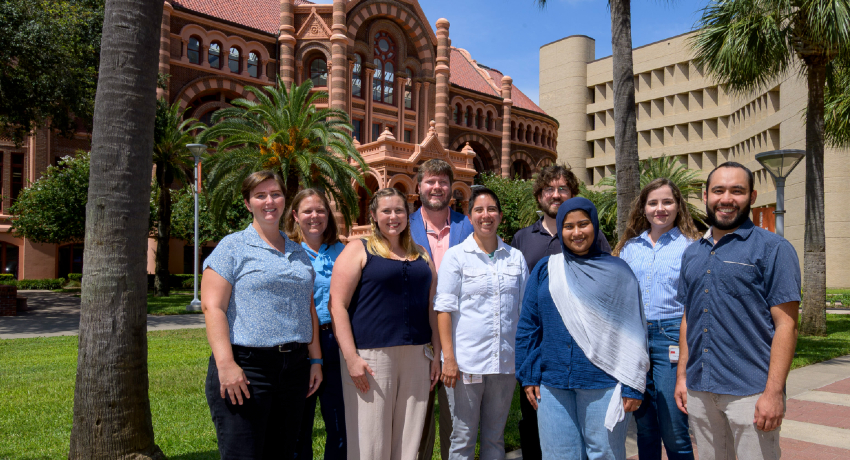
Pictured above, from left: UTMB researchers Nicole Weidner, Meredith Weglarz, Emma Keller, Robert Abbott, Kristyn Gonzales, Layne Pruitt, Maisha Aniqua, Kristy Waldrep, and Mauricio Padilla.