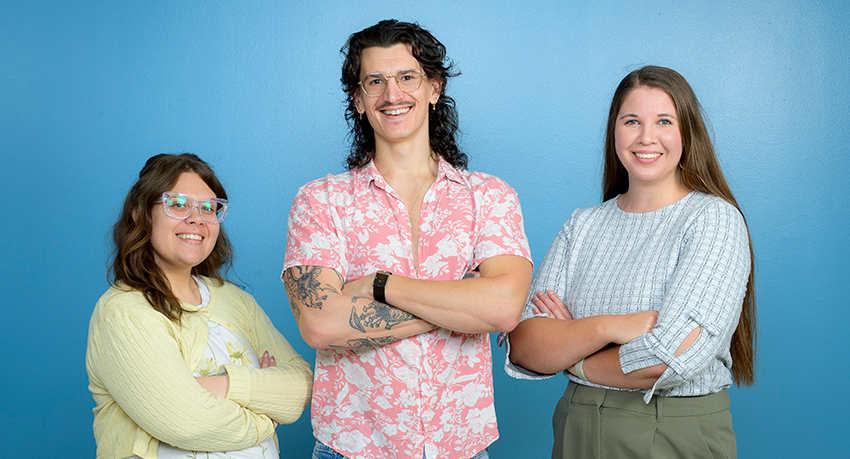
Three students from The University of Texas Medical Branch (UTMB) Graduate School of Biomedical Sciences (GSBS) have been awarded highly competitive National Institutes of Health (NIH) F31 predoctoral fellowships in recognition of their research accomplishments and potential as future scientific leaders.
The NIH F31 fellowship program provides doctoral students with financial support to advance their dissertation research while preparing for careers in biomedical, behavioral, and clinical research. Awards include support for stipends, tuition, research expenses, travel, and health insurance, enabling recipients to focus on innovative investigations that address critical health challenges.
This year’s awardees are pursuing research in Alzheimer’s disease and congenital Zika virus infection, advancing the UTMB mission of improving health through scientific discovery and innovation.
Meagan Rippee-Brooks explores immune mechanisms in Alzheimer’s disease
Meagan Rippee-Brooks, a doctoral student in the Microbiology and Immunology Graduate Program, received a three-year F31 fellowship from the National Institute on Aging for her project, “Characterizing Myeloid Nuclear Differentiation Antigen in Alzheimer’s Disease.”
Under the mentorship of Xiaoyong Bao, PhD, Rippee-Brooks is investigating the role of Myeloid Nuclear Differentiation Antigen (MNDA), an understudied innate immune-related protein that belongs to a family of proteins more commonly associated with viral infections. By examining how essential cells of the central nervous system contribute to disease progression, Rippee-Brooks hopes to investigate mechanisms that may one day lead to new treatments for Alzheimer’s disease.
Rippee-Brooks’ interest in Alzheimer’s disease is personal. She was inspired to pursue the research after losing her grandfather following a more than five-year battle with the disease.
A UTMB Presidential Scholar, Rippee-Brooks earned a Bachelor of Science in Biology from Missouri State University before completing an accelerated Master of Science in Biology.
She said receiving the F31 fellowship gave her the confidence to pursue her goal of becoming an independent scientific investigator in academia.
“This award contributes not only to my research through financial support, but also serves as a testament to the resilience I have fostered since childhood,” Rippee-Brooks said. “To receive that recognition from experienced scientific experts who do not know me personally, yet believed not only in my research proposal, but also in me, reinforced the importance of confidence in pursuing your goals.”
Samantha Cody investigates congenital Zika syndrome and neurodevelopment
Samantha Cody, a doctoral student in the Human Pathophysiology and Translational Medicine Graduate Program, also received an NIH F31 fellowship for her project, “Pellino 1 as a Critical Therapeutic Target to Mitigate ZIKV-Induced Postnatal Cognitive Dysfunction Following Congenital Infection.”
Working in the laboratory of Tian Wang, PhD, Cody studies how the body’s innate immune response contributes to Congenital Zika Syndrome and the long-term neurological effects that can occur after congenital infection. Her research focuses on identifying molecular pathways that could be targeted to reduce cognitive and developmental impairments in children exposed to Zika virus before birth.
“I want to identify therapeutics that allow pregnant folks to protect unborn children from fetal illness in the same way that we use vaccines and antibiotics help protect children after birth,” Cody said.
Cody brings an interdisciplinary background to her work, earning a Bachelor of Science in Chemical Engineering from the Georgia Institute of Technology and a Master of Science in Tropical Medicine, Medical Microbiology and Pharmacology from the University of Hawaiʻi at Mānoa.
Through her doctoral research, she is advancing understanding of congenital infections immunology while exploring potential therapeutic strategies to help protect brain development following viral infection.
“As an aspiring academic, receiving an F31 fellowship indicates independent approval of my ability to craft a research strategy and communicate it effectively to a panel of future peers,” Cody said. “This is encouraging as I look ahead to graduation and postdoctoral training, knowing I have developed both bench and communication skills during my time at UTMB that will serve me well in the future.”
Adam ‘Moose’ Trupp studies resilience in Alzheimer’s disease
Adam “Moose” Trupp, a doctoral student in the Neuroscience Graduate Program, received an NIH F31 fellowship for his project, “Differential Effects of Brain-Derived Tau Oligomers on Neurogenesis in Alzheimer's Disease and Cognitively Resilient Individuals.”
Under the mentorship of Maria-Adelaide Micci, PhD, Trupp’s research examines why some individuals maintain cognitive function despite exhibiting pathological changes associated with Alzheimer’s disease.
By investigating how tau oligomers affect the generation of new neurons in the brain, he hopes to identify biological factors that contribute to cognitive resilience. The findings could provide important insights into disease progression and reveal new opportunities for therapeutic intervention.
Trupp earned both a Bachelor of Science in Biology and a Bachelor of Arts in Music Performance from Northwestern State University. His work reflects a growing scientific effort to understand not only the causes of neurodegenerative disease but also the factors that allow some individuals to remain cognitively healthy despite it.
“Receiving this award and having recognition at the national level has given me a new level of confidence in myself and my research, which I could never have achieved without the support of my mentors, teachers, friends, and family,” Trupp said. “My background is anything but a linear path to the sciences, so to have this affirmation is beyond anything I thought I was capable of when first setting out in graduate school.”
Trupp hopes to become a professor at a leading academic medical institution.
Advice for UTMB F31 fellowship applicants
While the application process for an F31 fellowship can be daunting, all three students offered advice for applying.
“Spend as much time interrogating the literature as you do planning your experiments. Not only will you make your proposal as innovative as possible, but you may also uncover techniques and collaborations that can strengthen your research strategy,” Cody said.
Rippee-Brooks said it’s important not to be intimidated by the process.
“Don’t be afraid to try,” Rippee-Brooks said. “Feedback is not personal. It is a way to grow. You can be an incredible scientist and still have room to improve. Embrace that and be grateful that you can share your research with others.”
Trupp emphasized making full use of the resources available at UTMB.
“Make friends with your program officer (PO) or at least establish a direct line of communication with them,” Trupp said. “No one told me that your PO is an inside man from the NIH who is in your corner and wants you to succeed as much as you do. After you submit your application, you’re in limbo for months. Being able to reach out every now and again to get a read on how things are going helped the whole thing feel more manageable than just waiting in the dark.”
The GSBS Writing Studio also offers expertise, workshops, and writing support for students going through the application process. Jacqueline Silva, PhD, studio director, assists students working on grant applications.
“Dr. Silva is the absolute bomb!” Trupp said. “If you have questions, she has answers. I attended every workshop I could on F grants and set up individual meetings to get personalized feedback on my writing. I am beyond grateful for Dr. Silva and the GSBS Writing Studio.”