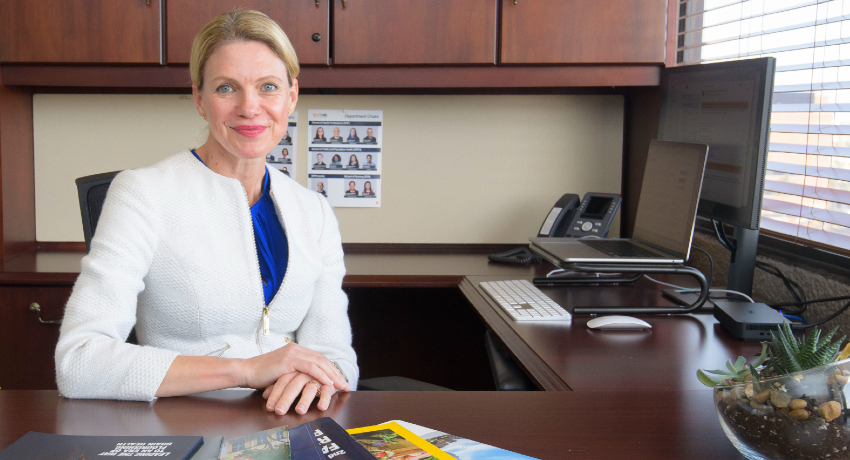
Mikele Epperly, PhD, MPH, knew early in life that she wanted to make a difference in healthcare. There was just one problem. She faints at the sight of blood.
Fortunately, the path to improving patient care doesn’t always lead to medical school.
For Epperly, that path began taking shape when she was 8 years old and her mother was diagnosed with stage 4 cancer after her symptoms had initially been dismissed. Her mother died two years later, leaving Epperly with a firsthand understanding of both the challenges patients face in navigating the healthcare system and the dedication of the clinicians working within it.
Those early experiences helped shape a career devoted to improving healthcare delivery — a career that has now brought her to The University of Texas Medical Branch (UTMB) as its first vice president of Brain Health Transformation.
While her mother’s illness exposed her to the challenges patients can face, her father, a physician, showed her the difference compassionate healthcare professionals can make.
“I always had that draw to helping people the way clinicians like my dad did,” Epperly said.
Rather than pursue clinical medicine, she dedicated her career to helping healthcare professionals provide the best possible care through data-driven decision-making, performance improvement methodologies, and change management techniques.
Along the way, that mission became personal again.
After working across a variety of healthcare disciplines, Epperly had an opportunity to help advance Alzheimer’s disease care on a global scale. Her mother-in-law faces a significant risk of developing the disease, raising concerns about the potential risk for her husband and daughter.
Having lost her mother at age 10 and her father at 25, Epperly saw a chance to make a difference for families facing similarly devastating diagnoses.
“I wasn’t in a position to help either of my parents, but I felt like this was my opportunity to make a difference,” she said.
A new approach to care
Epperly joined UTMB in August after serving in a global role at pharmaceutical company Roche, where she helped develop the brain health program there. Her previous experience also includes leadership roles in hospitals and health systems, including Scripps Health and Stanford Health Care.
What drew her to UTMB was the opportunity to help build something she believes could fundamentally change how healthcare organizations approach care.
Under the leadership of UTMB President Jochen Reiser, MD, PhD, the institution has committed to becoming the first academic medical center to institutionalize the concept of “brain capital,” which recognizes brain health and brain skills, such as resilience, adaptability, and critical thinking, as essential assets for individuals and communities.
For Epperly, it's a framework that brings together prevention, care, and human potential.
“It’s not often that you get an opportunity to be the first in the world to do something,” she said.
The initiative encompasses six areas of focus: education, research, clinical care, innovative partnerships, workforce development, and community engagement.
For Epperly, the appeal extended beyond the opportunity to pioneer a new approach to care. She was equally impressed by the institution’s leadership and its willingness to embrace innovation.
She described a culture in which leaders approach challenges not by declaring that something can’t be done, but by asking how it might be possible.
That openness, she said, helped convince her that UTMB was the right place to pursue her vision.
Turning vision into action
Although the concept of brain capital is expansive, Epperly is focused on translating it into meaningful improvements in people’s lives.
Her immediate priorities include developing a comprehensive strategic plan, identifying existing programs that support brain health, and launching one or two new initiatives to address gaps and opportunities.
A steering committee is being developed to help guide the work, establish organizational priorities, and determine how progress will be measured.
Communication will be particularly important. Epperly wants UTMB employees and community members to understand not only what brain health means, but also what they can do to support their own cognitive well-being and how the institution’s initiatives fit into that larger mission.
One example is the Blue Zones work at UTMB, an initiative focused on creating environments and promoting lifestyle habits that support healthier, longer lives.
Epperly sees the Blue Zones effort as a flagship community initiative that aligns naturally with the brain capital priorities taking shape at UTMB.
Other potential areas of emphasis include expanding clinical services and helping employees develop the skills and resources needed to thrive in demanding healthcare environments.
Epperly also wants the initiative to be financially sustainable, delivering measurable benefits while building on work already underway across UTMB. Rather than creating an entirely new collection of programs, she hopes to connect, strengthen, and elevate existing efforts while identifying opportunities to do more.
Addressing the barriers to better care
Epperly knows that even the most promising scientific discoveries cannot improve lives if patients can’t access them when they need them. Her work in Alzheimer’s disease illustrated that reality.
She recalled learning about the substantial delays that can occur between the first signs of dementia, a formal diagnosis, and the start of treatment.
Those delays can mean patients miss opportunities to benefit from treatments or participate in clinical trials during the stages when intervention may be most effective.
The realization made a lasting impression.
Epperly came to see that scientific advances alone would not be enough. Healthcare systems also needed to change to ensure patients could benefit from those discoveries.
She believes UTMB is uniquely positioned to help address that challenge by developing and implementing new approaches to care, studying their effectiveness, and sharing the results with other organizations.
That work could ultimately help inform broader changes in healthcare delivery, financing, and policy.
And she sees reason for optimism.
“Brain disorders are where cancer was 40 years ago,” she said. “We're right on the cusp of so many new discoveries.”
Researchers are increasingly investigating not only how neurological diseases develop, but also why some people remain cognitively healthy despite having risk factors for conditions such as dementia.
Epperly pointed to work at the Moody Brain Health Institute at UTMB that explores resilience among people who are predisposed to developing neurological conditions but do not.
Understanding those protective factors could help researchers develop new approaches to preventing disease before symptoms emerge.
Leading with integrity and collaboration
Experiences at Scripps Health and Roche shaped Epperly’s leadership approach, reinforcing the importance of transparency, listening, and respect for other perspectives. Those experiences continue to guide how she leads teams and approaches change.
“I think of my leadership attributes, my leadership values, as integrity, passion, and impact,” she said.
Having achieved many of her professional goals relatively early in her career, she is now focused on helping others succeed and advancing work that she finds personally meaningful.
“I don’t want to take ownership of anything that people are already doing to support the brain health or brain capital mission,” she said. “I just want to elevate and communicate all that great work that’s going on.”
Finding her place on the island
Epperly’s new position has brought changes beyond the workplace. After spending five years in Europe and another year in California, she and her family relocated to Galveston for her new role.
She admits she wasn't entirely sure what to expect from Texas, but the experience has exceeded her expectations.
She and her family have embraced the island’s relaxed atmosphere and welcoming community, although she acknowledges that the heat and mosquitoes have taken some getting used to.
Outside of work, Epperly enjoys staying active, spending time outdoors, and exploring Galveston with her husband and 8-year-old daughter. Family activities include pickleball, attending local festivals, and trips to the beach.
Even at home, brain health is never far from her thoughts.
After attending brain health events held alongside the United Nations General Assembly in New York, Epperly was intrigued by actress Goldie Hawn’s discussion of mindfulness practices that help children manage stress and improve concentration.
One technique involved taking short “brain breaks” to pause, refocus, and regain a sense of calm.
Epperly shared the idea with her daughter, suggesting that even a minute of quiet reflection might help when distractions in the classroom become overwhelming. Her daughter tried it and said it helped.
For Epperly, that’s the promise of brain health: translating big ideas into simple actions that improve everyday life.