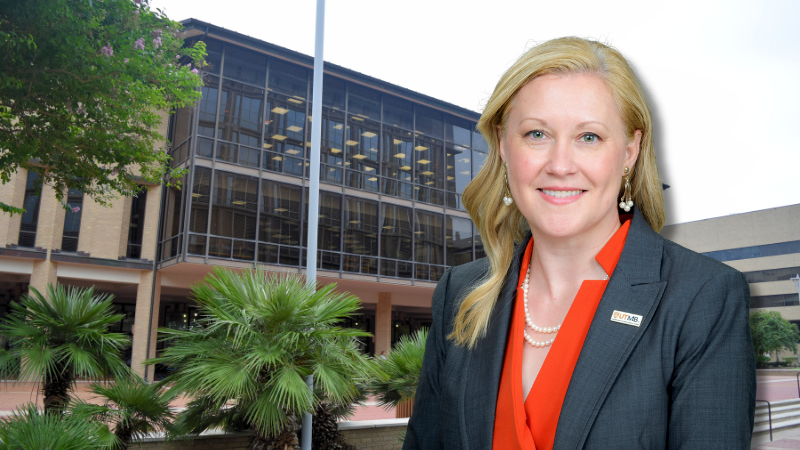
This summer, UTMB welcomed a new Director of Library Services, Emily J. Hurst, MSLS. With a wealth of experience in library leadership, strategic planning, development, and innovation, she opens an exciting new chapter for Moody Medical Library at UTMB.
Now, Hurst is welcoming the UTMB community to discover – or rediscover – everything the library has to offer.
“When you say the word ‘library,’ some people think of the place where there are books. But in time, the construct of what a library is has changed,” she says. “How do we bring people together around everything the library is doing today?”
Hurst is eager to partner with UTMB faculty, staff, and students to leverage the library in support of their academic and research goals. She outlines three central components – resources, people, and spaces – that uniquely shape the ways users experience the library.
Resources include the expansive selection of books, including ebooks, databases, historical collections, and journals. Though much of it is now digital, Hurst says, “It’s still the heart of what the library is.”
People are essential to the library’s mission. From librarians to customer service staff to everyone working behind the scenes, the library’s staff empower visitors by providing better access to resources and education as well as research support.
Over more than 50 years, the Moody Medical Library building has been visited by countless faculty, staff, and students. As the library’s function has evolved over time, Hurst is excited to reimagine some of its spaces.
“People want to go to places they are inspired to be in,” she says. “We have opportunities to accommodate new services and introduce new concepts of how the library can be used.”
Hurst most recently served as Associate Vice Provost and Dean of the Health Sciences and Human Services Library at the University of Maryland, Baltimore where she had a clear line to understand how curriculum, academic affairs, and clinical care had to be synchronous to support student success.
That experience guides her leadership at UTMB, where she anticipates partnering with faculty in a similar fashion.
“My vision is understanding where the library can provide a value add for students and faculty, and sharing the expertise that the library or staff can bring to the picture,” she says.
There is no shortage of opportunities for the library to support faculty, Hurst explains. Librarians can serve as guest lecturers, provide education on searching for literature, and assist with conducting literature searches, to name a few examples.
If a faculty member cannot get a certain book due to licensing, librarians can find and aggregate similar content to fulfill the faculty member’s needs.
“That way they can get the resources they need without having to spin their wheels,” she says. “We can help the faculty do this when their expertise is needed at the heart of the research.”
The library is also an important resource for researchers looking to publish their work. Through the library’s agreements with open access publishers, faculty members can publish without having to pay any fees.
Hurst says the librarians’ expertise also comes into play here, as they can share insights on where faculty members are currently publishing and what has a high impact factor.
Every UTMB academic department has a Library Liaison who can provide individualized support for a wide variety of needs. As an entry point to working with the library, Hurst recommends that faculty members connect with their Liaison or with her.
“I encourage all new faculty to come to the library and find out about all the things we can do,” she says. “I’ve also met established faculty members who don’t think the library has anything to offer them, but when I start naming the things we can do to support them, it opens up their eyes.”
Visit the Moody Medical Library website to learn more about its programs and services.