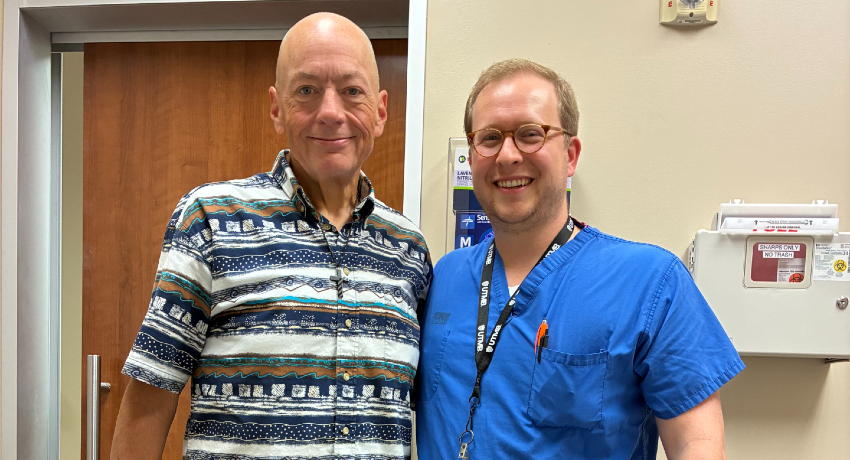
Jody Clevenger needed a place to hide. And he needed to find one quickly.
He knew a seizure was coming on, and he couldn't let the coworker assigned to watch him as he worked on an offshore oil rig see what was happening. He couldn't afford to lose his job.
But that's exactly what Clevenger feared would happen if anyone discovered he had epilepsy. So, when he sensed a seizure approaching, he tried to get out of sight. Then he endured — and survived — it alone.
Clevenger’s seizures were violent, sometimes causing him to bite his tongue, break teeth or bones, or fall against equipment. One fall left him with a painful hip injury. Eventually, he could no longer conceal his condition, and in late 2014, he stopped working.
Years later, surgery at The University of Texas Medical Branch (UTMB Health) would offer Clevenger something he had nearly given up hope of regaining: a life free from seizures.
Losing his livelihood was only one of the devastating consequences of living with uncontrolled epilepsy. For years, the seizures robbed Clevenger of his independence, his confidence and, at times, his desire to keep living.
“I wasn't able to do much because I would have seizures where I bit my tongue and broke things, bones and teeth,” he said. “Mentally and physically, I just wanted to lie down. And I really didn't want to go anywhere. I didn't want to do anything.
“It actually depressed me to the point that I didn’t want to live anymore.”
Today, the 59-year-old Seabrook resident has an entirely different story to tell.
In May 2024, Clevenger underwent a temporal lobectomy at UTMB Health. He hasn't experienced a single seizure since.
Also known as an anterior temporal lobectomy, the surgery removes a portion of the temporal lobe to treat drug-resistant focal epilepsy, a type of epilepsy in which seizures begin in one area of the brain.
Years of uncertainty
Clevenger's epilepsy diagnosis came in 2009 at age 42. He tried numerous combinations of medications, but the seizures continued.
With help from the Epilepsy Foundation, he eventually received an implanted vagus nerve stimulation (VNS) device. Often called a “pacemaker for the brain,” a VNS uses mild electrical impulses to help regulate brain activity and reduce seizures.
The device and medication reduced the frequency of Clevenger’s seizures but didn’t eliminate them. Even with treatment, he continued to experience seizures about twice a week.
The physical and emotional toll was enormous. Despite the support of family and friends, years of unsuccessful treatments had left Clevenger with little hope that his condition would ever improve.
Then his oldest daughter helped him find Todd Masel, MD, a UTMB neurologist.
Finding another answer
After meeting with Masel at UTMB Health in Webster, Clevenger agreed to undergo extensive testing in the Epilepsy Monitoring Unit (EMU) at Jennie Sealy Hospital in Galveston to determine whether surgery might offer a better way to control his seizures. The EMU at Jennie Sealy recently underwent an expansion, doubling its bed capacity from four to eight to provide more access for patients.
The evaluations included specialized electroencephalogram (EEG) monitoring to study the electrical activity in his brain and help physicians understand where his seizures originated.
Clevenger was skeptical. After so many years of unsuccessful treatments, he had come to expect disappointment and considered the evaluations as just another round of testing that probably wouldn’t lead anywhere.
“I thought, ‘Big deal,’” he said.
But the encouragement he received from members of his care team gradually changed his outlook. He fondly remembers a technician named Mike who took the time to talk with him during a particularly frustrating hospital stay. That conversation persuaded him to continue with the testing rather than give up.
He also remembers a young physician whose determination to find an answer made a lasting impression.
“She told me about her passion for helping find answers about my seizures,” he said.
Working with Masel and UTMB Health neurosurgeon Patrick Karas, MD, Clevenger underwent surgery to treat his drug-resistant epilepsy. The results exceeded anything he had dared to imagine.
“I haven’t had a seizure since the operation,” he said.
Learning to live again
Becoming seizure-free didn’t mean Clevenger immediately stopped worrying.
After living with epilepsy for so many years, he found it difficult to trust that the next seizure wasn’t just around the corner. He also faced challenges with speech following surgery, although he said his ability to communicate has improved substantially.
A friend who previously worked as a nurse encouraged Clevenger to focus on what he could do rather than what might go wrong.
“She told me to stop thinking about, ‘Oh, this might happen. That might happen. Yeah, it might, but you’re not having seizures now, so accept that as a positive and focus on that,’” Clevenger said. “She’d be like, ‘Let’s go do this, let’s go do that,’ and that made a big difference in me getting out doing things.”
Gradually, he began testing his limits. He started exercising, taking better care of his health, and exploring activities that had once seemed impossible. One of those activities was running.
Before surgery, Clevenger had never considered himself a runner. In fact, he said he had run a mile only once, and that was when he was in his early 20s. Now, he participates in 5Ks, 15Ks, and half marathons.
He regularly runs in the Seabrook area and enjoys tackling the incline of the Kemah Bridge. In September, he traveled to Plymouth, Indiana, to participate in a 5K.
“I got the idea that, well, if I run, I’ll see if something happens to me. And then my body will tell me, ‘Hey, you know, I’m physically not able to do this.’ But it never did that.”
His physical transformation has been equally dramatic. Clevenger reports that his weight dropped from approximately 380 pounds to 190 pounds as he embraced a more active lifestyle.
But the changes extend beyond his physical health. He’s traveling again and spent much of September visiting family and exploring several states. He’s also considering returning to work.
Masel said that while it’s tempting to call Clevenger’s recovery miraculous, it’s not uncommon for people who undergo epilepsy surgery to become seizure-free. But Clevenger had something else going for him as well.
 “What is unique about Mr. Clevenger’s case is that after the surgery he did not just stop and stay content with being seizure-free,” Masel said. “He continued to improve his life in incredible ways, losing nearly 200 pounds and starting to run half marathons in his late 50s.
“Epileptologists and epilepsy surgeons can often stop someone’s seizures with medications and surgery, but everything that happened after that in Mr. Clevenger’s case is really the result of his own determination and drive.”
More than medical care
When Clevenger talks about his experience at UTMB Health, he doesn’t limit his gratitude to the physicians who diagnosed and treated his epilepsy.
He remembers the nurses who stopped to talk with him, the technicians who offered encouragement, and the employees who made his hospital stays a little easier.
“I really hope that life treats them well because every person at UTMB Health is someone I look up to,” he said. “I don’t care if they were cleaning the bathroom or taking pieces of my brain. Everyone at UTMB helped me get through hell and come out fit and ready for life.
“People have helped me, and many of them have no idea they did. They were just doing their jobs. Well, to some of us, that work is a very special gift.”
That sense of gratitude has also shaped how he thinks about others living with epilepsy. Having experienced the isolation, fear, and frustration of uncontrolled seizures, he wants people facing similar challenges to know they aren’t alone. And he hopes his story will encourage others to keep seeking answers and support.
Masel said many people who are candidates for temporal lobectomy live with uncontrolled seizures for years before considering surgery. Some fear the surgery itself, he said, while others simply aren’t aware that it’s an option.
“In most cases, a person with epilepsy is a candidate if they are still having some seizures despite trying two or more antiseizure medications,” Masel said. “There are many people with epilepsy who are candidates for epilepsy surgery without knowing it.
“I would encourage anyone with epilepsy to have an immediate and constant dialogue with their neurologist about whether they are, or might become, a candidate for epilepsy surgery. The results can be dramatic, and the cure rate is incredibly high.”
For Clevenger, the surgery did more than stop his seizures. It gave him the opportunity to rediscover what it feels like to look forward to tomorrow. And these days, tomorrow might include another run, another road trip, or some other adventure he once never imagined possible.