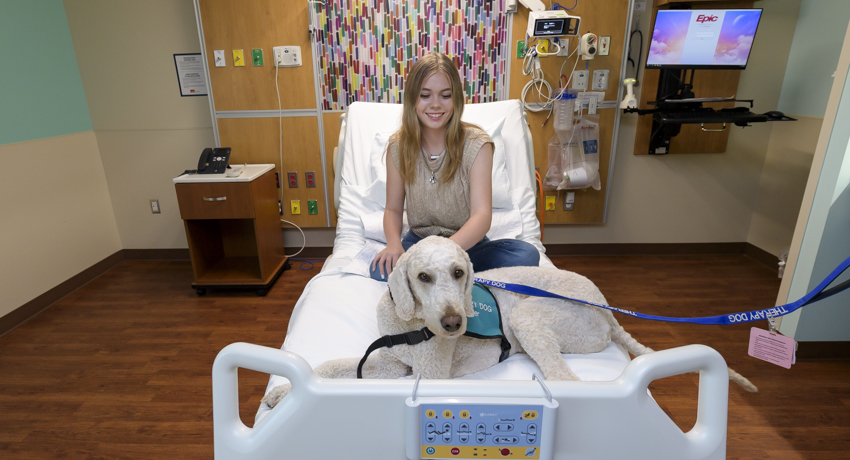
For 16-year-old Lilly Tucker of Van Vleck, Texas, a six-week hospitalization at The University of Texas Medical Branch (UTMB Health) following two major spinal fusion revision surgeries was marked by pain, uncertainty, and temporary partial paralysis. But amid the challenges of recovery, visits from dogs in the pet therapy program at UTMB Health offered comfort, distraction, and a sense of normalcy.
What began as a suggestion from UTMB Health certified child life specialist Lizette Pérez quickly became a bright spot in Lilly’s hospital stay, giving her and her mother, Jessica, something to look forward to during one of the most difficult times of their lives.
An unexpected turn
Jessica Tucker, nursing manager of Perioperative Services and the Sterile Processing Department at UTMB Angleton Danbury Campus, said Lilly’s scoliosis developed during her freshman year of high school and progressed rapidly, requiring surgery.
Last November, Lilly felt a pop in her back and immediately called her mother for help.
“She said something was wrong,” Jessica recalled. “Within an hour of arriving at UTMB Health, she had lost feeling in her right leg.”
Lilly required emergency revision surgery because she was still growing.
“The rods and screws in her back were not designed to stay in place as she grew,” Jessica said. “We couldn’t just get on an airplane and go somewhere else, so we were blessed to have UTMB Health. Even though I work here, I didn’t realize pediatrics offered this level of care.”
Four-legged therapy
Recovery was slow.
“I really couldn’t move that first month,” Lilly said. “When Lizette came in one Monday morning and asked if I’d like to see a dog, I said yes. The handler would put a blanket on my bed, let the dog jump up, and stay for about 30 minutes.”
Golden retrievers Turbo and Diva, along with Roger, an affectionate goldendoodle, became regular visitors.
“I missed my own Dalmatian a lot while I was in the hospital,” Lilly said. “Having them around made me feel more comfortable, more like I was at home. The handlers even offered to bring the dogs outside their regular visiting hours if I wanted, and I always said yes.”
Walking laps with Turbo
As Lilly regained strength, she began taking walking laps around the pediatric intensive care unit (PICU) as part of her rehabilitation. Turbo often walked beside her.
“Turbo became part of Lilly’s walking therapy,” Jessica said.
“I think I walked better with the dog than I would have without him,” Lilly said. “The next day, when Turbo wasn't there, it was harder. He would brush against my leg, look up at me, and make eye contact. It made everything easier and more comforting. He wasn’t there just for pet therapy. He became part of my physical therapy, too.”
Healing and hope beyond medicine
Jessica, who has managed intensive care units throughout her nursing career, said the emotional benefits extended beyond Lilly.
“Pet therapy gives patients a reason to get up,” she said. “It gives them something to look forward to, a reason to brush their teeth, brush their hair, and get through the day. The child life program at UTMB Health is already incredible, but adding the dogs brought a sense of peace.”
Pérez said that routinely integrating pet therapy animals into the child life program at UTMB Health has been instrumental in children’s healing and positive coping throughout their medical journey.
“I have consistently observed that our pet therapy animals create meaningful connections with our pediatric patients, their loved ones, and our staff,” she said.
For Jessica, the visits offered a brief escape from the uncertainty that accompanied each day in the hospital.
“When the dogs came in, everything felt right, even if it was only for a little while,” she said. “You could stop worrying about the ‘what ifs’ and what the doctors were going to tell us next. The dogs were there for Lilly, but petting them and loving on them helped me, too. The staff feels the same way. It’s unconditional love.”
Lilly said the dogs also helped distract her from pain.
“After my first surgery, I didn’t have animals around, and I had a lot less motivation to get up and walk,” she said. “There was nothing to distract me from the pain. The dogs really helped take my mind off everything that was going on.”
The difference was measurable.
“With the dogs, Lilly could make it around the PICU in about 10 minutes,” Jessica said. “Without them, it took about twice as long. The difference was remarkable.”
Back to normal teenage life
Today, Lilly has returned to an active life.
“I’m fully able to move, walk, and run,” she said. “Sometimes my leg still goes numb, but it always comes back. I have to give a big thank you to the dogs for helping me get to where I am.”
Jessica said Lilly’s spine is now fully fused from her fourth thoracic vertebra, or T4, to her fourth lumbar vertebra, or L4.
“She lives her life and doesn’t get out of doing anything,” Jessica said with a laugh. “And she has excellent posture.”
Looking back, both mother and daughter say the pet therapy program played an important role in Lilly’s recovery.
“This shows what UTMB Health has to offer,” Jessica said. “Some hospitals can only give you a doctor who visits and leaves. UTMB Health can give you that, but it can also give you this.”