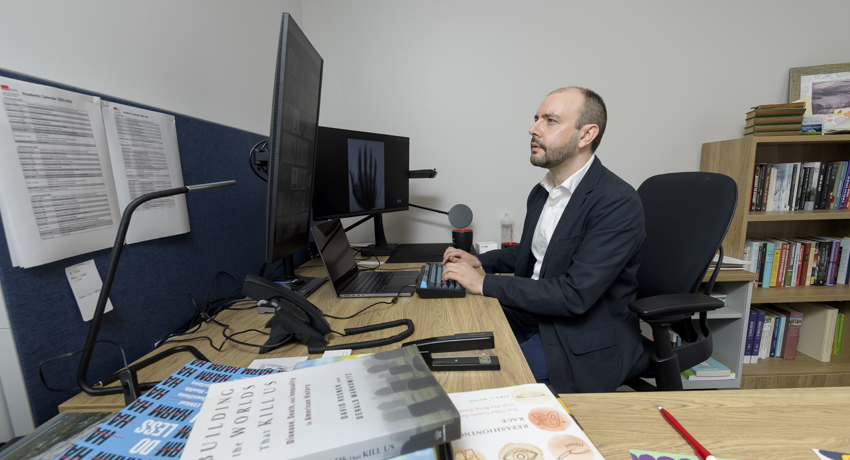
Artificial intelligence is changing diagnosis, but not replacing physicians
Artificial intelligence is rapidly reshaping medicine, promising faster diagnoses, greater accuracy, and new ways to detect disease. But as AI becomes more deeply embedded in healthcare, bioethicists at The University of Texas Medical Branch (UTMB) are asking a broader question: Beyond speed and precision, what makes a diagnosis meaningful, and what role should AI play in one of medicine’s most important decisions?
“One of the major questions in my field is how physicians categorize disease, how those categories have changed over time, and how those changes affect patients,” said Jacob Moses, PhD, an assistant professor in the Department of Bioethics and Health Humanities.
The rapid development of artificial intelligence and its growing use in healthcare have intensified those questions.
“The use of AI has been met with both concern and enthusiasm,” Moses said. “Efforts to automate diagnoses, describe disease more accurately, and ultimately diagnose patients more efficiently have garnered tremendous attention from physicians, healthcare payers, policymakers, and patients.”
While speed and accuracy are critical, Moses said they are only part of what makes a diagnosis valuable.
“A diagnosis is so key that, in medicine, a disease almost doesn’t exist until it has a name and a billing code,” he said. “Without a name, a disease isn’t visible to the medical system. Patients and families understand this as well.”
Diagnosis, he explained, is also deeply personal.
“When a diagnosis is not readily forthcoming, and it takes weeks, months, or even years to arrive at one, sociologists refer to it as a ‘diagnostic odyssey,’” Moses said. “Diagnoses guide care, but they are also a way of caring for someone who is sick.”
AI learns from physicians
As AI tools become more sophisticated, questions naturally arise about whether they can perform as well as physicians.
Moses cautions that the comparison is more complicated than it may seem.
“Doctors do many things, and arriving at an accurate diagnosis is just one of them,” he said.
Because AI systems learn from vast collections of physician-generated data, he said, they do not truly operate independently.
“All AI tools are trained on the labor of human practitioners,” Moses said. “It's not a fair comparison of human versus machine because the machine is drawing on the expertise and judgment of many humans who fed data into the model.”
The effectiveness of AI varies widely depending on the medical specialty and the maturity of the technology.
For Moses, the emergence of AI is the latest chapter in a much longer story.
“In the '70s, the process of digitization began,” Moses said. “Efforts to use computers to aid diagnosis is nothing new. The question is how to assess these tools based on their accuracy, their impact on access to care, and how they might displace human labor.”
Building guardrails for AI
As AI becomes more common in clinical care, Moses said medicine must establish clear guardrails for its use.
“Medicine is a highly regulated sphere of activity,” he said. “You can't make claims about drugs without going through a regulatory process, and that provides a useful model for how medicine evaluates, tests, and guides the development and use of new tools.”
Medicine already has experience evaluating emerging technologies, he added.
“Just because there are new aspects to this tool doesn't mean we can't use the models that have served us well, including requiring developers to back up their claims with independent data,” Moses said.
Protecting patient privacy
The ethical questions surrounding AI extend beyond diagnostic performance. As these technologies become more integrated into patient care, they also raise concerns about how sensitive health information is collected, shared, and protected.
For Moses, patient privacy is fundamental to evaluating AI’s role in medicine.
“A lot of our current digital system rests on the notion of individual consent to engage with the service and to give our data,” he said. “The bigger question is: What reasonable privacy protections can people expect when they disclose sensitive health information?”
Those questions cannot be answered by individual patients or physicians alone, he said.
“There are special protections for health information because everyone recognizes that it can be very sensitive,” Moses said. “Disclosing information inappropriately could negatively impact someone's life.”
The challenge is balancing the need for large amounts of health data to improve AI systems with patients’ expectations that their personal information will remain secure.
“When using digital services, how many people read the terms of service or really understand what those agreements mean?” Moses said. “Patients rightly expect their information will be treated with great security and integrity.”
Looking beyond technology
As artificial intelligence continues to evolve, Moses believes the conversation should focus on more than whether computers can diagnose disease faster than humans.
The larger challenge, he said, is ensuring that innovations strengthen, rather than weaken, the trust, relationships, and ethical foundations that have always been at the center of medicine.