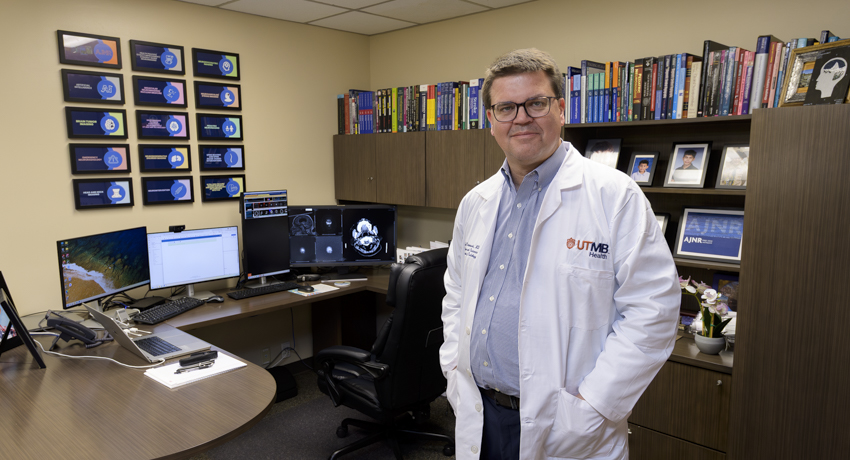
The University of Texas Medical Branch (UTMB) recently welcomed Max Wintermark, MD, a physician-scientist and internationally recognized leader, as chair of the Department of Radiology.
Wintermark, whose work has helped advance neuroimaging across stroke, traumatic brain injury, and mental health, joined UTMB Health after serving as professor and chair of neuroradiology at The University of Texas MD Anderson Cancer Center.
For Wintermark, radiology is fundamental to how modern medicine works across hospitals, clinics, and community settings.
“Radiology plays a central role in the management of many patients,” he said. “Almost every single patient undergoes some kind of imaging study.”
A fortuitous detour
Wintermark’s passion for radiology began when he was a medical student at the University of Lausanne in Switzerland. An asthma diagnosis cut short his summer commitment to military training, and he found himself with a few months of free time.
Rather than viewing the setback as a disappointment, Wintermark saw it as an opportunity to tackle something challenging.
“I'm the type of person who, when I eat my dinner, eats the spinach first because I really don't like it,” Wintermark said. “And then I enjoy the rest of the meal.”
He opted to get radiology training out of the way so he could get to the specialties he found most compelling: cardiology and neurology.
"Radiology was not at all what I expected. I loved it, and I serendipitously found my career path," he said.
Since arriving at UTMB, Wintermark has focused on strengthening the department’s clinical impact by improving the timeliness and efficiency of imaging services, with particular attention to helping patients receive scans and results as quickly as possible. He sees this work as a critical step toward better serving patients.
“It’s not something that can be achieved in one day,” he said. “But over the next year or so, I am confident that we will reach that goal.”
Commitment to research
At the same time, Wintermark, who earned a master’s degree in clinical research from the University of California, San Francisco, emphasizes that research is essential to the future of radiology and patient care.
“Because we have been so focused on the clinical mission, there has not been a lot of time to work on research,” he said. “But I think research is very important because the technology is evolving, and research is needed to adapt that new technology to patient care. If we don't do the research, we'll fall behind clinically. So really, the clinical and research missions need to work hand in hand.”
That vision extends beyond radiology.
“We want to do research within the department, but we also want to help other departments with their imaging research needs,” he said.
As a neuroradiologist, Wintermark is especially energized by the UTMB momentum in neuroscience and brain health. He highlights the potential of advanced imaging techniques to deepen understanding of how the brain works.
“We’re able to look beyond the structure of the brain to understand different brain networks,” he said. “It’s a very powerful approach.”
Collaborating across disciplines, Wintermark said, often requires translating shared goals into a common language.
“You often have common problems you are trying to tackle but need to learn how to use a different language to convey your message,” he said.
Wintermark also emphasized the importance of keeping patients at the center of the work, even though radiologists don’t interact with patients as often as many other clinicians.
“The nice thing with radiology is it's at the intersection of patient care and technology, so you get to use technology to help patients,” he said.
Training forward-thinking radiologists
Education is another key priority, particularly as the field faces a national workforce shortage.
“Radiology is changing, and we need to train our next generation of radiologists, especially because we have that shortage,” Wintermark said.
Since arriving at UTMB, the people and culture have made a strong impression on him.
“There are great people, amazing people, both within my department and outside, and also strong leadership,” Wintermark said.
He points to the institution’s sense of momentum.
“The energy is palpable. You feel the dynamic character of the institution,” he said, noting that the “long history of excellence here really attracted” him to UTMB.
Looking ahead, he is focused on ensuring the Department of Radiology plays a central role in the future of UTMB.
“It's an exciting time with all the initiatives that we have started and planned for the future,” Wintermark said. “My goal for myself and for my department is really to make sure that Radiology can be a full partner for all those initiatives.”