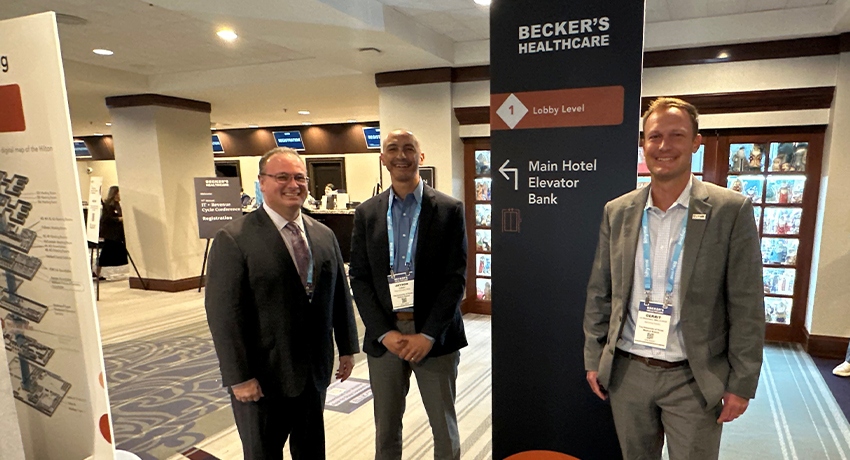
Leaders from The University of Texas Medical Branch (UTMB) joined healthcare executives from across the country in Chicago this month for Becker's Healthcare Future of AI & Digital Health Conference, contributing to national conversations about how artificial intelligence is transforming patient care, digital health, and healthcare communications.
Representing UTMB were Jayson Laban, chief information officer; Stephen Williams, MD, MBA, MS, FACS, FACHE, associate chief medical officer at UTMB Clear Lake; Gerrit von Wenckstern, MBA, director of marketing; and Jesse Dodd, director of access services.
Each speaker shared perspectives on how healthcare organizations can embrace innovation while maintaining a focus on patient needs, trust, and responsible implementation.
Building a foundation for responsible AI adoption
Speaking during a panel discussion on AI adoption and organizational strategy, Laban emphasized the importance of building a strong foundation before scaling new technologies.
“We need a foundation. We need governance in place. And we need to decide what we want to do,” Laban said. “We focus on use cases, prove those use cases out, work on scale, and do it within our own environment.”
Throughout the conversation, Laban highlighted the need to evaluate emerging technologies through the lens of measurable outcomes and patient value rather than simply pursuing the latest innovations.
“We need to get to a position where people get to the right care much more seamlessly,” he said, describing the future of digital patient engagement.
Using technology to improve patient experience
Williams participated in conversations focused on patient experience and technology-enabled care transformation, including sessions titled “Tech Tools to Reshape Patient Care” and “Transform the Digital Patient Experience: Bold Ideas From Top Systems.”
During those discussions, he addressed opportunities to use technology to improve access to care, identify health risks earlier, and create better patient experiences.
“We want patients to have accessible information at the point of scheduling with no surprise billing,” Williams said. “Ultimately, what we want to do is improve the continuum of care and create better experiences for patients.”
Williams also discussed opportunities to use AI, predictive analytics, and other digital tools to identify risks earlier and move healthcare toward more proactive and personalized care. He emphasized that successful technology adoption should ultimately be measured by its impact on patients, whether it improves access, reduces unnecessary burden, supports clinicians, or enables earlier and more effective care.
Preserving trust and authenticity in healthcare communications
In a separate panel focused on healthcare marketing and communications, von Wenckstern discussed the importance of maintaining trust, accountability, and authentic voices as AI becomes more prevalent.
“AI is great at giving the appearance of expertise,” von Wenckstern said. “Governance ensures that the expertise is actually there.”
He also stressed the importance of maintaining human accountability when using AI-assisted tools.
“Start with human judgment and end with human accountability. AI can strengthen what happens in between,” he said.
Von Wenckstern noted that healthcare organizations must remain focused on the people and communities they serve as new technologies continue to evolve.
“The goal isn't better marketing,” he said. "The goal is better health for the community we serve.”
AI in the healthcare contact center: What’s working, and what’s not
Dodd participated in a virtual panel that brought together leaders to discuss separating hype from reality when introducing AI within a healthcare contact center.
During this session, leaders discussed where AI truly adds value, how to avoid common pitfalls, and strategies for effective integration to improve efficiency, staff capacity, and patient experience. Future investment priorities were also a key topic. Dodd discussed the strategy of using AI to prioritize referrals.
“This process has allowed our teams to focus our efforts on higher-acuity patients, ensuring they receive the timely care they need,” he said.
He also stressed the importance of starting small and not trying to fix a broken process with AI.
“At UTMB, we are looking at our roadmap in a crawl, walk, run approach by identifying small areas of opportunity, gaining some successes, and moving to more complex processes down the road,” Dodd said.
Together, the presentations highlighted three essential elements of healthcare innovation: strong governance, measurable value for patients and clinicians, and preservation of human trust and accountability.