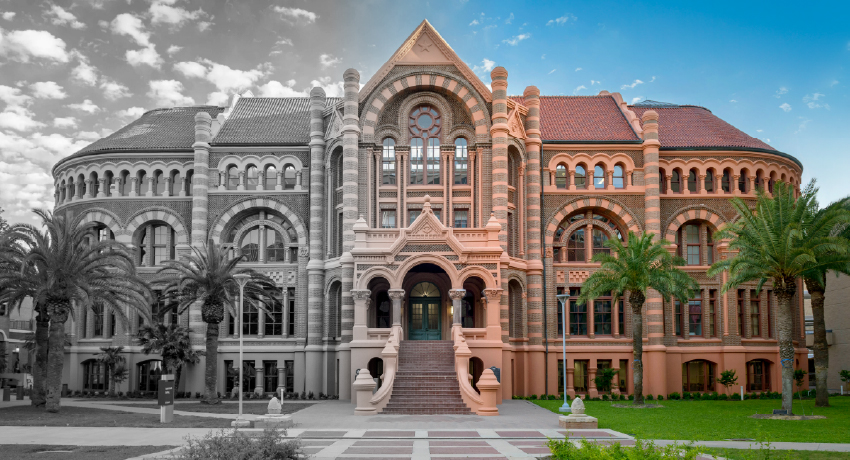
From Dr. Ashbel Smith to Dr. Jochen Reiser, the 135-year history of The University of Texas Medical Branch (UTMB) has been shaped by the hands, minds, and determination of people who had a vision of what could be and helped make it happen.
They were physicians and scientists, educators and philanthropists, students, and leaders. Some laid literal foundations. Others broke barriers, advanced medicine, rebuilt after disasters, or pushed the boundaries of research and discovery. Together, they transformed a small medical school on Galveston Island into an academic health system with impact that extends across Texas and around the world.
Building the foundation
UTMB opened its doors Oct. 5, 1891, as the Medical Department of The University of Texas, with 23 students and 13 faculty members. But its story began even earlier.
Physician, statesman, and educator Dr. Ashbel Smith was among the strongest advocates for establishing The University of Texas and a medical department to train physicians for the growing state. Galveston voters and civic leaders embraced the idea, and businessman and philanthropist John Sealy provided another critical piece of the emerging institution.
After Sealy’s death, a $50,000 bequest helped fund construction of the first John Sealy Hospital, which opened in 1890. The hospital gave students at the new medical school something essential: a place to learn medicine while caring for the people of Texas.
The partnership between the Sealy family and UTMB would become one of the most enduring relationships in the institution’s history. Sealy’s children, John Sealy II and Jennie Sealy Smith, established The Sealy & Smith Foundation in 1922. Over the century that followed, the foundation’s support helped shape the institution’s hospitals, research facilities, academic programs, and clinical enterprise.
Tested by tragedy
When the catastrophic 1900 hurricane devastated Galveston, the young medical school survived. Dean Henry Pendleton Cooke ensured that classes resumed and that the institution continued its mission despite the destruction surrounding it.
Others helped establish the academic foundation on which UTMB would grow.
William Keiller, the institution’s first professor of anatomy, became known for his teaching and anatomical scholarship. Marie Charlotte Schaefer, a UTMB graduate, became the first female faculty member at UTMB in 1901 and later its first female professor, opening doors for generations of women who followed.
UTMB also developed an early tradition of confronting infectious disease. Researchers and physicians responded to bubonic plague in Galveston in 1920, and scientists including Mark Boyd and William B. Sharp helped establish an infectious disease research tradition that would eventually become one of the institution’s defining strengths.
Expanding the mission
By the 1940s, UTMB was evolving from a medical school and hospital into a more comprehensive academic medical center.
Dr. Chauncey Leake, who arrived in 1942, championed research, graduate education, and the recruitment of scientists, strengthening the institution’s growing academic enterprise.
Then came one of the defining moments in the institution’s history.
On April 16, 1947, the SS Grandcamp exploded in the Port of Texas City, killing hundreds and injuring thousands. UTMB mobilized to care for victims of what became the deadliest industrial disaster in U.S. history.
Truman G. Blocker Jr., MD, a UTMB graduate and surgeon, helped lead that response. The experience helped fuel his work to advance burn treatment and ultimately contributed to UTMB becoming an internationally recognized center for burn care. Blocker would go on to serve as dean and, in 1967, become the first president of UTMB. The Blocker Burn Unit, established immediately after the 1947 disaster, bears his name.
In 1949, Herman Aladdin Barnett III enrolled at UTMB, becoming the first African American student admitted to a medical school in Texas. A former Tuskegee Airman, Barnett graduated in 1953 and went on to a career as a physician, surgeon, and educator.
Across the decades that followed, UTMB continued to expand. New schools and graduate programs were established, while hospitals, laboratories, and academic buildings rose across the Galveston Campus. Faculty members built nationally and internationally recognized programs in fields ranging from surgery and pediatrics to aerospace medicine, neuroscience, and infectious disease.
Taking discovery to the world
The institution’s infectious disease legacy took another leap forward beginning in the 1990s. Scientists including David Walker, Robert Shope, Robert Tesh, and Stanley Lemon built programs devoted to tropical and emerging infectious diseases and strengthened the ability of UTMB researchers to study some of the world’s most dangerous pathogens.
That work ultimately led to the establishment of the Galveston National Laboratory in 2003, one of only two National Institutes of Health-designated National Biocontainment Laboratories in the United States.
Researchers including Dr. James LeDuc, Dr. Thomas Geisbert, and many others further established UTMB as a global center for emerging infectious disease research.
Rebuilding and growing
When Hurricane Ike struck Galveston in 2008, flooding much of the campus and forcing widespread closures, UTMB rebuilt. The recovery became an opportunity not simply to restore what had been lost, but to rethink the future of UTMB.
In the years that followed, UTMB expanded its clinical footprint beyond Galveston, including major growth in League City, while adding new facilities on the island. Jennie Sealy Hospital opened in 2016, marking a new era in patient care while carrying forward the name of one of the family’s most important early benefactors.
Today, the institution that began with 23 students and 13 faculty members is home to more than 16,000 people across four campuses, six hospitals, numerous clinics, five health sciences schools, and seven institutes for advanced study.
The next 135 years
Since becoming UTMB president and CEO of the UTMB Health System in 2023, Jochen Reiser, MD, PhD, has emphasized greater integration among the institution’s missions of patient care, education, and research while adding innovation as a core institutional pillar.
Under his leadership, UTMB has launched the Moody Brain Health Institute and expanded its work in brain health and the emerging brain economy; advanced a major expansion of the League City Campus; strengthened cancer programs; increased the use of artificial intelligence and other emerging technologies; and brought the Blue Zones Project to Galveston to support community health and longevity.
UTMB also has begun an ambitious new chapter in cardiovascular medicine. In 2025, The Sealy & Smith Foundation committed $50 million to establish the Sealy Heart & Vascular Institute and Department of Cardiovascular Medicine. In August 2026, the foundation announced an additional $180 million commitment — the largest philanthropic commitment in UTMB history — to expand cardiovascular care, research, and education.
Those investments are part of a larger vision for what the next era of UTMB can become.
“The history of UTMB is remarkable not simply because of how long this institution has endured, but because generation after generation of people has chosen to build upon what came before,” Reiser said. “As we celebrate 135 years, our responsibility is to honor that legacy by continuing to push forward, connecting science, education, innovation, and compassionate care in ways that improve health for the people of Texas and beyond.”
Reiser’s vision of the future is rooted in a history of meeting challenges and embracing change.
Over 135 years, storms have passed. Epidemics have faded. New discoveries have replaced old certainties.
What has endured is the determination of people who believed UTMB could do more for the health of Texas and the world. One generation built the foundation. Another expanded it.
Now, a new generation is building on that legacy and carrying it forward.