Allison Brown says she isn’t much of a cook, but she’s hoping to change that. The beautifully illustrated cookbook she received at the inaugural Blue Zones One Pot Miracle Moai class at The University of Texas Medical Branch (UTMB) Osher Lifelong Learning Institute (OLLI) should help — if she can get her hands on it
When asked at the second class if she had tried any of the recipes from the book, Brown explained that her husband, Galveston City Councilman Bob Brown, had commandeered it as soon as she brought it home and started marking dishes he wanted to make.
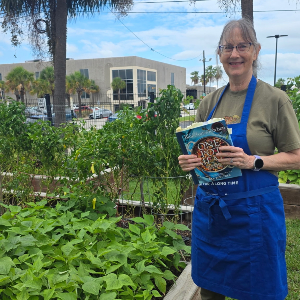
And she had the cookbook, complete with colorful tabs marking the recipes he had selected, with her to prove it.
The Blue Zones One Pot Miracle Moai is a 10-week program in which 25 OLLI members are learning how to prepare simple, healthy meals while exploring something equally important to the Blue Zones approach to longevity: the role that relationships, purpose, and community play in helping people live longer, healthier lives.
The program combines nutritional education, hands-on cooking, and social connection around the Blue Zones “Power 9®” principles — lifestyle practices identified in areas of the world where people routinely live long, healthy lives.
UTMB has partnered with Blue Zones Project to help reshape Galveston's environment, food systems, and social infrastructure in support of community health and longevity.
Participants learn whole-food recipes they can recreate at home using an Instant Pot, which is included in the program fee.
The goal isn't to persuade participants to completely overhaul the way they eat, according to Craig Kovacevich, MA, vice president for Strategic Community Impact at UTMB.
“As we start to think about our Blue Zones Project journey in Galveston, one of the core principles of the Blue Zones philosophy is healthy eating,” Kovacevich said. “And it is really a focus on ‘plant slant,’ thinking about how you incorporate more vegetables, fruits, beans, and whole grains into your diet.
“We're not asking people to abandon their current diet, but we do want them to make healthier choices through simple, practical changes.”
“Plant Slant” is one of the Blue Zones Power 9 principles and emphasizes incorporating more plant-based foods into everyday meals. Other principles focus on natural movement, purpose, stress reduction, family, belonging, and cultivating a supportive social circle — what Blue Zones calls the “Right Tribe.”
More than a cooking class
That social component is built directly into the OLLI experience. Participants are divided into five-person groups known as Moais®, modeled on a tradition from Okinawa, Japan, one of the original blue zones. Rather than simply attending class together, Moai members are encouraged to become an ongoing circle of support as they work toward healthier habits.
The OLLI course describes the Moai as a committed social circle designed to ensure participants don’t undertake their well-being journey alone. Weekly “Deep Dive” conversations explore topics including legacy, gratitude, and purpose, with the goal of creating relationships that continue after the 10-week course ends.
Brown said those ideas were part of what drew her to the program. She was already familiar with Blue Zones principles and saw their potential to improve life in Galveston. But her interest was personal as well.
“I don't know how far I’m going to go as far as age goes, but I would like to be in the best condition I can, if possible,” she said.
Although nutrition matters to her, Brown said the program’s emphasis on purpose and relationships is equally compelling. Since retiring several years ago, she has missed some of the daily connections that once came naturally through work.
The classes also offer an opportunity to reconnect with familiar faces and build new relationships while participating in a communitywide effort to improve health and well-being.
Brown was especially encouraged by the collaboration between UTMB and the city of Galveston, seeing it as an example of how institutions and residents can work together to make a meaningful difference in the community.
That connection becomes especially visible once participants get into the kitchen. As the recipes become more challenging, Kovacevich said, the sessions are becoming increasingly hands-on, with participants gathering around tables to chop ingredients, taste-test, compare results, and offer feedback.
“It really, really became a fun interaction,” he said, explaining that the experience fits naturally with the Moai concept and several of the other Power 9 principles.
“We want to encourage these individuals to see food as more than just fuel to sustain the body. Food is family, community, power, and identity. It brings purpose and passion — elements that are absolutely essential at every single stage of life."
Brown has appreciated the atmosphere in the classroom, particularly the number of people available to help participants as they learn. She said she was surprised by the level of staffing and support, with organizers and volunteers readily available to answer questions or connect participants with someone who could help.
Making healthy eating doable
The classes also tackle one of the practical barriers that can make changing eating habits difficult: the idea that healthier food is more expensive or complicated to prepare.
“Healthy eating doesn't require a gourmet budget and a culinary degree,” Kovacevich said. “Our mission is to prove that healthy can be simple, affordable, and, more importantly, taste really good.”
Brown was impressed by Chef Kelsey Thomas of The San Luis Resort, Spa and Conference Center, who is leading the cooking demonstrations throughout the program. Thomas incorporates budget-friendly strategies into the lessons, including substituting seasonal or less-expensive ingredients and purchasing ingredients that can be used in multiple recipes.
For Brown, those practical tips are among the most valuable parts of the experience. She recalled Thomas explaining that he substituted extra-virgin olive oil for avocado oil in some recipes because it was less expensive. He also offered suggestions for finding unfamiliar ingredients and substitutions that could be used in recipes.
Having a local restaurant chef involved in the program adds another dimension, Brown said, because participants can learn from someone who understands both food preparation and the practical considerations of cooking at home.
Now that her husband has loosened his grip on the cookbook, Brown is planning a grocery trip to pick up ingredients for a few recipes and hopes the experience will encourage her to spend more time cooking.
She wants to buy fresh ingredients and follow the recipes from start to finish, gradually developing a new routine in the kitchen.
Other members have returned to class after attempting recipes at home, sometimes successfully and sometimes with questions for the chef about what went wrong.
“They’re experimenting, which I think is good,” Kovacevich said. “That tells me that they’re open and receptive.”
The course also incorporates guest sous chefs from the community. Galveston Independent School District Superintendent Matthew Neighbors joined the session on Sept. 21, which featured Blue Zones black bean and guacamole tacos with cabbage slaw. Neighbors also talked with participants about healthy food choices in Galveston and opportunities for older adults to volunteer with the district.
For Brown, Neighbors’ participation was an unexpected highlight. Without children of her own, she wasn’t closely familiar with many of the district’s programs. She was impressed to learn about opportunities available to Galveston students, including experiences that might otherwise be out of reach for some families.
His presentation reinforced her appreciation for the broader community connections the program is creating.
Galveston Mayor John Paul Listowski joined in the session on Oct. 5 when tofu was on the menu.
At left: Craig Kovacevich, GISD Superintendent Matthew Neighbors and Chef Kelsey Thomas prepare to make Guacamole & Bean Tacos at the Sept. 21 class. At right: Ava Cares, Kara Listowski, Mayor John Paul Listowski, Craig Kovacevich, Danica Premirelli, and Beth Nunes prepare to take on tofu at the Oct. 5 class.
Starting with 25
OLLI, a community-based, noncredit educational program designed for adults, was chosen as the setting for the pilot in part because its members could provide feedback as the program develops.
Kovacevich said organizers want to know not only whether participants like the recipes, but also whether they will make them at home and serve them to spouses, children, or extended family — potentially extending the program’s reach well beyond the original 25 participants.
There is already a waiting list of people who couldn’t get into the inaugural course, and interest continued to grow after the first two sessions. Kovacevich would eventually like to see the concept extend beyond OLLI through partnerships with organizations such as churches, schools, and Galveston College’s culinary program.
Brown sees the program as part of a larger transformation taking shape in Galveston. She recalled her involvement with Project Rosenberg, a community effort to transform the former Rosenberg School property into a green space. Over several years, she watched the vacant school building come down, the property be cleared and a park begin to take shape, complete with trees and the historic Rosenberg fountain.
For Brown, the transformation demonstrated what can happen when community members work together toward a shared vision. She sees similar potential in Blue Zones Project, particularly its emphasis on creating environments that support physical, mental, and social well-being.
Being involved at the beginning of an effort that could have a lasting impact on Galveston, she said, is part of what makes the cooking program so appealing.
For Kovacevich, that’s how Galveston’s larger Blue Zones Project effort ultimately takes hold — not through a dramatic transformation overnight but through relatively small changes that become part of everyday life.
“We know it’s not going to be snap your fingers and Galveston is transformed one day to the next,” he said. “But it really is doing simple things, like getting this first group of 25 individuals to think about healthy eating.”
The hope, he added, is that participants become “ambassadors of change” as Galveston works toward becoming a fully certified Blue Zones community®.