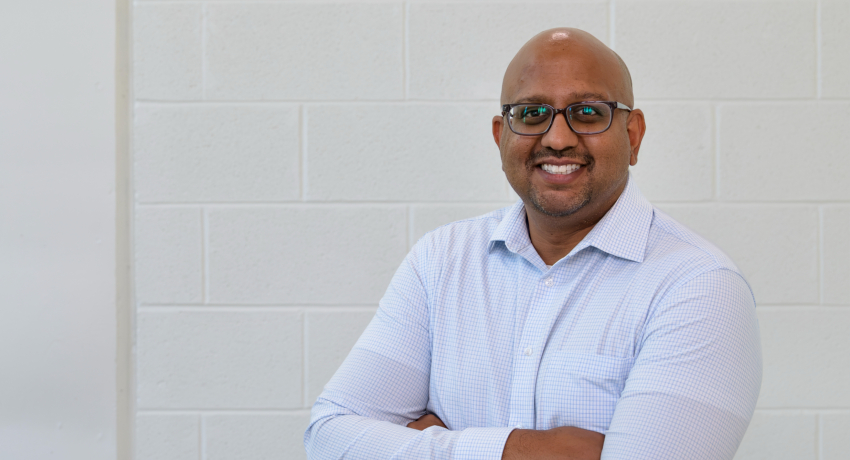
Long before becoming president of the School of Health Professions Alumni Association at The University of Medical Branch (UTMB) in 2026, Sachin Patel, MHA, RRT, RRT-ACCS, considered himself just another busy alumnus who rarely engaged with alumni communications.
Today, as a UTMB faculty member, alumnus, and alumni association president, Patel is working to strengthen connections between graduates and the institution that helped launch their careers.
“My goal is, ‘How do we get former students to open alumni mail?’” he said.
The question goes beyond convincing graduates to read something from the alumni association. Patel wants them to understand something he didn’t fully appreciate when he was a student himself: UTMB can be more than a place to earn a degree. It can become a professional community, a source of lifelong mentors, and a place to give back.
From student to clinician
As a student in the respiratory therapy program in the School of Health Professions Class of 2012, Patel was focused on something much more immediate: learning how to care for patients. And he was nervous.
“I realized that when I graduated, I would be taking care of people, and their lives would be in my hands," he said.
His clinical rotations took him from tiny patients in the neonatal intensive care unit to adults in intensive care, while also exposing him to emergency care, acute care, and pulmonary function testing.
“I remember how nervous I was the first time I put a patient on a ventilator,” Patel said. “The therapist training me and our clinical instructors stayed by my side, talked me through it, and let me learn by doing.”
Over time, the nervousness gave way to confidence. Patel credits his professors, clinical instructors, classmates, and hands-on experience at UTMB with preparing him for a career in healthcare.
An unexpected path to teaching
After graduating in 2012, Patel spent nearly a decade at Houston Methodist, working in intensive care units and emergency departments, primarily in the cardiovascular ICU, where he cared for patients including heart and lung transplant recipients.
When Jose Rojas, MD, then-chair of the UTMB respiratory therapy program, asked him to become a clinical instructor, it wasn’t a career path Patel had ever envisioned.
“If you had asked me when I was a student here, ‘Do you want to teach,’ I'd have said, ‘Heck no,’” he said. “I never pictured myself as an instructor or a leader. I looked up to my professors, but I never saw myself in their shoes. Even today, my parents say they can’t believe I’m an instructor.”
But Patel found that teaching as a clinical instructor reconnected him with what had drawn him to healthcare in the first place. During a difficult period for the profession, students brought enthusiasm and curiosity to the work , and he discovered how much he enjoyed helping them find their own way.
“After working in the ICU through the height of the pandemic, it was students and new graduates who really reignited my passion for this work,” he said. “Their energy helped me remember why I’m doing this: to help patients breathe better and simply be there for them when they need it most.”
That experience helped bring Patel back to UTMB as a faculty member in 2021 and gave him a new perspective on the professors who had once seemed larger than life. Some became his colleagues. They also remained his teachers.
Learning from mentors, then becoming one
“They're still teaching me today,” Patel said. “They’re awesome instructors and mentors, and they’re even better people.”
If Patel could give his younger self advice, he knows exactly what he would say: “Find a mentor early.”
As a student, he was so focused on grades, clinical competencies, and keeping up that he didn’t fully recognize the opportunity to learn from his professors beyond the classroom.
“Sit down with professors and pick their brains a little more than just trying to get A’s,” he tells students today. “Learn about the parts of the profession you sometimes don’t see in class, like research, leadership, and teaching.”
Now Patel occupies the role those professors once held for him. He admits that even after several years in academia, thinking of himself as a mentor still feels a little strange.
“I don't know if I’ll ever get used to it,” he said.
Seeing Galveston differently
Returning to UTMB also changed the way Patel saw Galveston.
“When I was a student, I just saw UTMB as a school,” he said. “I just saw Galveston as an island. I didn’t see it as a community of people that we have a responsibility to go help.”
Today, he volunteers at The Luke Society Clinic, serving Galveston’s underinsured and homeless population and encourages students to become involved in the community. The experience has taught him to look beyond someone’s immediate circumstances and consider the story that brought them there.
“Healthcare is more than treating a patient in the hospital,” Patel said. “It’s you being involved in other areas.”
It’s a broader view of UTMB, healthcare, and community than Patel had when he first arrived.
Before coming to UTMB, he had earned a bachelor’s degree in biology from the University of Houston but knew medical school wasn’t for him. Laboratory work wasn’t, either. Then he met a respiratory therapist working at UTMB who suggested he consider the profession.
“I looked into it. I came here. I never looked back,” Patel said. “I seriously don’t know what I would be doing without UTMB and the respiratory therapy program.”
Now, the former student who never imagined himself teaching is helping prepare the next generation and encouraging students to see their connection to UTMB as something that doesn’t end at graduation.
“UTMB has given me a lot,” Patel said. “It took me a while, but now I feel it’s time for me to give back.”