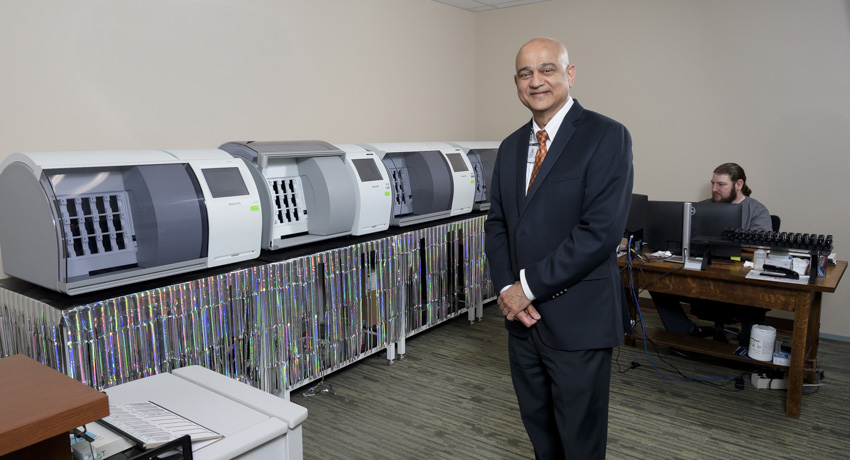
When Harsh Thaker, MD, PhD, talks about pathology, he doesn’t focus on laboratory tests or microscopes.
Instead, he talks about connections.
The newly appointed chair of The University of Texas Medical Branch (UTMB) Department of Pathology sees the specialty as a bridge between science and medicine, researchers and clinicians, and increasingly, between emerging technologies and the delivery of better patient care.
“Pathology sits right at the interface of science and medicine,” Thaker said. “It’s the science of medicine.”
As a young physician in India, Thaker imagined a future in scientific discovery, driven by questions about biology, disease, and how the human body works. That curiosity eventually took him to Yale University for doctoral studies in neuroscience, to Stanford University for cancer research, and ultimately to a specialty that united those interests.
“Once I discovered pathology, it really made sense,” he said. “It brought together everything I was interested in.”
Today, Thaker aims to expand innovation, strengthen collaborations across the institution, and advance the use of artificial intelligence and precision medicine to improve patient care.
Foundational experience
Following residency training at Columbia University, Thaker built a career that blended research, clinical medicine, and leadership. He served in several leadership roles at Mount Sinai Health System in New York, where his growing interest in informatics, digital medicine, and process improvement helped shape his approach to healthcare innovation.
That experience continues to influence his work at UTMB.
Before becoming chair, Thaker led the UTMB Diagnostic Center, helping lead initiatives in digital pathology, artificial intelligence, and advanced diagnostics. Under his leadership, the center became a hub for collaboration among pathologists, clinicians, and researchers seeking new ways to improve diagnosis and treatment.
Applying AI to improve diagnosis and treatment
One area of focus has been the use of artificial intelligence in cancer care. Working alongside colleagues in a variety of specialties, Thaker and his team are developing tools that combine pathology findings, imaging results, laboratory data, and clinical guidelines to improve diagnosis and help streamline the path to treatment.
Thaker sees AI as a tool that can strengthen clinical decision-making.
“I think of it like the safety features in a modern car,” he said. “It’s there to support the physician, help catch things that might otherwise be missed, and improve the quality of decisions.”
The department is also expanding its efforts in precision medicine through molecular diagnostics and pharmacogenomics, which uses genetic information to help predict how individual patients will respond to medications. The work has implications across multiple specialties, including oncology, psychiatry, neurology, and cardiology.
Putting patients first
For Thaker, however, innovation is not the end goal.
“The most important thing is benefiting patients,” he said.
That patient-centered mindset extends to how he views the department’s role within the institution. Rather than operating independently, he sees pathology as a connector, linking primary care providers, specialists, researchers, and health system leaders.
“We want to benefit the whole enterprise,” he said. “At the end of the day, it’s about improving care for patients.”
As chair, Thaker hopes to continue building partnerships across UTMB while fostering a culture of innovation within the department. He believes the institution’s size and collaborative culture create unique opportunities to move quickly and turn new ideas into real-world solutions.
“We’re large enough to have tremendous expertise and resources, but we’re still nimble,” he said. “If you have an idea, you can bring people together and make things happen.”
That spirit of collaboration and innovation, he said, is one of the reasons he has remained at UTMB for nearly a decade.
“Sometimes when you’re trying to do something new, there isn’t another example to follow," Thaker said. "You have to become the example.”