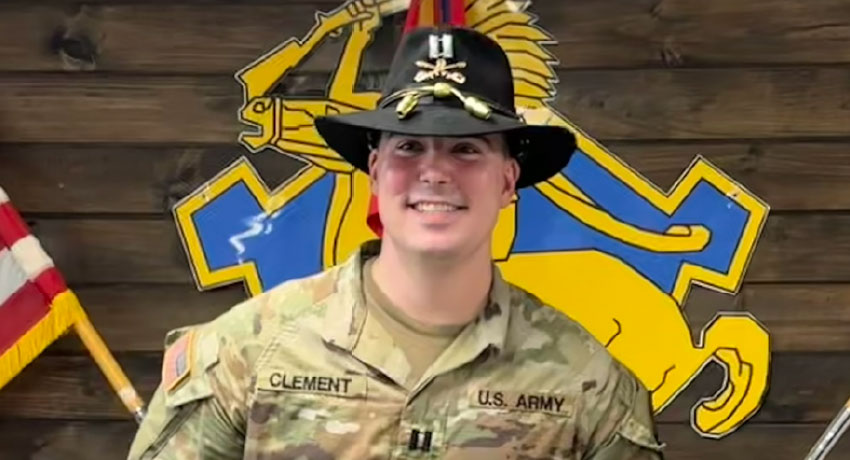
Four years as an Army armor officer weren’t part of Kelsey Clement’s plan to become a doctor. But the experience that delayed his medical education also helped prepare him for it, teaching him lessons in resilience, responsibility, and empathy that the 29-year-old first-year medical student at The University of Texas Medical Branch (UTMB) now carries into the classroom.
“My parents both retired from the U.S. Army, active duty and reserve, and my brothers are currently serving in the Army,” Clement said. “My family turned military service into a tradition. The importance of service was instilled in us. They taught us that one of the greatest ways to contribute was through military service, and so we all served in the Army. None of us strayed from that path.”
An unexpected path to medicine
Clement completed his undergraduate degree at Texas A&M University and joined the Corps of Cadets. He planned to go straight to medical school and delay his military commissioning until after becoming a physician.
“My intention was always to be a doctor,” he said. “I had shadowed, volunteered, and taken the Medical College Admission Test (MCAT). I was ready to start applying.”
The Army had other plans. Looking back, Clement considers the unexpected detour a mixed blessing.
“The Army will choose what you will do,” he said. “I always knew I had a military obligation, but delaying my entry into active service isn’t how it happened. I was commissioned in 2019 because the Army needed to fill positions, and so I became an armor officer with the 6th Squadron, 9th Cavalry Regiment at Fort Hood.”
In 2022, Clement deployed to Poland as Russia's invasion of Ukraine continued. He trained alongside Polish and Finnish forces, gaining a new perspective on other cultures and the importance of international alliances.
“That part was a blessing,” he said. “They were so thankful to have us there, and I learned that alliance between Poland and the U.S. is so important. I see now that experience really allowed me to gain insights. People come from all walks of life and backgrounds, and this helped me get ready for medical school and the rigors of what will come afterward.”
Lessons that extend beyond the battlefield
After four years as an armor officer, Clement had gained confidence, maturity, and a stronger sense of purpose. But returning to his original goal meant confronting another challenge: He had gone nearly five years without taking a science course.
“I had to pick it all back up where I had left off,” he said. “I volunteered again, shadowed again, and had to redo some of the core curriculum. I had to retake the MCAT because my scores had lapsed over the years. That part was really difficult.”
His military experience had already taught him how to make decisions under pressure, adapt when resources were limited, and work with people from different backgrounds. Those lessons, he believes, will serve him well as a physician.
“In the Army, I learned that you have to make it work, and you don’t get to choose who’s on your right or your left, or how the team is built,” he said. “You have to understand people and know that everyone has a reason, a purpose, and a why. You have to look at it from their perspective, and as a physician, I will have to serve people who are underserved or have limited health literacy. I gained that experience, and as a physician, I will have more of these experiences.”
He said Veterans Day has always felt a bit more personal to him, as the son of two veterans and the brother of two more who continue to serve.
“This day gives me the chance to reflect not only on my own time in uniform, but on the generations of service within my family and the sacrifices made by others across the country,” he said. “It’s a reminder that service is bigger than any one person, and I’m proud to carry that sense of responsibility with me as I move into medicine.”