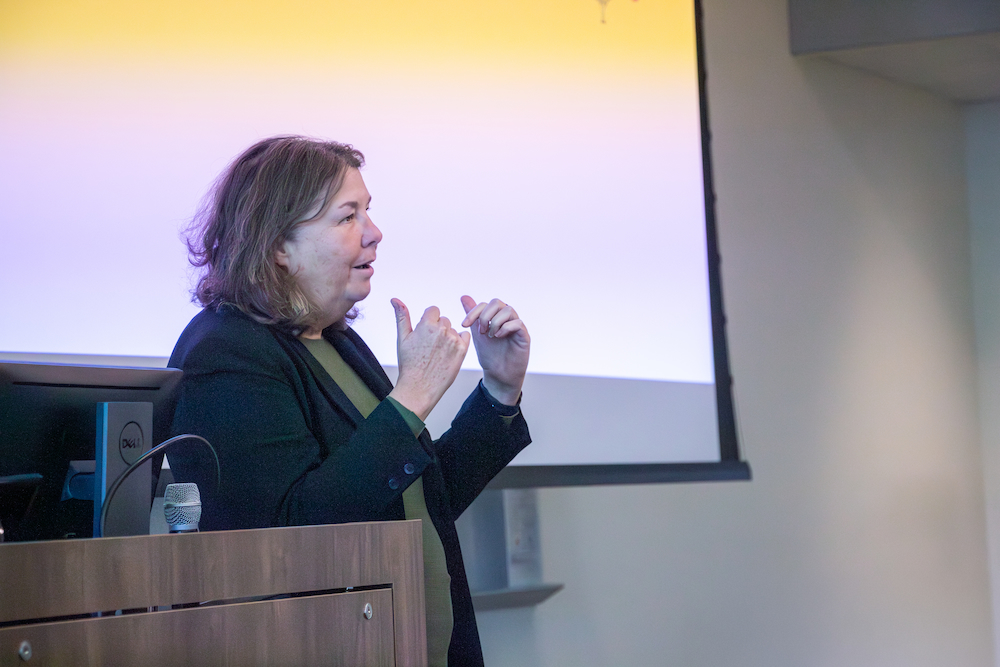
The UTMB School of Public and Population Health hosted Dr. Leila Brammer on Feb. 23 for a series of interactive sessions on constructive communication and productive disagreement. Dr. Brammer, who directs outreach and instructional development for the Parrhesia Program for Public Discourse at the University of Chicago, led separate sessions tailored for staff, students, and faculty, giving each group space to explore how they communicate across differences in their daily roles.
Why disagreement matters in public health
Dr. Brammer's work centers on helping organizations build the skills and structures needed to engage disagreement well. Drawing on decades of experience in faculty development, civic engagement, and community deliberation, she has developed frameworks used by schools, civic leaders, and workplaces across the country. At SPPH, she brought those frameworks to life through real-time exercises and candid conversation.
A central theme across the sessions was the idea that disagreement, handled well, leads to better thinking and stronger communities. Dr. Brammer walked participants through the difference between reactive, polarized discourse and the kind of responsive, inquiry-driven conversation that produces real understanding.
She encouraged attendees to start from a place of curiosity rather than argument, to ask follow-up questions before forming judgments, and to recognize that silence in a room often masks important perspectives that go unheard.
Engaged listening and practical takeaways
Each session included hands-on practice. Participants paired up to try "engaged listening," an exercise rooted in marriage and family counseling research, in which one person shares a perspective while the other asks two or three follow-up questions before paraphrasing what they heard. The goal was understanding, not agreement. Attendees practiced sitting with perspectives different from their own and resisting the urge to jump to solutions or redirect the conversation back to themselves.
Dr. Brammer also introduced two practical tools for meetings and team settings.
Sequential contributions Each person shares one perspective in turn before discussion opens up, ensuring no voice dominates early and quieter participants have a structured moment to contribute. | Fist to Five A consensus-checking method developed after the Challenger disaster and now widely used in the tech industry, allowing groups to gauge agreement on a spectrum rather than forcing a yes-or-no vote. |
A session worth repeating
Feedback from attendees was overwhelmingly positive. Many wished the sessions had been longer. Others highlighted specific moments or phrases from Dr. Brammer that stuck with them, and several said they planned to apply what they learned in both their professional and personal lives.
SPPH organized the sessions as part of its ongoing commitment to building a strong, communicative academic community. For peer institutions and other schools of public health looking to invest in their campus culture, Dr. Brammer's work offers a concrete, evidence-informed model worth exploring.
More information about the Parrhesia Program is available through the University of Chicago's Forum for Free Inquiry and Expression.