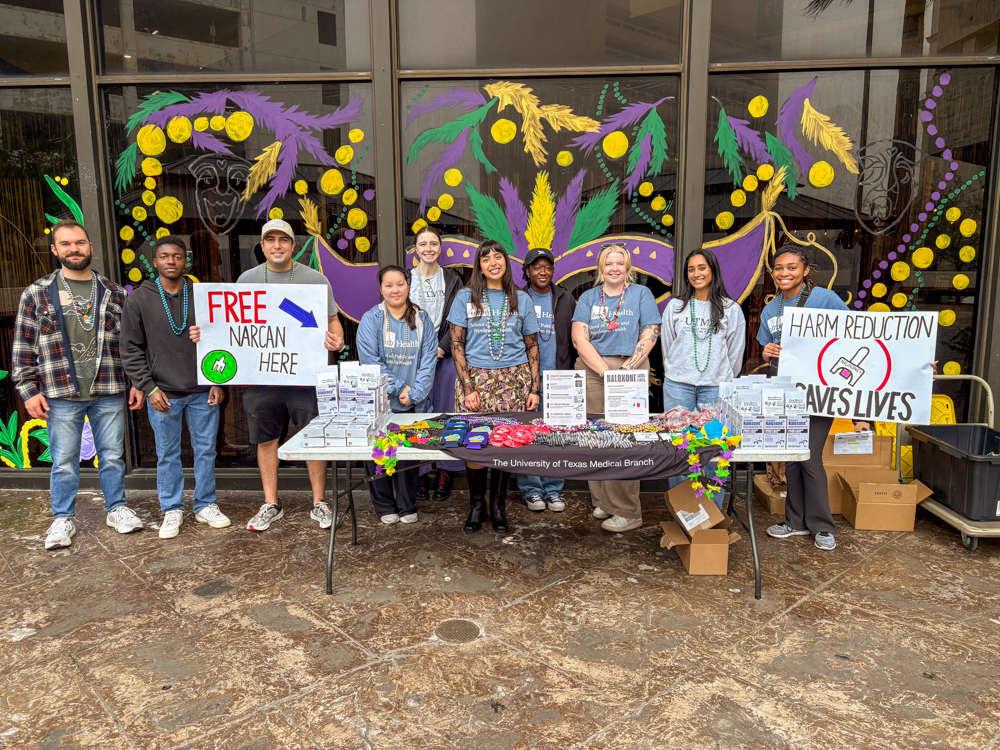
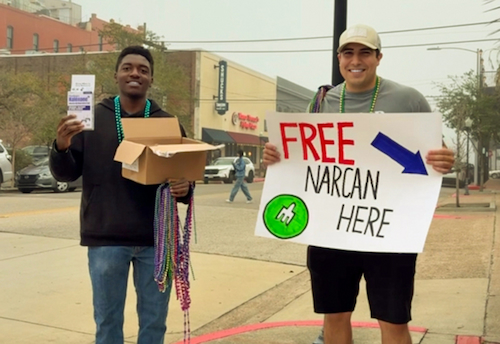
On a Friday evening during Galveston's Mardi Gras season, 13 graduate students from the UTMB School of Public and Population Health set up a booth at Marmo Plaza to hand out free Narcan and teach people how to use it.
By 8:45 p.m., more than an hour before the event was scheduled to end, every box was gone. The SPPH Student Association distributed all 72 boxes of naloxone nasal spray, each containing two doses, to community members passing through the plaza. Fifty-nine people completed an anonymous intake survey. And the students walked away with something they hadn't fully anticipated: a candid look at how the public thinks, feels, and sometimes recoils when confronted with the opioid crisis up close.
An applied epi course sparked the idea
The project started in an applied epidemiology class. Izabella Galindo, vice president of the SPPH Student Association and a second-year MPH student, was examining Galveston County overdose data when she noticed that the county's rates exceeded the state average and tended to peak during February and March, right when Mardi Gras draws thousands of locals and visitors to the island. She saw a natural opportunity to pair naloxone distribution with a high-traffic event.
Izabella and Emily Edgar, the association's president, began planning in summer 2025. Their original goal was to secure a booth at Mardi Gras itself, but the cost exceeded $1,000 before accounting for insurance, and there were no discounts for student groups. Volunteers would have also needed to pay admission. Then Marmo Plaza got back to them. The venue offered the students a free booth space outside its bar area during the festival weekend.
"We were incredibly grateful that Marmo was willing to host us at their space. It was a journey to get the booth together, and their support was motivating to keep going."
Izabella Galindo, Vice President, SPPH Student Association
72 boxes of naloxone, sourced through a statewide program
Obtaining the naloxone at no cost required its own round of coordination. Izabella connected with Naloxone Texas, a program run through UT Health San Antonio that distributes free naloxone and overdose response training across the state. Through the program's network of regional distribution hubs, she picked up the supply at a community-based hub in Houston.
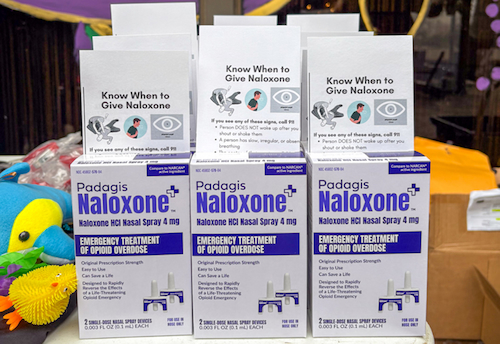
Each box contained two single-use doses of Narcan nasal spray. A person experiencing an opioid overdose may need more than one dose. Naloxone works for 30 to 90 minutes, and if the opioids in a person's system outlast the naloxone, a second dose can be critical. The two-dose boxes gave recipients a better chance of having what they'd actually need in an emergency.
Volunteers placed quick-reference information cards into each box, telling recipients when to give naloxone and how to recognize an overdose. The cards also listed local and regional resources for obtaining Narcan and accessing addiction support services. Thanmayi Parasu, a second-year MD/MPH student with experience in opioid overdose prevention and naloxone education, created the cards.
An hour-long training prepared 13 volunteers
Before the event, all 13 volunteers completed an hour-long training session developed by Izabella and the student association board. The training covered how to recognize an opioid overdose, how to administer Narcan nasal spray, what steps to take afterward (including always calling 911), and how to communicate respectfully with the public.
The volunteer roster drew from across SPPH's student body, including MPH students, PhD students from UTMB's Graduate School of Biomedical Sciences, and students balancing dual degrees. The full team: Izabella Galindo, Emily Edgar, Gabrielle Dewson, Nevaeh Hayden, Brian Amburn, Abi Sotade, Sivi Palanisami, Andrew Tijerina, Sophia Pan, Segun Sotade, Rebecca Anumel-Ackah, Klarisa Lopez, and Maria Henriquez.
The training emphasized a few key principles:
| Narcan is safe and has no harmful effect if given to someone who is not experiencing an opioid overdose. | |
| The nasal spray is a single-use device that should never be tested beforehand. | |
| Even if a person wakes up after receiving naloxone, they still need medical attention. | |
| Treat Narcan like any other public safety tool and never ask people about their personal drug use. |
Younger crowds were open; older passersby pushed back
The event ran from 5:30 to 10:00 p.m. Some volunteers focused on drawing people in and starting conversations. Others walked attendees through the survey and handed out boxes. The reactions varied widely. Young people, especially those in the 15-to-24 age bracket (the event's largest demographic group), were generally open to the conversation. Several took a box and then went back to bring their friends.
Survey respondents by age group
| 15–24 | 23 | |
| 35–44 | 13 | |
| 25–34 | 10 | |
| 45–54 | 4 | |
| 55–64 | 4 | |
| 65+ | 3 |
n = 57 respondents who answered this question
Older attendees reacted differently. Some had sharp, visceral responses. When volunteers mentioned opioid overdose or even the word Narcan, certain passersby became visibly offended. Common refrains included "I don't do drugs" and "I don't hang out with bad people like that." Some people seemed to interpret the offer of Narcan as an implication about their personal behavior or the company they keep.
That pattern became one of the night's clearest takeaways. Many people assumed that carrying Narcan implied personal drug use or association with people who use drugs. The students found themselves explaining, again and again, that naloxone is meant for bystanders. A person experiencing an opioid overdose cannot administer Narcan to themselves, just as a person in cardiac arrest cannot perform CPR on themselves. Carrying naloxone means being prepared to help someone else.
The students changed their messaging midway through the night
Midway through the evening, the students made a deliberate shift in how they approached the crowd. Early on, they had been leading with specific language about opioid overdose, which was prompting defensive reactions.
"We quickly realized that mentioning opioids at the beginning of our conversation scared people away. We had to communicate that understanding how to use Narcan is a skill that we can teach you right here, right now."
Izabella Galindo
They began reframing Narcan as a basic life-saving tool, comparable to CPR or an AED.
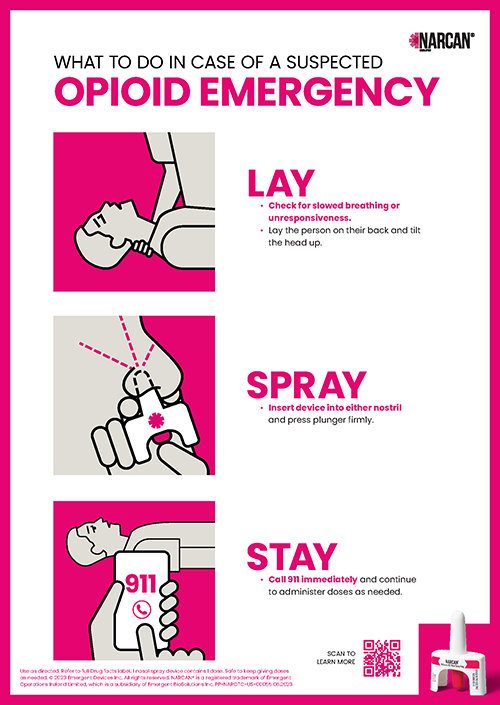
Narcan nasal spray is simpler to administer than either of those. It requires no prior certification. You peel the packaging, place the nozzle in one nostril, and press the plunger. If the person doesn't respond within two to three minutes, you administer a second dose and wait for emergency medical services.
By leading with "this can help save somebody's life" rather than specific overdose terminology, the volunteers found that more people were willing to stop and listen.
The students noted a clear difference between the early crowd's resistance and the later crowd's willingness to engage.
66% of survey respondents were Galveston locals
The anonymous intake survey collected responses from 59 community members who accepted a box of Narcan. The survey focused on age range, local or visiting status, prior knowledge of naloxone, and a basic comprehension check.
Are you a Galveston local or visiting for Mardi Gras?
n = 59 respondents |
The survey included a true-or-false question ("If someone wakes up after naloxone, you should still call 911") to gauge whether the booth conversation had stuck. The association plans to cross-reference the responses with demographic breakdowns to identify patterns, such as whether younger respondents were more likely to have prior naloxone awareness, or whether visitors answered the comprehension question differently than locals.
The team also collected qualitative feedback from volunteers about common reactions, reasons people refused Narcan, and how they adapted their communication strategies throughout the night. Across the volunteer feedback forms, a consistent picture emerged. Most interactions were positive, and curiosity was the most common initial reaction. People frequently stopped to ask questions, and many who were hesitant at first still listened.
When volunteers reflected on what they wished they'd been better prepared for, several mentioned wanting more practice responding to stigma in real time, particularly from people who made dismissive or patronizing comments. One volunteer raised the challenge of talking to children who accompanied adults to the booth and wondered whether a youth-friendly explanation of naloxone's purpose could be developed for future events.
Coursework came to life at the booth
For the second-year students leading the effort, the event was a chance to apply skills they'd been developing in the classroom — health communication, community outreach, survey design, data collection, reading a crowd and adjusting strategy in real time.
These are all taught in MPH coursework, but using them in a live setting with real resistance added something that classroom exercises can't replicate. For the first-year students on the volunteer team, the event offered a look at what student-led public health work can involve at scale.
Plans for an annual event and a presentable abstract
The SPPH Student Association plans to develop the event data into a presentable abstract. The combination of survey results, volunteer feedback, and observational notes from the evening gives the team material to analyze patterns in public attitudes toward naloxone, particularly the stigma that shaped so many interactions at the booth.
Emily and Izabella are also preparing a transition report for future student association leadership, with the hope that the Mardi Gras Narcan booth becomes a yearly tradition. Elections for next year's board positions will be held over the summer.
For anyone in Texas looking to obtain free naloxone or learn how to respond to an opioid overdose, Naloxone Texas offers training and distributes Narcan through regional hubs at no cost.