

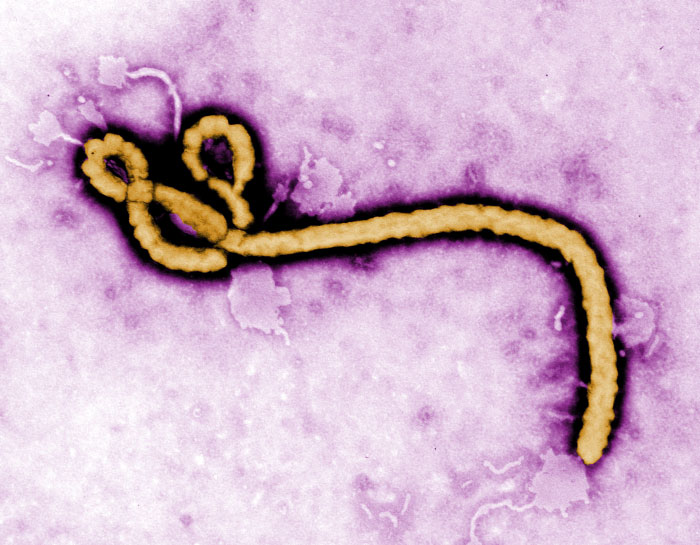
Researchers at the University of Texas Medical Branch at Galveston have been awarded an $11.3 Million, multi-year grant from the National Institute of Allergy and Infectious Diseases to study immunopathogenesis of Ebola, and in particular to determine why cells infected with Ebola develop “immune system paralysis,” which inhibits immune response leads to hyper inflammation and allows the deadly infection to spread. The research will be led by Co-Principal Investigators Alexander Bukreyev, PhD., of UTMB’s Department of Pathology, and Mariano Garcia-Blanco, MD, PhD, Chair of the Biochemistry and Molecular Biology Department.
While some might question, “Why Ebola now?” Dr. Bukreyev explains that, while the COVID-19 pandemic has grabbed headlines and been a primary focus for researchers worldwide for the last 18 months, scientists at UTMB have never stopped working to increase their understanding of Ebola as part of a global effort to develop effective medical countermeasures against a virus with an average case fatality rate of as much as 50 percent, according to the World Health Organization (WHO).
“There have been two Ebola outbreaks going on in Africa this year, and this disease remains one of the deadliest known to humans,” Bukreyev said. “With COVID-19 we have seen how easily an infectious disease can originate in one location and spread around the world. The same is true with more deadly viruses, as well, and for that reason, research on Ebola that will help us develop effective vaccines and therapies has never stopped at UTMB.”
Research on live Ebola virus must take place inside of a Biosafety Level 4 (BSL4) laboratory at the Galveston National Laboratory. BSL4 labs are built with specially designed air handling and waste systems, and scientists who work in BLS4 labs further protect themselves by wearing spacesuits that are connected by a hose to breathing air. It is in this environment that the team will investigate Ebola infections in human cell culture and in nonhuman primates.
“There are very few places in the world where this type of medical research can take place, and while our focus will be on Ebola, this work will have important implications for other severe acute viral infections that share mechanisms with Ebola, such as Marburg virus, Lassa virus, and SARS-CoV-2, which causes COVID-19,” Garcia-Blanco said.
The research, which will take place over five years, will also involve the development of sophisticated models using ‘big data’ that can be manipulated to predict infection outcomes and pathogenicity. The multi-disciplinary project will result in a comprehensive understanding of how Ebola infections take hold, with the goal of developing new insight into effective prevention and treatments against the deadly disease.
The UTMB team also includes Ricardo Rajsbaum, PhD, and Thomas Geisbert, PhD, from the Department of Microbiology & Immunology and Andrew Routh, PhD, from the Department of Biochemistry and Molecular Biology. Additional collaborators include Ivan Marazzi, PhD, and Stuart Sealfon, MD, of the Icahn School of Medicine at Mount Sinai Hospital, and Dr. Matt Weirauch, PhD, of Cincinnati Children’s Hospital.